Melrose, Oakland
Updated · 2,794 residents
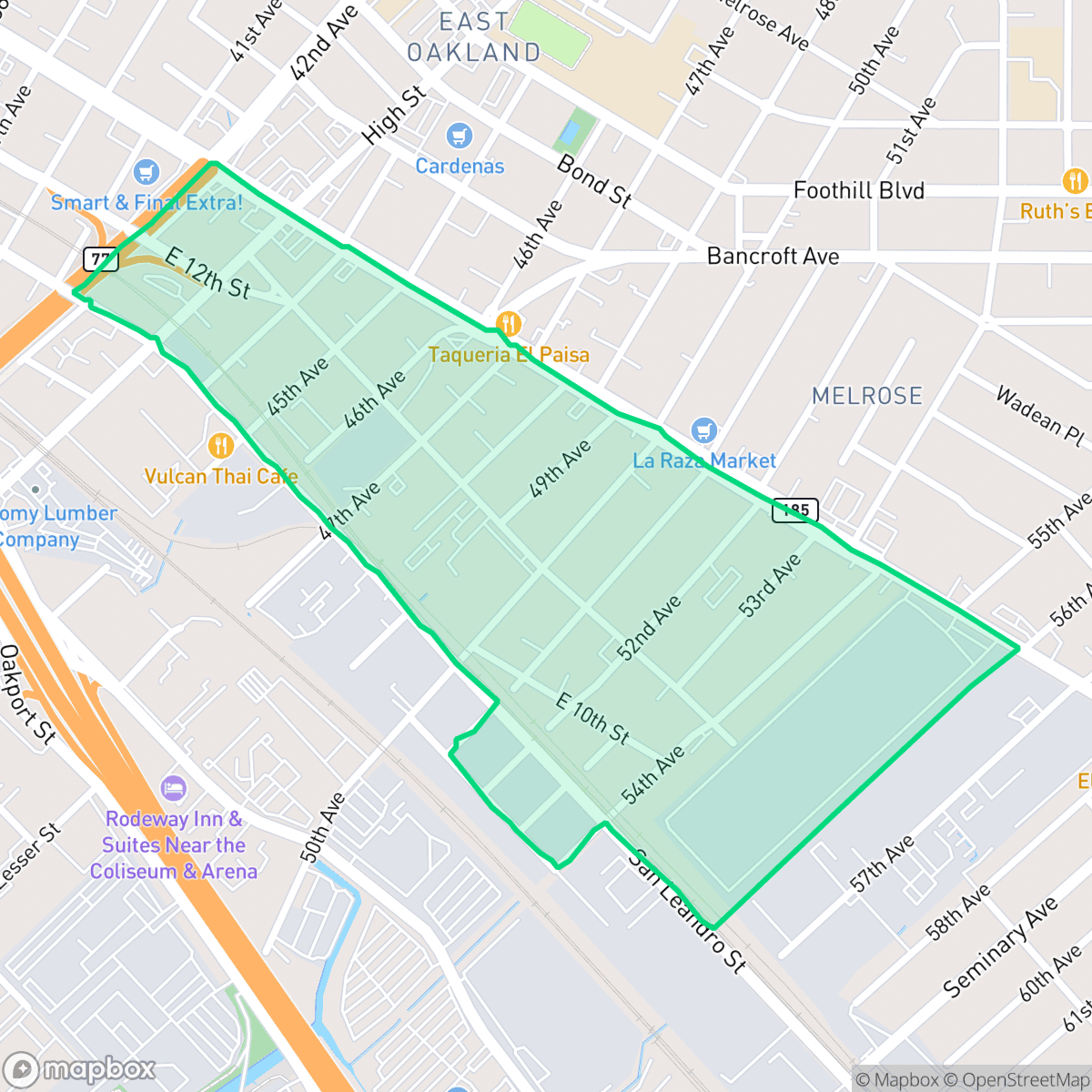
Melrose is an East Oakland neighborhood defined by a dense grid of early 20th-century housing and proximity to heavy industrial zones. While it offers a steady local rhythm with diverse culinary spots, the area experiences significant noise from road and rail traffic and limited pedestrian infrastructure.
Key Highlights
About Melrose
Originally part of Rancho San Antonio, the East Oakland neighborhood of Melrose began as a 19th-century settlement along the Oakland-San Leandro Road (now International Boulevard). Early ranching and cattle shipping at 47th Avenue gave way to unique local industries, including a smelting plant operated by "Borax" Smith and the Bentley Ostrich Farm at High Street. Following the 1906 San Francisco earthquake, displaced residents flooded the area, spurring a residential boom. Melrose was officially annexed by Oakland in December 1909. Its housing stock features early 20th-century Craftsman bungalows and shotgun-style homes built for local rail and factory workers. During the mid-20th century, urban renewal in West Oakland drew African American and Latino families to Melrose, establishing a vibrant cultural identity anchored by long-standing local businesses like Taqueria Morelia.
Located in East Oakland, the area functions as a dense, low-rise urban environment where residential blocks frequently border logistics warehouses and rail lines. The local atmosphere is shaped by a mix of long-standing eateries, such as Taqueria El Paisa and Tortas Ahogadas Mi Barrio, which provide a consistent community rhythm. According to iHuus data, the neighborhood maintains a balanced air quality index despite its industrial proximity, though the density of the housing stock and the prevalence of heavy logistics traffic create a challenging environment for those seeking quiet or significant personal space. Prospective residents should note that the area presents notable trade-offs regarding infrastructure and safety. The lack of green spaces, combined with sidewalks that abut busy roads, results in low walkability and limited opportunities for outdoor recreation. Furthermore, the neighborhood faces significant challenges regarding flood and fire safety, and the local school district remains in a state of financial and organizational instability. It is best suited for those prioritizing proximity to local cultural hubs and industrial employment centers over suburban-style amenities or quiet, pedestrian-friendly streets.
Neighborhood Scores Across 15 Qualities
Residential structures are positioned in close proximity with minimal separation between property lines. According to iHuus data, this density and lack of side yard space is slightly higher than the Oakland average.
Residential blocks feature a consistent grid with sidewalks and clear crosswalks, though heavy industrial traffic on main arterials makes walking less convenient than in many other parts of Oakland. According to iHuus data, navigating the neighborhood on foot is generally safe, but the presence of large warehouses and high-traffic roads reduces overall pedestrian ease compared to the city average.
Modest tract housing and small, uniform yards define the local landscape. According to iHuus data, the area features lower visual variety compared to the Oakland average.
Sparse greenery and a lack of accessible public parks make finding outdoor space for dogs difficult. According to iHuus data, the area features dense streetscapes with very narrow sidewalks and minimal public green space compared to the Oakland average.
Frequent open land and scattered homes amid woodland provide a more semi-rural feel than the Oakland average. According to iHuus data, the area features a mix of low-density residential grids and significant industrial footprints.
Local activity is noticeably more subdued than the Oakland average, characterized by a steady but low-key rhythm of warehouses, railways, and scattered dining spots. Residents will find a primarily quiet, suburban-industrial landscape with limited concentrations of walkable businesses according to iHuus data.
Frequent noise from nearby busy thoroughfares provides a constant background sound, though levels are relatively calmer than the Oakland city average according to iHuus data.
Air quality remains consistently high with rare instances of elevated readings; this level is largely in line with the average for Oakland.
Residential areas coexist with active commercial zones, featuring warehouses and significant truck traffic. This level of industrial proximity is notably higher than the Oakland average, according to iHuus data.
Health insurance coverage among residents is notably lower than the Oakland average, according to iHuus data.
Voting patterns and census indicators show a deeply liberal political leaning that is consistent with the broader Oakland area, according to iHuus data.
Residents live alongside a varied mix of young adults, families, and older populations. According to iHuus data, the demographic spread is slightly more concentrated in specific age brackets compared to the broader Oakland average.
Address-Level Insights for Melrose


iHuus Neighborhood Intelligence Insights
Get address-level neighborhood insights for Melrose
- Street-level scores — see how individual blocks compare, not just neighborhood averages
- Micro-zone boundaries — identify quiet pockets, flood boundaries, and walkable clusters before you visit
- 15 dimensions in full — walkability, noise, air quality, school quality, insurance coverage, population age profile, urban/rural index, and more
- Boundary risk alerts — know if your address sits near a block boundary where scores drop, the kind of detail no listing will ever mention
- School insights — individual school ratings and insights, not just district-level data
- Compare before you commit — side-by-side data across neighborhoods, down to block precision
No credit card required
Compare with Any Neighborhood
| Dimension | Melrose | Acorn |
|---|---|---|
| 🚶 Walkabilityavg 8.99 | ||
| 🔊 Acoustic Comfortavg 3.24 | ||
| 🤫 Privacy Indexavg 3.74 | ||
| 🎨 Visual Appealavg 6.28 | ||
| 🐕 Dog Friendlinessavg 5.74 | ||
| 🗺️ Urban-Rural Indexavg 6.02 | ||
| ✨ Neighborhood Vibeavg 5.22 | ||
| 🏥 Health Insurance Coverageavg 7.4 | ||
| 🌿 Air Qualityavg 8.06 | ||
| 🏭 Industrial Proximityavg 8.37 | ||
| 🌊 Flood Safetyavg 2.61 | ||
| 🗳️ Ideological Leanavg 9.95 | ||
| 👥 Population Age Profileavg 4.92 | ||
| 🔥 Fire Safetyavg 0.17 | ||
| 🏫 School Quality |
Melrose Rankings
School Districts Serving Melrose
School Insights for Melrose
Below average outcomes; significant attendance and academic challenges.
School Insights
See what's really behind every school rating near Melrose
- Individual school ratings — each school's own score with outcome context, not just a district average
- Enrollment & class size data — student-to-teacher ratio and how it compares to the state average
- Full demographics breakdown — ethnicity and gender composition for every school in the enrollment zone
- Every school in the district — all schools within the enrollment boundary ranked by rating, not just the closest one
- Grade levels & benchmarks — elementary through high school, with below/above state-average flags
No credit card required