Maxwell Park, Oakland
Updated · 5,854 residents
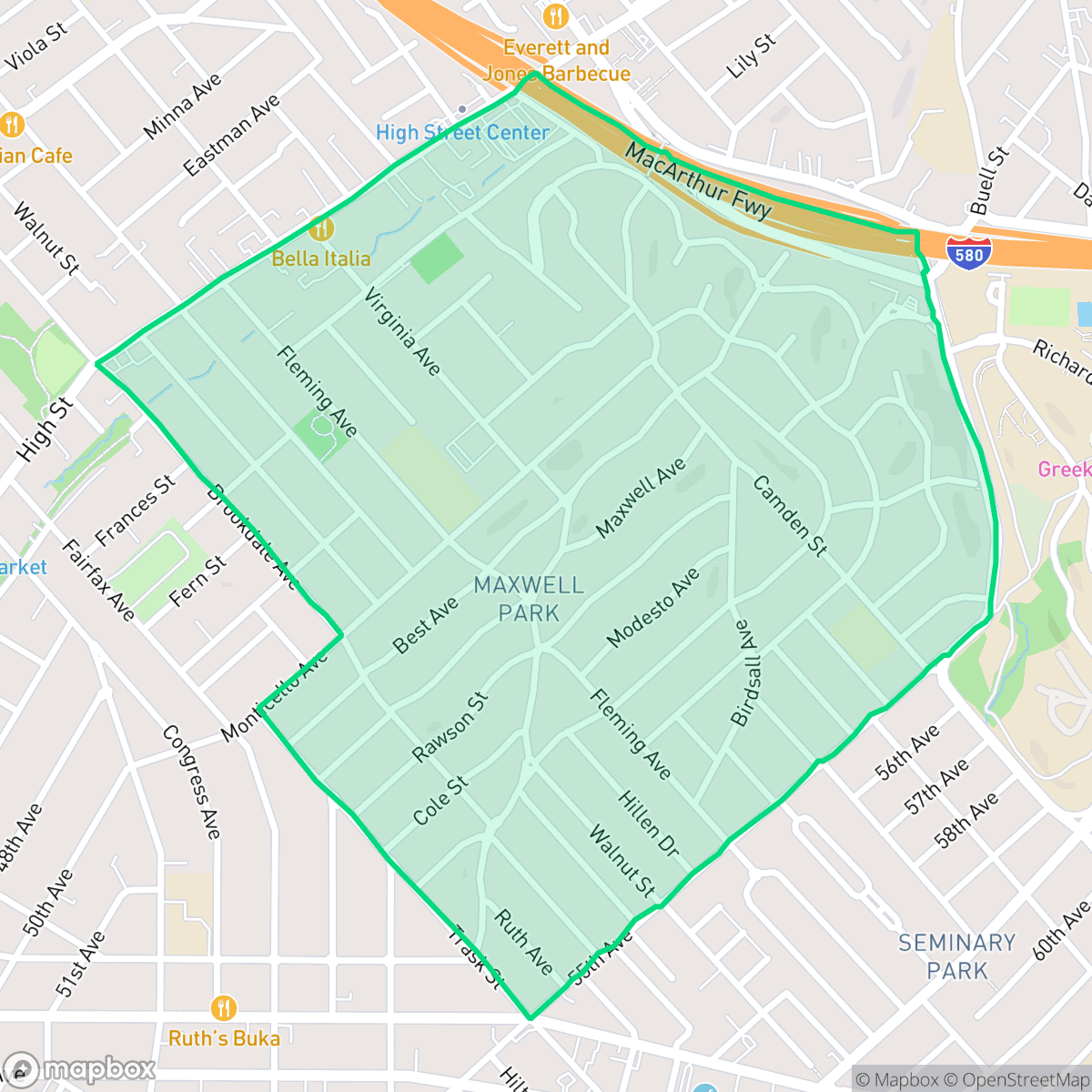
Maxwell Park is a quiet, residential enclave in East Oakland known for its diverse architectural styles and a highly walkable street grid. Residents benefit from exceptionally low noise levels and a lack of industrial proximity, though the area is characterized by tightly packed homes that offer limited private space.
Key Highlights
About Maxwell Park
Nestled in the East Oakland foothills, Maxwell Park was developed in 1921 by hardware merchant John P. Maxwell as "Oakland's Addition Beautiful". Marketed for its warm climate and scenic views, the tract was initially restricted by exclusionary racial covenants. Developers Burritt and Shealey designed the neighborhood with diverse architectural styles, including Spanish, English Tudor, and Craftsman bungalows, ensuring each home had a distinct character. To attract buyers, Maxwell secured an extension of the 55th Avenue streetcar line directly into the neighborhood. Maxwell Park is also culturally significant as the birthplace of Jeet Kune Do; in 1964, martial artist Bruce Lee moved to a home on Monticello Avenue, where he lived and ran an influential martial arts school out of the garage of fellow master James Yimm Lee.
The neighborhood functions as a stable, residential suburban grid with a high degree of walkability, owing to its consistent sidewalk network on both sides of every street. Unlike many parts of Oakland, it maintains a tranquil acoustic environment with low traffic noise levels. The housing stock consists primarily of single-family homes on small lots, contributing to a dense, urban-suburban feel that prioritizes residential life over commercial development. This layout creates a consistent, uniform streetscape that emphasizes the neighborhood's role as a quiet, purely residential zone.
Prospective residents should note the high density of the area, which results in close proximity between homes and limited private outdoor space. While the community offers a secure and peaceful living environment, it lacks large public parks, which may be a consideration for pet owners. Educational options are primarily served by the Oakland Unified School District, where performance varies significantly between individual campuses, such as the local Melrose Leadership Academy.
Neighborhood Scores Across 15 Qualities
Residential structures are situated in close quarters with minimal separation between adjacent properties. According to iHuus data, this level of density is slightly higher than the Oakland average.
Comprehensive sidewalk networks and marked crosswalks facilitate easy pedestrian movement throughout the residential streets. While the neighborhood is nearly as navigable as the rest of Oakland, high-traffic arterials and a major freeway corridor intersect the local grid.
Standard tract housing features small lots and consistent, boxy rooflines. This level of visual variety is slightly lower than the average for Oakland.
Public park access and green verges are inconsistent across the neighborhood, making it slightly less dog friendly than the Oakland average. While some areas offer direct access to large parks, other residential pockets feature dense housing with very narrow sidewalks and minimal open space.
Residential grids featuring single-family homes and small apartment blocks provide a more open, semi-rural feel than much of the surrounding Oakland area. According to iHuus data, the landscape contains more frequent open land and woodland patches compared to the city average.
Residential streets and green spaces define this area, offering a calmer pace than the Oakland average. While local cafes and dining options are scattered throughout, the neighborhood lacks the dense commercial activity found in more central urban districts.
Steady sounds from nearby thoroughfares create a consistent ambient hum. This level of acoustic activity is notably higher than the average found elsewhere in Oakland.
Air quality remains consistently high with very few instances of pollution. This level of air purity is roughly in line with the broader Oakland area according to iHuus data.
Heavy industrial presence is minimal in this area, with the landscape consisting primarily of residential streets and light commercial use. According to iHuus data, the neighborhood remains slightly more residential in character than the Oakland average.
Health insurance enrollment among residents is notably higher than the Oakland average, according to iHuus data.
Voting patterns and census indicators reflect a deeply progressive political landscape that is very similar to the broader Oakland area. According to iHuus data, residents here align closely with the city's overall liberal leaning.
Residents live alongside a balanced mix of young adults, families, and older populations. According to iHuus data, this demographic distribution is in line with the broader Oakland area.
Significant flood hazards and wave action are present in this area, which is considerably higher than the Oakland average. Residents should anticipate elevated or potentially prohibitive insurance costs according to iHuus data.
Address-Level Insights for Maxwell Park


iHuus Neighborhood Intelligence Insights
Get address-level neighborhood insights for Maxwell Park
- Street-level scores — see how individual blocks compare, not just neighborhood averages
- Micro-zone boundaries — identify quiet pockets, flood boundaries, and walkable clusters before you visit
- 15 dimensions in full — walkability, noise, air quality, school quality, insurance coverage, population age profile, urban/rural index, and more
- Boundary risk alerts — know if your address sits near a block boundary where scores drop, the kind of detail no listing will ever mention
- School insights — individual school ratings and insights, not just district-level data
- Compare before you commit — side-by-side data across neighborhoods, down to block precision
No credit card required
Compare with Any Neighborhood
| Dimension | Maxwell Park | Acorn |
|---|---|---|
| 🚶 Walkabilityavg 8.99 | ||
| 🔊 Acoustic Comfortavg 3.24 | ||
| 🤫 Privacy Indexavg 3.74 | ||
| 🎨 Visual Appealavg 6.28 | ||
| 🐕 Dog Friendlinessavg 5.74 | ||
| 🗺️ Urban-Rural Indexavg 6.02 | ||
| ✨ Neighborhood Vibeavg 5.22 | ||
| 🏥 Health Insurance Coverageavg 7.4 | ||
| 🌿 Air Qualityavg 8.06 | ||
| 🏭 Industrial Proximityavg 8.37 | ||
| 🌊 Flood Safetyavg 2.61 | ||
| 🗳️ Ideological Leanavg 9.95 | ||
| 👥 Population Age Profileavg 4.92 | ||
| 🔥 Fire Safetyavg 0.17 | ||
| 🏫 School Quality |
Maxwell Park Rankings
School Districts Serving Maxwell Park
School Insights for Maxwell Park
Below average outcomes; significant attendance and academic challenges.
School Insights
See what's really behind every school rating near Maxwell Park
- Individual school ratings — each school's own score with outcome context, not just a district average
- Enrollment & class size data — student-to-teacher ratio and how it compares to the state average
- Full demographics breakdown — ethnicity and gender composition for every school in the enrollment zone
- Every school in the district — all schools within the enrollment boundary ranked by rating, not just the closest one
- Grade levels & benchmarks — elementary through high school, with below/above state-average flags
No credit card required