Lynn, Oakland
Updated · 1,495 residents
Lynn is a highly walkable residential enclave in Oakland, defined by its dense, historic streetscape and proximity to Highland Hospital. Residents benefit from excellent pedestrian access, though the area is characterized by tightly packed housing and noticeable road traffic noise.
Key Highlights
About Lynn
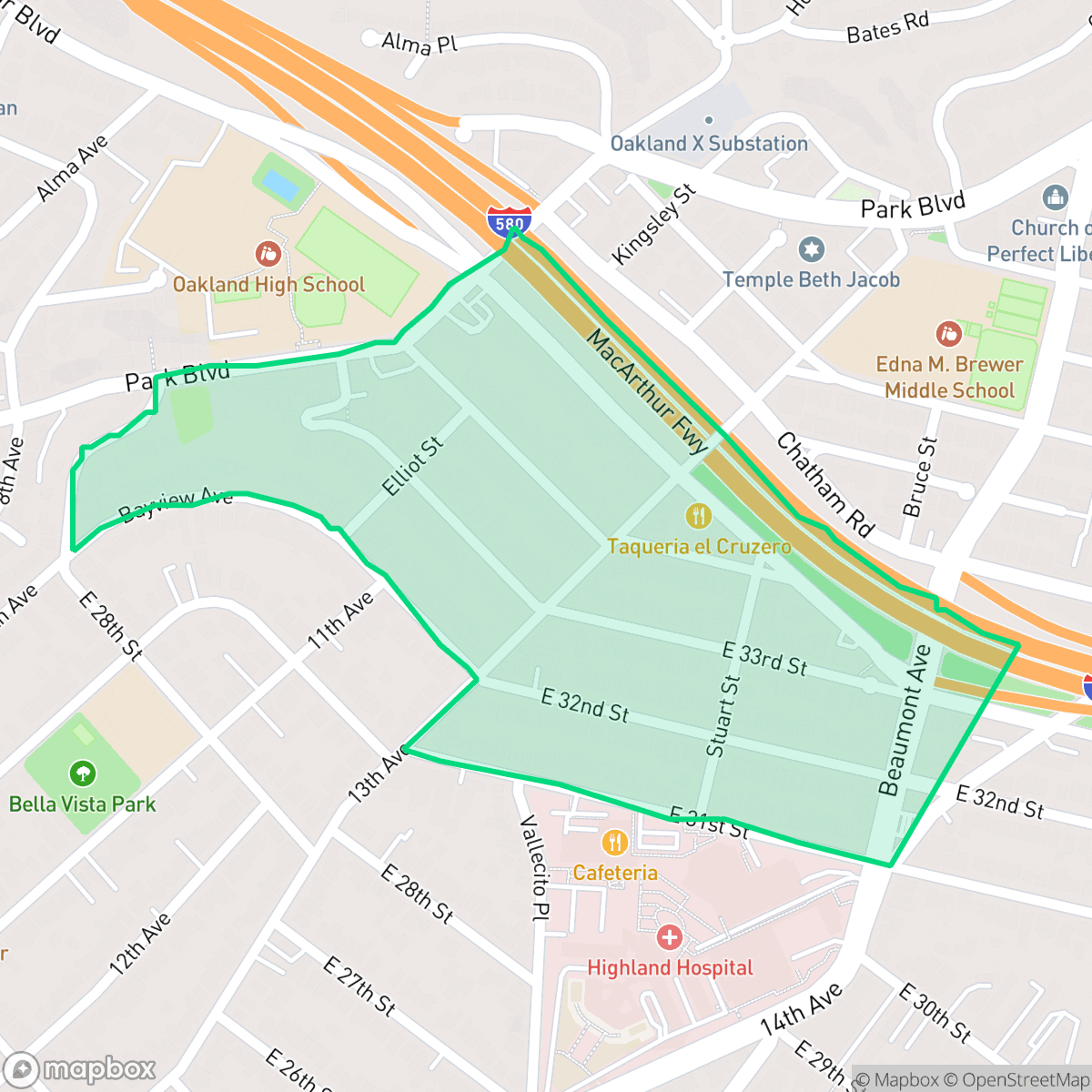
Originally laid out in 1868 as the "New Town of Lynn," the Lynn neighborhood in Oakland began as a short-lived independent settlement northeast of Brooklyn. Named after the prominent shoe-manufacturing hub of Lynn, Massachusetts, the community was defined by its own major industrial anchor, the Lynn Boot and Shoe Manufacturing Company, which incorporated in 1869. In 1870, Lynn merged with Brooklyn, which was subsequently annexed by Oakland in 1872. Historically bordered by East 31st Street, 13th Avenue, and MacArthur Boulevard, the neighborhood's early development was accelerated in 1875 when the Highland Park & Fruit Vale Railroad was built along what is now 14th Avenue. Today, this historic enclave sits adjacent to Highland Hospital, retaining its legacy as one of Oakland's earliest settled tracts.
The neighborhood functions primarily as a dense, residential zone with light commercial activity. It features a consistent sidewalk network that makes it exceptionally walkable for daily errands. The atmosphere is generally calm, with a mix of suburban-style blocks and institutional buildings. While it lacks significant green space, the area maintains a steady, urban character that integrates well with its historic surroundings. Prospective residents should note that the neighborhood has limited privacy due to the close proximity of homes. According to iHuus data, acoustic comfort is impacted by consistent road traffic, though air quality remains high. The area is best suited for individuals who prioritize walkability and central access over expansive private yards or quiet, secluded environments. Families should also consider the current challenges facing the local school district when evaluating long-term educational options.
Neighborhood Scores Across 15 Qualities
Residential spacing varies throughout the area, ranging from detached homes with moderate yard space to denser clusters where structures sit very close to one another. According to iHuus data, the level of separation between neighbors is slightly higher than the Oakland average.
Pedestrian movement is supported by a consistent sidewalk network and clear crossings on many residential blocks. However, the presence of a high traffic freeway corridor and steep terrain makes the area slightly less walkable than the Oakland average, according to iHuus data.
Large homes with complex rooflines and private backyard pools characterize much of the area. According to iHuus data, the presence of these amenities and wide driveways makes the visual landscape slightly more premium than the Oakland average.
Public green space and wide grassy verges are sparse in this area, making it less dog friendly than the Oakland average. While some residential streets feature mature tree cover, most properties rely on private, fenced backyards for outdoor access.
Spacious residential layouts with mature tree canopies and significant vegetation provide a more open feel than the typical Oakland urban core. According to iHuus data, the area features a higher presence of open land and woodland compared to the city average.
Local social hubs and wellness businesses provide a level of activity that is higher than the Oakland average. While certain blocks offer a lively atmosphere, the area remains largely car-dependent due to the suburban layout.
Frequent sounds from nearby freeway and railroad corridors contribute to lower acoustic comfort levels compared to the Oakland average. According to iHuus data, residents may experience regular disturbances from heavy transit infrastructure.
Air quality remains consistently high with rare instances of elevated readings. This level of air cleanliness is roughly in line with the Oakland average, according to iHuus data.
Heavy industry and hazardous facilities are entirely absent from this area. According to iHuus data, the neighborhood maintains a higher level of separation from industrial zones than the Oakland average.
Health insurance coverage among residents is high, though slightly below the Oakland average according to iHuus data.
Voting patterns and census indicators show a very strong liberal lean that is slightly more pronounced than the Oakland average. According to iHuus data, the area's political landscape is characterized by consistent liberal-leaning demographics.
Residents live alongside a balanced mix of young professionals, families, and older adults. According to iHuus data, this age distribution is slightly more varied than the Oakland average.
Flood risk in this area is higher than the Oakland average, though the specific level of danger remains undetermined because official federal studies for this neighborhood are not yet complete.
Address-Level Insights for Lynn


iHuus Neighborhood Intelligence Insights
Get address-level neighborhood insights for Lynn
- Street-level scores — see how individual blocks compare, not just neighborhood averages
- Micro-zone boundaries — identify quiet pockets, flood boundaries, and walkable clusters before you visit
- 15 dimensions in full — walkability, noise, air quality, school quality, insurance coverage, population age profile, urban/rural index, and more
- Boundary risk alerts — know if your address sits near a block boundary where scores drop, the kind of detail no listing will ever mention
- School insights — individual school ratings and insights, not just district-level data
- Compare before you commit — side-by-side data across neighborhoods, down to block precision
No credit card required
Compare with Any Neighborhood
| Dimension | Lynn | Acorn |
|---|---|---|
| 🚶 Walkabilityavg 8.99 | ||
| 🔊 Acoustic Comfortavg 3.24 | ||
| 🤫 Privacy Indexavg 3.74 | ||
| 🎨 Visual Appealavg 6.28 | ||
| 🐕 Dog Friendlinessavg 5.74 | ||
| 🗺️ Urban-Rural Indexavg 6.02 | ||
| ✨ Neighborhood Vibeavg 5.22 | ||
| 🏥 Health Insurance Coverageavg 7.4 | ||
| 🌿 Air Qualityavg 8.06 | ||
| 🏭 Industrial Proximityavg 8.37 | ||
| 🌊 Flood Safetyavg 2.61 | ||
| 🗳️ Ideological Leanavg 9.95 | ||
| 👥 Population Age Profileavg 4.92 | ||
| 🔥 Fire Safetyavg 0.17 | ||
| 🏫 School Quality |
Lynn Rankings
School Districts Serving Lynn
School Insights for Lynn
Below average outcomes; significant attendance and academic challenges.
School Insights
See what's really behind every school rating near Lynn
- Individual school ratings — each school's own score with outcome context, not just a district average
- Enrollment & class size data — student-to-teacher ratio and how it compares to the state average
- Full demographics breakdown — ethnicity and gender composition for every school in the enrollment zone
- Every school in the district — all schools within the enrollment boundary ranked by rating, not just the closest one
- Grade levels & benchmarks — elementary through high school, with below/above state-average flags
No credit card required