Longfellow, Oakland
Updated · 5,800 residents
Longfellow is a dense, highly walkable urban neighborhood defined by its collection of pre-1939 Victorian homes and small-scale apartment buildings. While the area offers a vibrant local food scene and easy access to city amenities, residents should be prepared for significant road traffic noise and limited private outdoor space. According to iHuus data, the neighborhood provides a unique blend of historic character and urban density for those prioritizing a central location over quiet seclusion.
Key Highlights
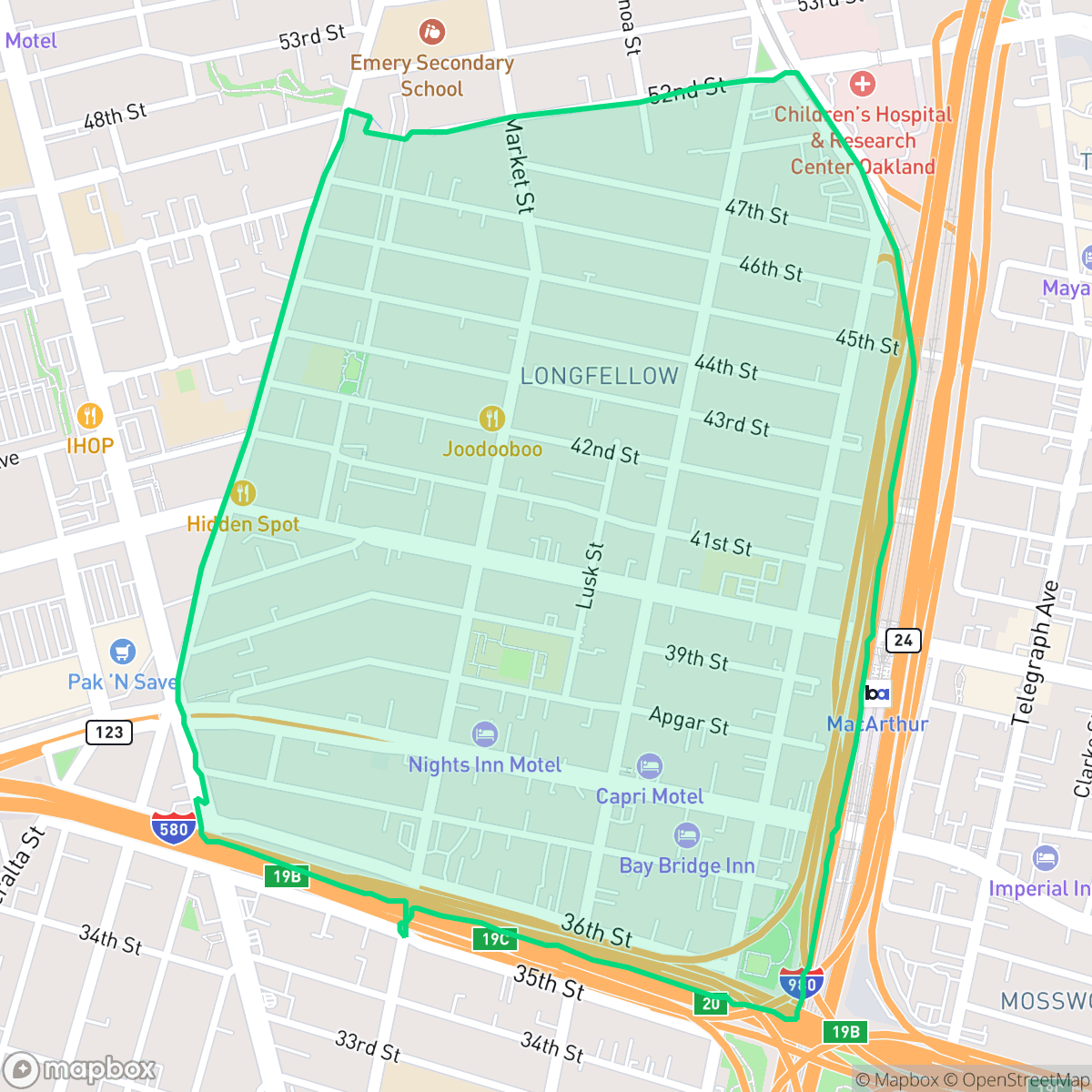
About Longfellow
Originally part of Oakland's historic Temescal district, the Longfellow neighborhood was physically isolated in the 1960s by the construction of the Grove-Shafter Freeway. It took its name from Longfellow Elementary School, where First Lady Nancy Reagan famously coined the "Just Say No" slogan during a 1982 visit. Historically, the area transitioned from a vibrant early-20th-century Italian-American enclave—anchored by the 1876 Sacred Heart Parish—into a hub of African American culture and activism by the 1940s and 1950s. Notably, the East Bay Negro Historical Society (predecessor to the African American Museum and Library at Oakland) was founded here in 1965, initially meeting at the historic Church of the Good Shepherd. Today, Longfellow is characterized by its highly walkable streets and a dense concentration of historic, pre-1939 architecture, including classic Victorian homes and duplexes.
The area maintains a distinct urban identity shaped by its dense grid and proximity to major transportation corridors. Residents benefit from a highly walkable layout that connects them to local staples like the Bank Club Cafe and various neighborhood eateries. The architecture remains a defining feature, with a high concentration of preserved Victorian homes and duplexes that reflect the neighborhood's early twentieth-century roots.
Prospective residents should consider the trade-offs of living in such a centralized urban environment. The proximity to the Grove-Shafter Freeway contributes to consistent road noise, and the tightly packed housing lots offer limited privacy and minimal private green space. While the area boasts excellent air quality, it is best suited for individuals who value walkability and historic aesthetics over the quiet of a suburban setting. According to iHuus, families should also note the varying performance of local school districts when evaluating long-term residency.
Neighborhood Scores Across 15 Qualities
Residential structures are situated in close quarters with minimal separation between properties. According to iHuus data, this level of building density and proximity to neighbors is higher than the Oakland average.
Pedestrian transit is seamless throughout this area due to a continuous sidewalk grid and frequent marked crosswalks. This level of walkability is even higher than the Oakland average, according to iHuus data.
Housing consists primarily of modest tract homes with small yards and simple rooflines. This level of visual variety and greenery is slightly below the Oakland average.
Public green space for pets is sparse due to narrow sidewalks and a lack of large parks, making the area less dog friendly than much of Oakland. While some tree-lined streets offer small verges, most residents rely on private backyards for outdoor access.
Residential streets and green spaces are distributed in roughly equal measure, providing a suburban character that is very similar to the Oakland average. This area features a mix of low-rise housing and paved urban density according to iHuus data.
Active pockets of dining and local eateries create a more vibrant atmosphere than much of Oakland. According to iHuus data, the area features a notable concentration of social spots and diverse food markets, though the accessibility of these hubs varies between urban clusters and more suburban blocks.
Frequent traffic and transit sounds from nearby freeways and railroad tracks characterize this area. According to iHuus data, acoustic comfort is notably lower than the Oakland average.
Air quality in Longfellow is exceptionally high and remains significantly cleaner than the Oakland average. According to iHuus data, residents can expect minimal exposure to pollutants and very low health risks related to air quality.
Residential and light commercial uses dominate the area, with no significant warehouses or heavy industrial hazards detected. This lack of industrial proximity is slightly better than the Oakland average, according to iHuus data.
Health insurance accessibility is strong in this area, with coverage rates appearing notably higher than the Oakland city average according to iHuus data.
Voting patterns and census indicators show a deeply liberal political leaning that is slightly more pronounced than the Oakland average, according to iHuus data.
Residents live alongside a balanced demographic of young professionals, families, and older adults. This age distribution is largely consistent with the broader Oakland area, according to iHuus data.
Properties in this area are situated within a 100-year floodplain, which represents a higher risk level than the Oakland average. According to iHuus data, residents should expect that flood insurance will likely be a requirement for property owners.
Address-Level Insights for Longfellow


iHuus Neighborhood Intelligence Insights
Get address-level neighborhood insights for Longfellow
- Street-level scores — see how individual blocks compare, not just neighborhood averages
- Micro-zone boundaries — identify quiet pockets, flood boundaries, and walkable clusters before you visit
- 15 dimensions in full — walkability, noise, air quality, school quality, insurance coverage, population age profile, urban/rural index, and more
- Boundary risk alerts — know if your address sits near a block boundary where scores drop, the kind of detail no listing will ever mention
- School insights — individual school ratings and insights, not just district-level data
- Compare before you commit — side-by-side data across neighborhoods, down to block precision
No credit card required
Compare with Any Neighborhood
| Dimension | Longfellow | Acorn |
|---|---|---|
| 🚶 Walkabilityavg 8.99 | ||
| 🔊 Acoustic Comfortavg 3.24 | ||
| 🤫 Privacy Indexavg 3.74 | ||
| 🎨 Visual Appealavg 6.28 | ||
| 🐕 Dog Friendlinessavg 5.74 | ||
| 🗺️ Urban-Rural Indexavg 6.02 | ||
| ✨ Neighborhood Vibeavg 5.22 | ||
| 🏥 Health Insurance Coverageavg 7.4 | ||
| 🌿 Air Qualityavg 8.06 | ||
| 🏭 Industrial Proximityavg 8.37 | ||
| 🌊 Flood Safetyavg 2.61 | ||
| 🗳️ Ideological Leanavg 9.95 | ||
| 👥 Population Age Profileavg 4.92 | ||
| 🔥 Fire Safetyavg 0.17 | ||
| 🏫 School Quality |
Longfellow Rankings
School Districts Serving Longfellow
School Insights for Longfellow
Below average outcomes; significant attendance and academic challenges.
School Insights
See what's really behind every school rating near Longfellow
- Individual school ratings — each school's own score with outcome context, not just a district average
- Enrollment & class size data — student-to-teacher ratio and how it compares to the state average
- Full demographics breakdown — ethnicity and gender composition for every school in the enrollment zone
- Every school in the district — all schools within the enrollment boundary ranked by rating, not just the closest one
- Grade levels & benchmarks — elementary through high school, with below/above state-average flags
No credit card required