Lockwood Tevis, Oakland
Updated · 1,692 residents
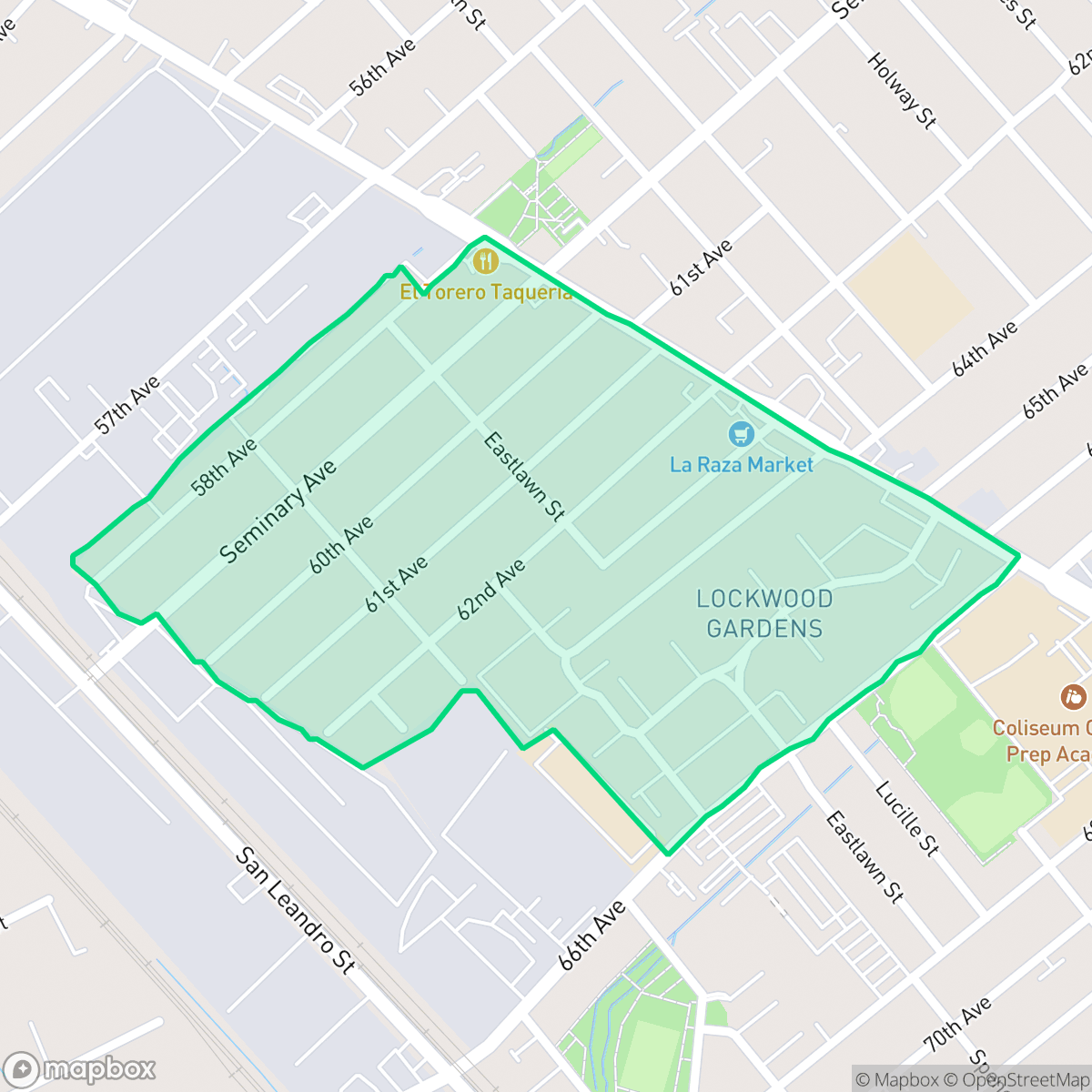
Lockwood Tevis is a dense, highly walkable neighborhood in Central East Oakland characterized by a structured grid and proximity to industrial corridors. Residents experience a quiet, urban environment featuring a mix of mid-century residential architecture, though the area offers limited private outdoor space and faces specific environmental safety challenges.
Key Highlights
About Lockwood Tevis
The Lockwood-Tevis neighborhood in Central East Oakland traces its origins to the mid-19th century. Its name honors Mr. Lockwood, a trustee of the local school district established in 1860 (where Isaac Yoakum founded Lockwood School in 1858), and L. Tevis, an early landowner in the area around 1884. The neighborhood's modern identity is closely tied to Lockwood Gardens, a major housing development designed by architect Carl Warnecke. Opened in August 1942 to support defense industry workers during World War II, the complex was later remodeled by the Oakland Housing Authority. Locally referred to as the "6-5 Vill" (Village), the neighborhood features a mix of mid-20th-century single-family homes, duplexes, and apartments.
The neighborhood functions as a dense, low-rise urban grid that prioritizes pedestrian accessibility. Its layout creates a consistent, walkable streetscape that connects residential blocks with nearby commercial and industrial zones. While the area maintains a quiet atmosphere, the proximity to active transit routes and industrial footprints defines much of its daily character. According to iHuus data, the neighborhood is exceptionally easy to navigate on foot, making it a functional choice for those who rely on local transit and pedestrian paths to reach nearby amenities.
Prospective residents should consider that the area offers limited access to private backyards and public parks, which may impact those seeking extensive outdoor space. The neighborhood is situated in a zone that requires awareness of flood and fire safety risks, and the local schools within the Oakland Unified School District are currently navigating significant institutional and budgetary instability. This area is best suited for individuals who prioritize a central, walkable location and are comfortable with a high-density, urban-industrial setting over traditional suburban amenities.
Neighborhood Scores Across 15 Qualities
Residential structures are situated in close proximity with minimal separation between properties. This dense layout provides less privacy than the Oakland average, according to iHuus data.
Pedestrian travel is highly efficient here due to a dense street grid with continuous sidewalks and frequent crosswalks. According to iHuus data, this level of walkability is superior to the Oakland city average.
Residential views consist primarily of uniform tract housing with small yards and boxy architectural styles. This area offers less visual variety than the Oakland average, as the landscape is characterized by high-density lots and some industrial warehouse presence according to iHuus data.
Public green space and wide sidewalk verges are scarce in this area, as most greenery is confined to private backyards. According to iHuus data, the availability of accessible parks and open walking paths is below the Oakland average.
Open land and scattered homes are more frequent here than in the typical Oakland urban environment. This provides a slightly more spacious, less dense atmosphere compared to the city average, according to iHuus data.
Low levels of commercial activity and a prevalence of industrial or warehouse zones make this area much quieter than the Oakland average. Most daily needs require a vehicle due to the limited number of walkable businesses and a predominantly suburban, car-oriented layout.
Frequent acoustic disturbances from nearby railroad tracks and major freeway traffic characterize this area. According to iHuus data, noise levels in Lockwood Tevis are slightly higher than the Oakland average.
Air quality in this area is mostly clean with infrequent periods of elevated readings, though it remains slightly below the Oakland average according to iHuus data.
The area is primarily residential and light commercial, lacking the heavy warehouses or large-scale logistics hubs found in other parts of Oakland. According to iHuus data, residents will experience much less exposure to industrial activity and heavy truck traffic than the city average.
Health insurance accessibility is notably lower in this area than the Oakland average, according to iHuus data.
Voting patterns and census indicators show a deeply liberal political landscape that is very similar to the broader Oakland area, according to iHuus data.
Residents live alongside a varied demographic of young adults, families, and seniors. According to iHuus data, this age distribution is slightly more concentrated in certain age brackets than the Oakland average.
Flood vulnerability in this area is significant and notably higher than the Oakland average, according to iHuus data.
Address-Level Insights for Lockwood Tevis


iHuus Neighborhood Intelligence Insights
Get address-level neighborhood insights for Lockwood Tevis
- Street-level scores — see how individual blocks compare, not just neighborhood averages
- Micro-zone boundaries — identify quiet pockets, flood boundaries, and walkable clusters before you visit
- 15 dimensions in full — walkability, noise, air quality, school quality, insurance coverage, population age profile, urban/rural index, and more
- Boundary risk alerts — know if your address sits near a block boundary where scores drop, the kind of detail no listing will ever mention
- School insights — individual school ratings and insights, not just district-level data
- Compare before you commit — side-by-side data across neighborhoods, down to block precision
No credit card required
Compare with Any Neighborhood
| Dimension | Lockwood Tevis | Acorn |
|---|---|---|
| 🚶 Walkabilityavg 8.99 | ||
| 🔊 Acoustic Comfortavg 3.24 | ||
| 🤫 Privacy Indexavg 3.74 | ||
| 🎨 Visual Appealavg 6.28 | ||
| 🐕 Dog Friendlinessavg 5.74 | ||
| 🗺️ Urban-Rural Indexavg 6.02 | ||
| ✨ Neighborhood Vibeavg 5.22 | ||
| 🏥 Health Insurance Coverageavg 7.4 | ||
| 🌿 Air Qualityavg 8.06 | ||
| 🏭 Industrial Proximityavg 8.37 | ||
| 🌊 Flood Safetyavg 2.61 | ||
| 🗳️ Ideological Leanavg 9.95 | ||
| 👥 Population Age Profileavg 4.92 | ||
| 🔥 Fire Safetyavg 0.17 | ||
| 🏫 School Quality |
Lockwood Tevis Rankings
School Districts Serving Lockwood Tevis
School Insights for Lockwood Tevis
Below average outcomes; significant attendance and academic challenges.
School Insights
See what's really behind every school rating near Lockwood Tevis
- Individual school ratings — each school's own score with outcome context, not just a district average
- Enrollment & class size data — student-to-teacher ratio and how it compares to the state average
- Full demographics breakdown — ethnicity and gender composition for every school in the enrollment zone
- Every school in the district — all schools within the enrollment boundary ranked by rating, not just the closest one
- Grade levels & benchmarks — elementary through high school, with below/above state-average flags
No credit card required