Lincoln Highlands, Oakland
Updated · 1,851 residents
Lincoln Highlands is an affluent residential enclave in the Oakland Hills known for its architectural diversity and proximity to major landmarks like the Oakland California Temple. The area offers a quiet, suburban atmosphere with excellent air quality and abundant greenery, though residents should expect moderate noise levels from local road traffic.
Key Highlights
About Lincoln Highlands
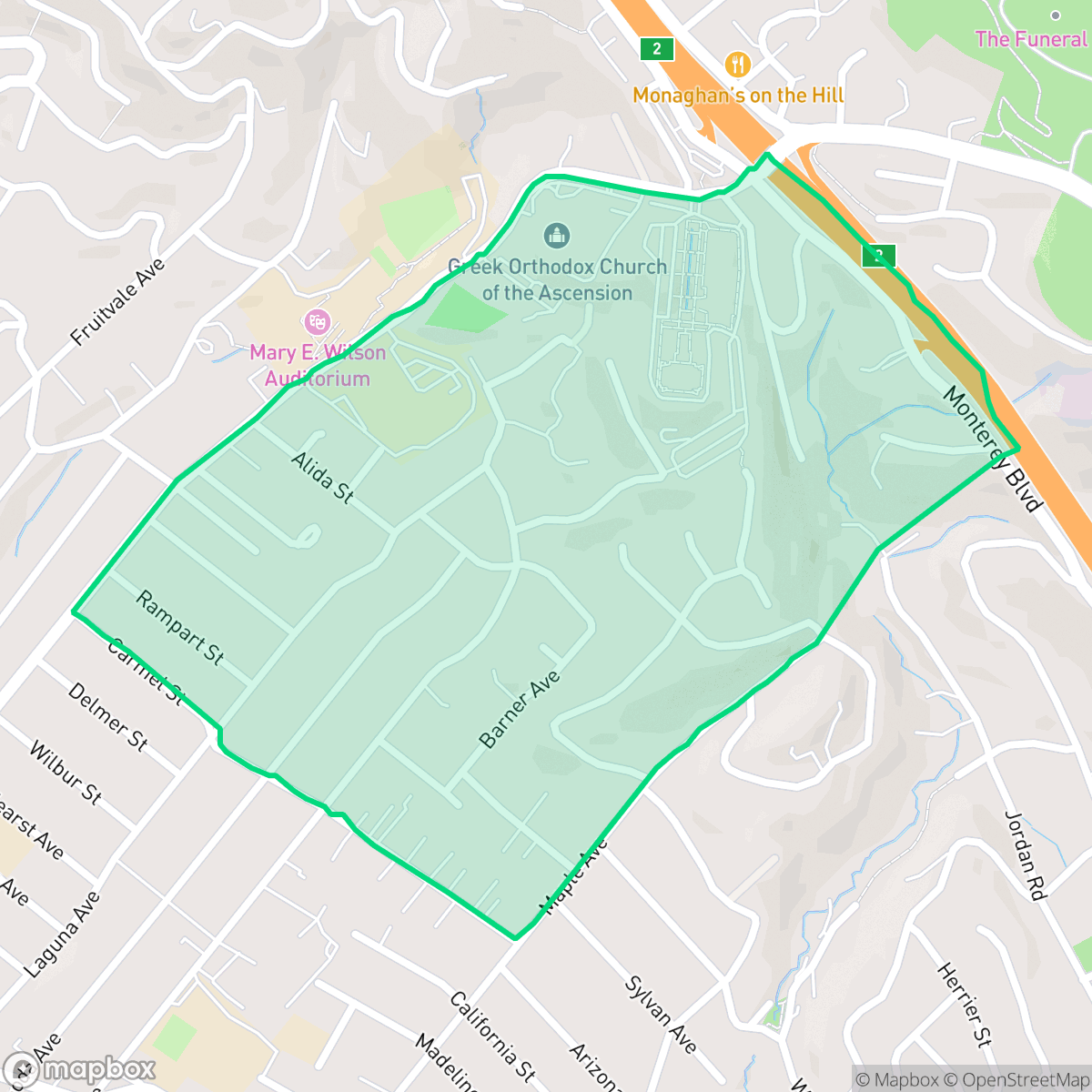
Situated on a gentle hillside in the Oakland Hills, Lincoln Highlands evolved from agricultural land into a residential enclave starting in the 1920s. During that decade, the area hosted a pheasant hunting resort on Potomac Street for weekend travelers. Most of the neighborhood's diverse housing stock was constructed between 1923 and the 1980s, featuring an eclectic mix of Craftsman, Tudor, mid-century modern, and split-level ranch homes, including several pre-fabricated "Ward-Way" homes built in 1940. Lincoln Highlands is defined by its prominent local landmarks along Lincoln Avenue, most notably the towering Oakland California Temple and the Ascension Greek Orthodox Cathedral, which hosts the annual Oakland Greek Festival. The neighborhood is also bordered by Peralta Creek Park.
The neighborhood is defined by its hilly terrain and well-maintained properties, which contribute to a high visual appeal. It maintains a dense suburban feel with significant tree canopy and private outdoor spaces, providing a peaceful environment for its residents. While the area lacks a high density of commercial businesses, it benefits from a strong institutional presence and well-kept streets that support a comfortable, if quiet, lifestyle. According to iHuus data, the neighborhood provides a stable, high-income environment that effectively balances privacy with a strong sense of community.
Prospective residents should weigh the benefits of high air quality and strong community health insurance coverage against certain environmental risks. Specifically, the area faces significant fire safety challenges, which is a common concern in the Oakland Hills. Additionally, while the local school district faces systemic financial instability, the area remains a desirable choice for those prioritizing a serene, residential setting with convenient access to the broader East Bay region.
Neighborhood Scores Across 15 Qualities
Residential spacing varies between densely clustered homes and detached houses with private yards and foliage. This level of separation is slightly higher than the Oakland average, according to iHuus data.
Pedestrian movement is supported by an established sidewalk network and low-traffic residential streets. This level of connectivity and safety is nearly identical to the average found throughout Oakland.
Large homes with well-manicured grounds and private pools characterize much of the area. This level of visual appeal and architectural complexity is notably higher than the Oakland average, according to iHuus data.
Abundant greenery and nearby wooded slopes provide ample space for pet exercise. According to iHuus data, these connected natural areas make the neighborhood more dog friendly than much of Oakland.
Residential streets feature a balance of single-family homes and significant mature tree canopy. This area presents a slightly more suburban landscape compared to the Oakland average, according to iHuus data.
Social and local hubs provide a noticeable level of activity that is higher than the Oakland average. While some blocks remain calm and suburban, other areas near major transit corridors feature more constant movement and accessible dining options.
Persistent sounds from nearby railroad tracks and heavy freeway traffic characterize the area. According to iHuus data, acoustic levels are slightly higher than the Oakland average.
Air quality in this area is consistently high and presents little to no health concern. According to iHuus data, the air quality here is significantly cleaner than the Oakland average.
Industrial presence is non-existent here, as the area consists entirely of residential and recreational spaces without any detectable warehouses or heavy industrial hazards. According to iHuus data, this lack of industrial proximity is notably higher than the Oakland average.
Health insurance access is more prevalent in this area than the Oakland average, according to iHuus data. Most residents have access to medical coverage through employer-sponsored or private plans.
Voting patterns and census indicators show a predominantly liberal community, which is slightly more pronounced than the average seen across Oakland. According to iHuus data, political leanings in this area align closely with the broader citywide trend.
Residents live alongside a balanced mix of young adults, families, and older individuals. This demographic distribution is slightly more varied than the Oakland average, according to iHuus data.
Flood risk in this area is notably higher than the Oakland average, though specific details remain uncertain because FEMA has not yet completed a detailed study for this location.
Address-Level Insights for Lincoln Highlands


iHuus Neighborhood Intelligence Insights
Get address-level neighborhood insights for Lincoln Highlands
- Street-level scores — see how individual blocks compare, not just neighborhood averages
- Micro-zone boundaries — identify quiet pockets, flood boundaries, and walkable clusters before you visit
- 15 dimensions in full — walkability, noise, air quality, school quality, insurance coverage, population age profile, urban/rural index, and more
- Boundary risk alerts — know if your address sits near a block boundary where scores drop, the kind of detail no listing will ever mention
- School insights — individual school ratings and insights, not just district-level data
- Compare before you commit — side-by-side data across neighborhoods, down to block precision
No credit card required
Compare with Any Neighborhood
| Dimension | Lincoln Highlands | Acorn |
|---|---|---|
| 🚶 Walkabilityavg 8.99 | ||
| 🔊 Acoustic Comfortavg 3.24 | ||
| 🤫 Privacy Indexavg 3.74 | ||
| 🎨 Visual Appealavg 6.28 | ||
| 🐕 Dog Friendlinessavg 5.74 | ||
| 🗺️ Urban-Rural Indexavg 6.02 | ||
| ✨ Neighborhood Vibeavg 5.22 | ||
| 🏥 Health Insurance Coverageavg 7.4 | ||
| 🌿 Air Qualityavg 8.06 | ||
| 🏭 Industrial Proximityavg 8.37 | ||
| 🌊 Flood Safetyavg 2.61 | ||
| 🗳️ Ideological Leanavg 9.95 | ||
| 👥 Population Age Profileavg 4.92 | ||
| 🔥 Fire Safetyavg 0.17 | ||
| 🏫 School Quality |
Lincoln Highlands Rankings
School Districts Serving Lincoln Highlands
School Insights for Lincoln Highlands
Below average outcomes; significant attendance and academic challenges.
School Insights
See what's really behind every school rating near Lincoln Highlands
- Individual school ratings — each school's own score with outcome context, not just a district average
- Enrollment & class size data — student-to-teacher ratio and how it compares to the state average
- Full demographics breakdown — ethnicity and gender composition for every school in the enrollment zone
- Every school in the district — all schools within the enrollment boundary ranked by rating, not just the closest one
- Grade levels & benchmarks — elementary through high school, with below/above state-average flags
No credit card required