Leona Heights, Oakland
Updated · 1,547 residents
Leona Heights is a quiet, low-density community in the Oakland Hills characterized by its rugged terrain and proximity to open green space. While the area offers high dog-friendliness and significant visual appeal, it is notably affected by ambient noise from nearby highway traffic.
Key Highlights
About Leona Heights
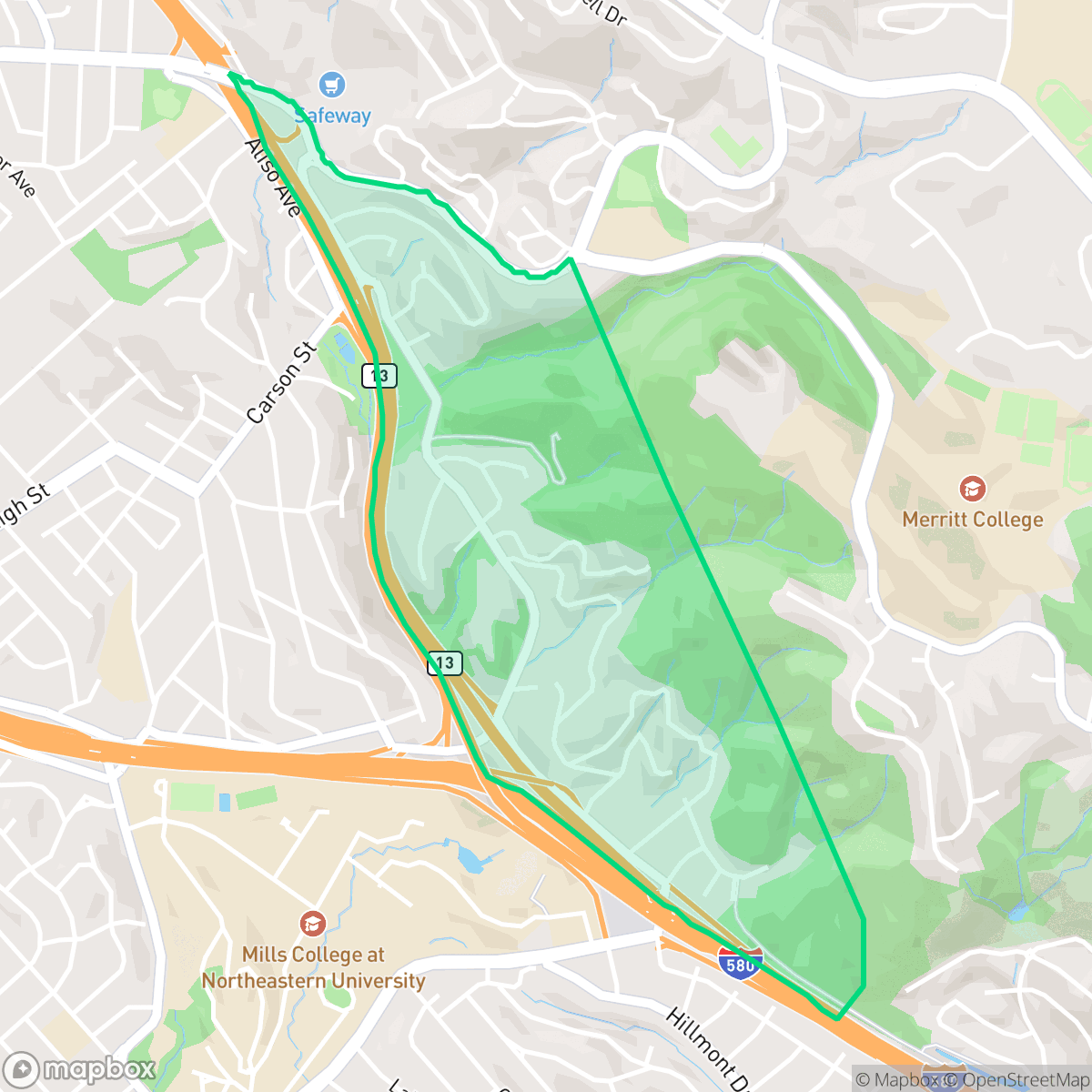
Leona Heights, nestled in the Oakland Hills, originated as a resort and residential development in 1896 on the former "Laundry Farm" estate along Lion Creek. The area’s early history was defined by heavy industry, including redwood lumbering and mining. Beginning in 1891, the Ohlone people's historical ochre mining sites were succeeded by commercial operations, including the Alma, Stauffer, and Leona pyrite and sulfur mines. In 1917, the Realty Syndicate transferred land to establish a California National Guard rifle range, which operated from 1920 through World War II. During the 1920s, the Realty Syndicate marketed the neighborhood as a commuter suburb for nearby auto plants. Redeveloped for housing in the late 1940s, Leona Heights today preserves its rugged past through Leona Heights Park and the York Trail, where hikers can still spot century-old mining ruins.
This neighborhood, situated in the Oakland Hills, offers a secluded, low-density environment that feels distant from the bustle of the city. It is primarily residential with minimal commercial presence, making it a quiet retreat for its residents. The terrain is steep and naturally beautiful, contributing to the area's high visual appeal and rural character.
Prospective residents should weigh the benefits of the natural setting against the acoustic environment. The area experiences elevated noise levels from highway traffic, which contrasts with its otherwise tranquil atmosphere. It is best suited for those who prioritize outdoor access and a suburban-rural lifestyle over walking to local businesses. Additionally, families should note that the local school district is currently navigating significant financial and operational instability.
Neighborhood Scores Across 15 Qualities
Residential spacing provides a degree of separation between neighbors that is notably higher than the Oakland average. According to iHuus data, properties feature mixed density with some existing buffers between homes.
Sidewalks are available on one side of the street and crossings are considered safe. This level of walkability is slightly lower than the average for Oakland.
Large residential properties and premium amenities provide a landscape that is significantly more aesthetically pleasing than the Oakland average, according to iHuus data.
Interconnected green spaces and wide, traffic-free paths make this an exceptionally suitable area for dog owners. According to iHuus data, these features provide significantly more opportunities for safe pet exercise than the Oakland average.
Frequent open land and scattered homes among woodlands provide a more rural atmosphere than most of Oakland. According to iHuus data, this area features significantly more open space and greenery compared to the city average.
Residential streets and green spaces provide a calm atmosphere, though local services and dining options are somewhat sparse compared to the Oakland average. Residents can find occasional social spots and parks, but the area lacks the dense commercial activity found in more urban parts of the city.
Frequent noise from nearby major roadways and transit corridors characterizes this area. According to iHuus data, acoustic comfort levels are significantly lower than the Oakland city average.
Air quality in this area is consistently high, remaining largely comparable to the Oakland average. Residents can expect mostly clean air with only rare instances of elevated readings according to iHuus data.
Industrial activity and heavy warehouses are entirely absent from this area, providing a cleaner environment than the Oakland average. According to iHuus data, the neighborhood consists solely of residential streets and light commercial spaces without nearby hazard sites.
Health insurance access is notably higher than the Oakland average. Residents in this area benefit from widespread coverage compared to many other parts of the city.
Voting patterns and census indicators show a deeply liberal political leaning, consistent with the broader Oakland area according to iHuus data.
Residents live alongside a balanced mix of young adults, families, and older individuals. According to iHuus data, this demographic spread is slightly more varied than the average found across Oakland.
Flood risk in this area is notably higher than the Oakland average, though official FEMA studies for this specific location remain incomplete. Residents should remain aware of potential vulnerabilities during extreme weather events according to iHuus data.
Extreme wildfire hazards exist in this area, representing a significantly higher risk than the Oakland average. Residents should be prepared for intensive fire prevention and mitigation requirements according to iHuus data.
Address-Level Insights for Leona Heights


iHuus Neighborhood Intelligence Insights
Get address-level neighborhood insights for Leona Heights
- Street-level scores — see how individual blocks compare, not just neighborhood averages
- Micro-zone boundaries — identify quiet pockets, flood boundaries, and walkable clusters before you visit
- 15 dimensions in full — walkability, noise, air quality, school quality, insurance coverage, population age profile, urban/rural index, and more
- Boundary risk alerts — know if your address sits near a block boundary where scores drop, the kind of detail no listing will ever mention
- School insights — individual school ratings and insights, not just district-level data
- Compare before you commit — side-by-side data across neighborhoods, down to block precision
No credit card required
Compare with Any Neighborhood
| Dimension | Leona Heights | Acorn |
|---|---|---|
| 🚶 Walkabilityavg 8.99 | ||
| 🔊 Acoustic Comfortavg 3.24 | ||
| 🤫 Privacy Indexavg 3.74 | ||
| 🎨 Visual Appealavg 6.28 | ||
| 🐕 Dog Friendlinessavg 5.74 | ||
| 🗺️ Urban-Rural Indexavg 6.02 | ||
| ✨ Neighborhood Vibeavg 5.22 | ||
| 🏥 Health Insurance Coverageavg 7.4 | ||
| 🌿 Air Qualityavg 8.06 | ||
| 🏭 Industrial Proximityavg 8.37 | ||
| 🌊 Flood Safetyavg 2.61 | ||
| 🗳️ Ideological Leanavg 9.95 | ||
| 👥 Population Age Profileavg 4.92 | ||
| 🔥 Fire Safetyavg 0.17 | ||
| 🏫 School Quality |
Leona Heights Rankings
School Districts Serving Leona Heights
School Insights for Leona Heights
Below average outcomes; significant attendance and academic challenges.
School Insights
See what's really behind every school rating near Leona Heights
- Individual school ratings — each school's own score with outcome context, not just a district average
- Enrollment & class size data — student-to-teacher ratio and how it compares to the state average
- Full demographics breakdown — ethnicity and gender composition for every school in the enrollment zone
- Every school in the district — all schools within the enrollment boundary ranked by rating, not just the closest one
- Grade levels & benchmarks — elementary through high school, with below/above state-average flags
No credit card required