Laurel, Oakland
Updated · 1,593 residents
The Laurel is a highly walkable Oakland neighborhood defined by its dense, grid-based residential layout and a vibrant commercial corridor along MacArthur Boulevard. While it offers excellent air quality and a strong sense of community, residents should be prepared for significant road noise and limited private outdoor space.
Key Highlights
About Laurel
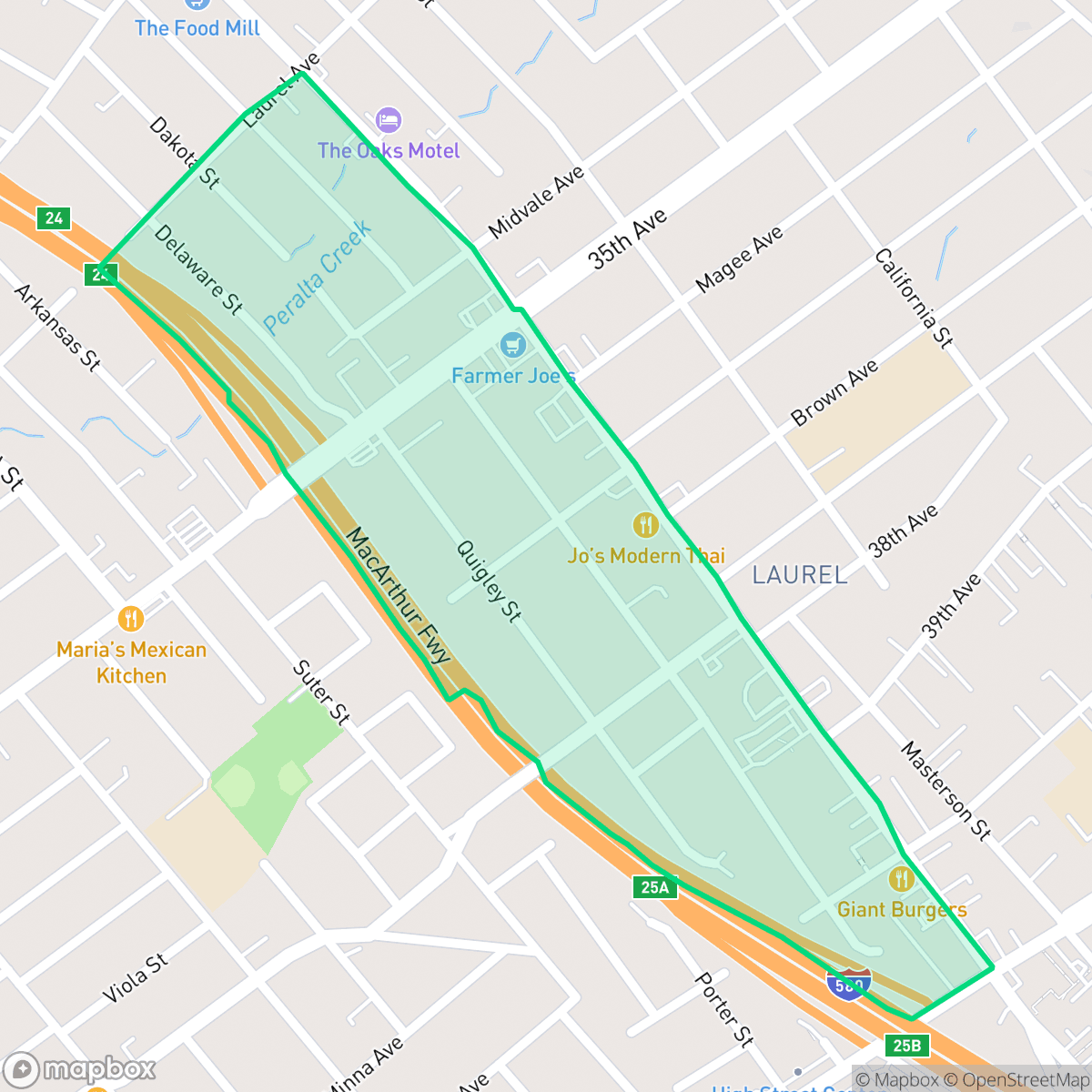
Oakland's Laurel district traces its name to the Laurel Grove Park tract subdivided in 1900, though it was also known as Key Route Heights due to the local Key System streetcar lines that spurred its early development. Annexed by Oakland in 1909, the neighborhood grew rapidly in the 1920s and 1930s, leaving a legacy of Craftsman and Spanish-style bungalows. Its central artery, MacArthur Boulevard, was once part of U.S. Highway 50 and became a bustling commercial strip. Historically, the Laurel played a vital role in Native American activism; during the 1960s, the neighborhood's Hilltop Tavern served as a meeting place for the American Indian Movement, where organizers planned the 1969 occupation of Alcatraz. Today, the neighborhood is celebrated for its diverse local businesses, vibrant murals, and the annual Laurel StreetFair.
The neighborhood functions as a dense, urban residential hub where daily errands can be completed entirely on foot. The area maintains a high level of activity, anchored by a diverse selection of local restaurants and community-focused institutions. According to iHuus data, the lack of nearby industrial activity contributes to superior air quality, making the environment cleaner than many other parts of the city. The architectural landscape is characterized by tightly packed housing, which reflects the area's historical development patterns and high population density.
Living here involves certain trade-offs, particularly regarding acoustic comfort and personal space. The proximity to major thoroughfares results in elevated noise levels, and the compact housing stock means residents have minimal privacy and limited yard access. The area is best suited for those who prioritize walkability and urban convenience over quietude or expansive private gardens. Prospective families should also consider the current instability within the local school district when evaluating the neighborhood as a long-term home.
Neighborhood Scores Across 15 Qualities
Residential structures are situated in close proximity with narrow separations or shared walls. According to iHuus data, this level of density provides significantly less personal privacy than the Oakland average.
A consistent sidewalk network and a navigable grid layout facilitate pedestrian movement, although a major high-traffic freeway corridor creates a notable break in the streetscape. While easy for local navigation, the walkability level is slightly lower than the Oakland average.
Residential streets feature standard tract housing with consistent roof geometries and small yards. This landscape is slightly less visually diverse than the Oakland city average according to iHuus data.
Dense housing and narrow sidewalks offer few opportunities for outdoor exercise, making this area less dog friendly than the Oakland average. According to iHuus data, most residents rely on a single small baseball field for nearby green space.
Frequent open land and scattered greenery provide a slightly more semi-rural feel than the typical Oakland urban landscape. According to iHuus data, the area features a blend of dense residential grids and pockets of woodland.
Residential streets offer a blend of quiet suburban pockets and active social nodes with various dining options. According to iHuus data, the local energy is slightly higher than the Oakland average due to these concentrated amenity clusters.
Frequent noise from nearby rail lines and airport flight paths makes for a loud environment. This level of acoustic disruption is significantly higher than the Oakland average, according to iHuus data.
Air quality in Laurel is consistently excellent, providing a healthier environment than the typical Oakland average according to iHuus data.
Industrial presence is minimal in this area, as the neighborhood is composed almost entirely of residential and light commercial zones. According to iHuus data, this lack of heavy industry and hazardous sites is even more pronounced here than in the rest of Oakland.
Health insurance accessibility is strong in this area, sitting above the Oakland average according to iHuus data.
Voting patterns and census indicators show a predominantly liberal political leaning that is consistent with the rest of Oakland. According to iHuus data, the area's ideological profile remains closely aligned with the city average.
Residents live alongside a balanced mix of young professionals, families, and older adults. This demographic distribution is slightly more varied than the typical Oakland profile, according to iHuus data.
Flood risk in this area is notably higher than the Oakland average, though current FEMA studies for the neighborhood remain incomplete. According to iHuus data, residents should remain aware of potential vulnerabilities due to the lack of detailed local flood mapping.
Address-Level Insights for Laurel


iHuus Neighborhood Intelligence Insights
Get address-level neighborhood insights for Laurel
- Street-level scores — see how individual blocks compare, not just neighborhood averages
- Micro-zone boundaries — identify quiet pockets, flood boundaries, and walkable clusters before you visit
- 15 dimensions in full — walkability, noise, air quality, school quality, insurance coverage, population age profile, urban/rural index, and more
- Boundary risk alerts — know if your address sits near a block boundary where scores drop, the kind of detail no listing will ever mention
- School insights — individual school ratings and insights, not just district-level data
- Compare before you commit — side-by-side data across neighborhoods, down to block precision
No credit card required
Compare with Any Neighborhood
| Dimension | Laurel | Acorn |
|---|---|---|
| 🚶 Walkabilityavg 8.99 | ||
| 🔊 Acoustic Comfortavg 3.24 | ||
| 🤫 Privacy Indexavg 3.74 | ||
| 🎨 Visual Appealavg 6.28 | ||
| 🐕 Dog Friendlinessavg 5.74 | ||
| 🗺️ Urban-Rural Indexavg 6.02 | ||
| ✨ Neighborhood Vibeavg 5.22 | ||
| 🏥 Health Insurance Coverageavg 7.4 | ||
| 🌿 Air Qualityavg 8.06 | ||
| 🏭 Industrial Proximityavg 8.37 | ||
| 🌊 Flood Safetyavg 2.61 | ||
| 🗳️ Ideological Leanavg 9.95 | ||
| 👥 Population Age Profileavg 4.92 | ||
| 🔥 Fire Safetyavg 0.17 | ||
| 🏫 School Quality |
Laurel Rankings
School Districts Serving Laurel
School Insights for Laurel
Below average outcomes; significant attendance and academic challenges.
School Insights
See what's really behind every school rating near Laurel
- Individual school ratings — each school's own score with outcome context, not just a district average
- Enrollment & class size data — student-to-teacher ratio and how it compares to the state average
- Full demographics breakdown — ethnicity and gender composition for every school in the enrollment zone
- Every school in the district — all schools within the enrollment boundary ranked by rating, not just the closest one
- Grade levels & benchmarks — elementary through high school, with below/above state-average flags
No credit card required