Lakewide, Oakland
Updated · 3,418 residents
Lakeside is a high-density urban enclave in Oakland known for its exceptional walkability and immediate access to the recreational amenities of Lake Merritt. The area features a vibrant, high-energy atmosphere with a concrete-dominant landscape and a diverse selection of local eateries.
Key Highlights
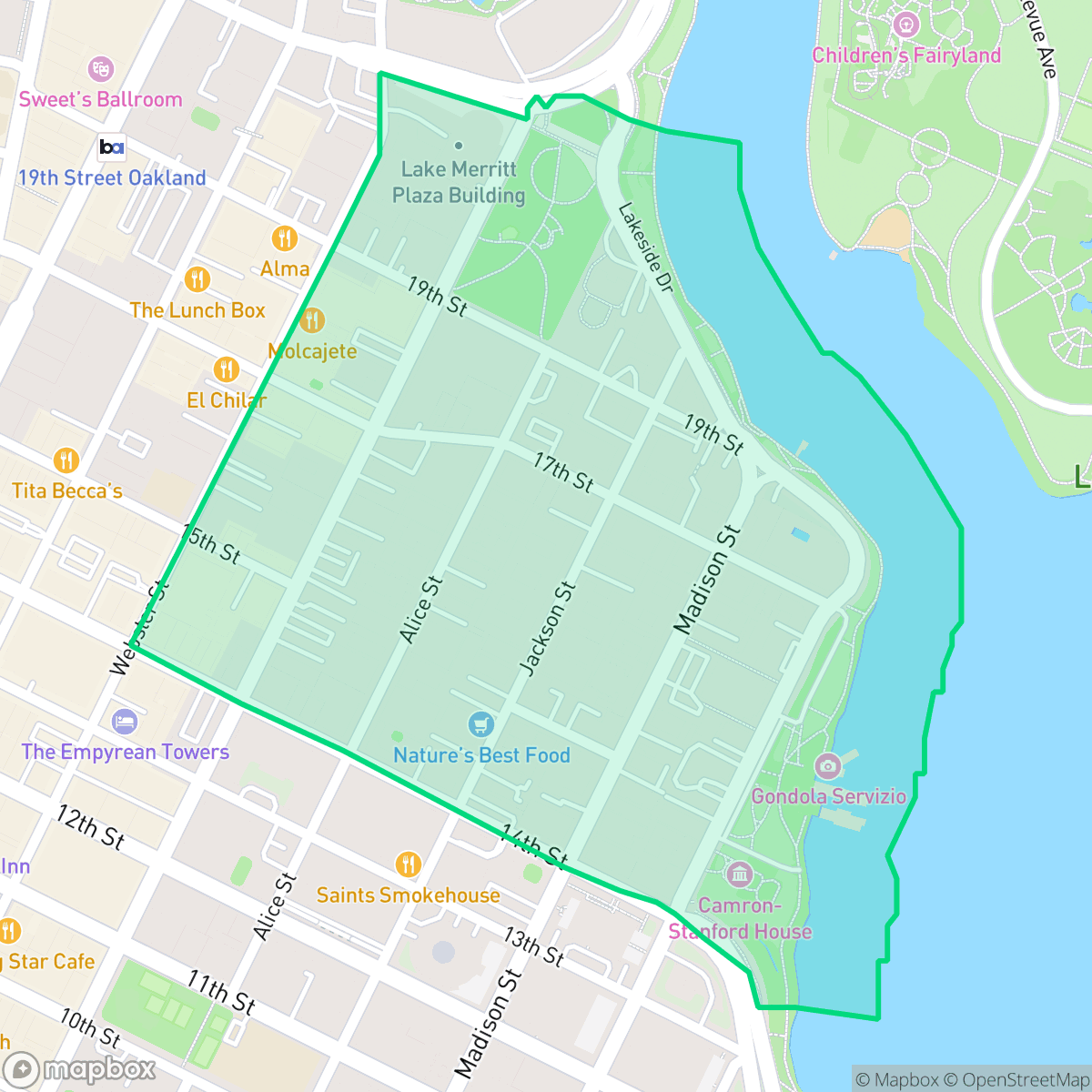
About Lakewide
The Lakeside neighborhood of Oakland, historically known as the "Gold Coast" or the Lakeside Apartments District, is a historic residential enclave situated between Downtown and Lake Merritt. Originally part of the 1820 Rancho San Antonio land grant, the area transitioned from 19th-century estates to a dense, urban residential district in the early 20th century. Officially designated as a local historic district, Lakeside is celebrated for its rich architectural stock, which includes notable structures like the 1876 Victorian-era Camron-Stanford House, the grand Regillus Apartments, and the Oakland Scottish Rite Center. The neighborhood is bordered by Snow Park—originally the site of Oakland's first zoo—and the historic Schilling Gardens. It remains defined by its historic multi-family apartment buildings and its close proximity to the nation's oldest official wildlife refuge at Lake Merritt.
The neighborhood functions as a dense, transit-oriented hub where residents benefit from near-perfect walkability and proximity to the city's most prominent waterfront park. The streetscape is defined by mid-rise apartment buildings and commercial blocks, creating a lively, urban environment that remains free from heavy industrial activity. Residents enjoy a high level of convenience, with daily errands and dining options like local cafes and pizzerias accessible on foot. While the area offers a strong sense of community and cultural engagement, it is characterized by typical urban noise levels primarily driven by road traffic.
Living in this area requires adjusting to the realities of a high-density environment, where privacy is limited due to the proximity of neighboring structures. The neighborhood is best suited for individuals who prioritize walkability and an active, urban lifestyle over suburban quiet or private green space. Prospective residents should note that the local school district currently faces significant systemic challenges, and the area lacks the flood and fire safety infrastructure found in less developed parts of the region.
Neighborhood Scores Across 15 Qualities
Buildings in this area are characterized by close quarters and minimal separation, featuring structures that are often touching or divided only by narrow alleys. This level of density is notably higher than the Oakland average, resulting in limited private yard space and very little distance between adjacent homes.
Continuous sidewalks and lakeside recreational trails provide an exceptionally easy environment for walking, which is notably more accessible than the average Oakland neighborhood. Extensive pedestrian crossings and a dense street grid ensure safe movement throughout the area.
Uniform residential and commercial structures define the area, featuring typical boxy rooflines and modest yards. This visual landscape is slightly below the Oakland average for aesthetic variety.
Access to Lake Merritt provides extensive trails and green space for pets, making this area significantly more dog friendly than the Oakland average. While the high-density core consists primarily of pavement, the nearby lakefront offers ample natural paths away from traffic.
Dense, multi-storey buildings and commercial structures characterize this area. The level of urbanization is significantly higher than the Oakland average, with very little open natural space or private greenery.
Constant movement and a dense concentration of diverse dining and commercial hubs define this area. According to iHuus data, the level of activity and commercial pull is significantly higher than the Oakland average.
Steady noise from nearby busy streets is present, though acoustic comfort remains higher than the Oakland average according to iHuus data.
Air quality in Lakewide is consistently good, appearing nearly identical to the average found across Oakland. Rare instances of elevated readings are infrequent, according to iHuus data.
Residential and commercial uses dominate this area without the presence of heavy warehouses or industrial chimneys. According to iHuus data, the neighborhood lacks the large-scale industrial facilities found more frequently in other parts of Oakland, though a nearby Superfund site should be noted.
Health insurance accessibility is notably lower in this area than in the rest of Oakland. According to iHuus data, a small minority of residents possess coverage, which may present challenges for accessing routine medical care.
Voting patterns and census indicators show a highly liberal political leaning that is consistent with the rest of Oakland.
Residents live alongside a balanced mix of young adults, families, and older populations. According to iHuus data, this age distribution is more varied than the average found across Oakland.
Located within a designated floodplain, this area faces significantly higher flood risks than most of Oakland. Residents should prepare for potential water damage and likely necessity for flood insurance according to iHuus data.
Address-Level Insights for Lakewide


iHuus Neighborhood Intelligence Insights
Get address-level neighborhood insights for Lakewide
- Street-level scores — see how individual blocks compare, not just neighborhood averages
- Micro-zone boundaries — identify quiet pockets, flood boundaries, and walkable clusters before you visit
- 15 dimensions in full — walkability, noise, air quality, school quality, insurance coverage, population age profile, urban/rural index, and more
- Boundary risk alerts — know if your address sits near a block boundary where scores drop, the kind of detail no listing will ever mention
- School insights — individual school ratings and insights, not just district-level data
- Compare before you commit — side-by-side data across neighborhoods, down to block precision
No credit card required
Compare with Any Neighborhood
| Dimension | Lakewide | Acorn |
|---|---|---|
| 🚶 Walkabilityavg 8.99 | ||
| 🔊 Acoustic Comfortavg 3.24 | ||
| 🤫 Privacy Indexavg 3.74 | ||
| 🎨 Visual Appealavg 6.28 | ||
| 🐕 Dog Friendlinessavg 5.74 | ||
| 🗺️ Urban-Rural Indexavg 6.02 | ||
| ✨ Neighborhood Vibeavg 5.22 | ||
| 🏥 Health Insurance Coverageavg 7.4 | ||
| 🌿 Air Qualityavg 8.06 | ||
| 🏭 Industrial Proximityavg 8.37 | ||
| 🌊 Flood Safetyavg 2.61 | ||
| 🗳️ Ideological Leanavg 9.95 | ||
| 👥 Population Age Profileavg 4.92 | ||
| 🔥 Fire Safetyavg 0.17 | ||
| 🏫 School Quality |
Lakewide Rankings
School Districts Serving Lakewide
School Insights for Lakewide
Below average outcomes; significant attendance and academic challenges.
School Insights
See what's really behind every school rating near Lakewide
- Individual school ratings — each school's own score with outcome context, not just a district average
- Enrollment & class size data — student-to-teacher ratio and how it compares to the state average
- Full demographics breakdown — ethnicity and gender composition for every school in the enrollment zone
- Every school in the district — all schools within the enrollment boundary ranked by rating, not just the closest one
- Grade levels & benchmarks — elementary through high school, with below/above state-average flags
No credit card required