Lakeshore, Oakland
Updated · 4,775 residents
Lakeshore is an exceptionally walkable neighborhood in Oakland defined by its mix of historic residential architecture and a vibrant commercial corridor. Residents benefit from high health insurance coverage and proximity to local amenities, though the area experiences moderate noise levels from nearby road traffic.
Key Highlights
About Lakeshore
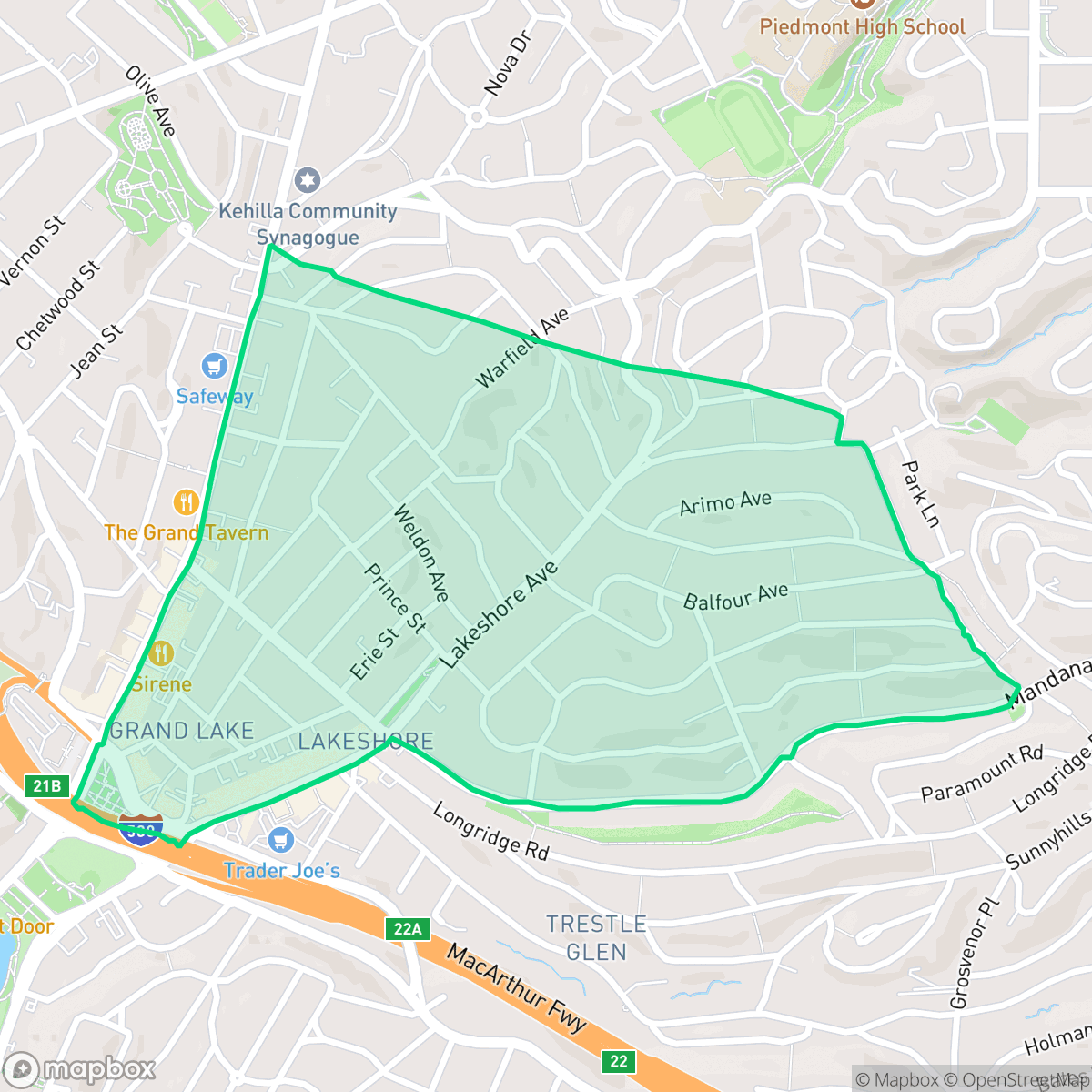
Oakland's Lakeshore neighborhood, originally known as Pleasant Valley, transitioned from a 19th-century recreational tract into an upscale residential district in the early 20th century. In 1917, developers Wickham Havens and Walter H. Leimert established the Lakeshore Highlands "residential park," beautifully laid out by the Olmsted Brothers. To protect its aesthetic, the Lakeshore Homes Association was founded that same year, making it one of the oldest homeowners associations in the West. The neighborhood features picturesque Tudor, Mediterranean, and Spanish Revival homes crafted by legendary architects like Julia Morgan and Bernard Maybeck. Its commercial hub is anchored by the iconic 1926 Grand Lake Theater. In the 1960s, the neighborhood underwent a major transformation when the construction of the MacArthur Freeway (I-580) claimed numerous historic structures along Lake Park Avenue.
The neighborhood maintains a distinct character through its blend of single-family homes and small-scale commercial buildings. It is entirely free of industrial hazards, providing a clean residential environment with high air quality. The area is highly accessible on foot, with a consistent network of sidewalks and clear crosswalks that connect residents to diverse dining options and local coffee shops. According to iHuus data, the area is characterized by a dense suburban and low-density urban mix that prioritizes residential comfort.
While the neighborhood offers a calm, suburban feel, it is situated near major transit routes, resulting in moderate noise levels primarily attributed to road traffic. Prospective residents should note that while the area is well-served by local services, school quality varies significantly depending on district boundaries. The neighborhood is particularly well-suited for those seeking a stable, health-conscious community with high walkability and proximity to urban amenities.
Neighborhood Scores Across 15 Qualities
Residential spacing is varied, offering more separation between homes than the Oakland average. While some multi-unit structures feature shared walls, many properties maintain private yards and greenery buffers between buildings.
Pedestrian-priority zones around the lake and an extensive network of sidewalks make most errands easily accessible on foot. This area offers superior walkability compared to the Oakland average, featuring many tree-shaded streets and dedicated crossings.
Large homes with manicured yards and private amenities like pools are common throughout this area. According to iHuus data, the visual environment is more polished than the Oakland average.
Direct access to Lake Merritt and abundant nearby parkland provides significantly more walking space and green verges than the Oakland average. Wide sidewalks and separated paths offer a safe environment for pets to navigate the neighborhood.
Residential streets offer a balance of single-family homes and mature tree canopies, reflecting a suburban character that is consistent with the Oakland average. According to iHuus data, the area features a transition from dense, multi-story urban pockets to low-density residential layouts.
Local social hubs and diverse dining options provide a notable level of activity that is higher than the Oakland average. While various cafes and restaurants are scattered throughout the area, many blocks remain calm and suburban in character.
Frequent acoustic disturbances from nearby freeway and railroad corridors characterize this area. According to iHuus data, noise levels are significantly higher than the Oakland average.
Air quality remains consistently good with rare instances of elevated readings. This level of cleanliness is roughly in line with the Oakland average, according to iHuus data.
Industrial activity and large warehouses are entirely absent from this area, which sits well above the Oakland average for industrial proximity. Residents can expect an environment consisting exclusively of residential, recreational, and light commercial uses without exposure to heavy machinery or industrial hazards.
Health insurance enrollment among residents is exceptionally high, significantly exceeding the Oakland average according to iHuus data.
Voting patterns and census indicators reflect a highly progressive political climate that is slightly more liberal than the Oakland average, according to iHuus data.
Residents live alongside a varied demographic of young professionals, families, and seniors. This population spread is slightly more balanced across age brackets than the Oakland average, according to iHuus data.
Flood risk in this area is notably higher than the Oakland average, though the specific level of danger remains undetermined due to incomplete local studies. According to iHuus data, the neighborhood sits in an area where detailed federal flood assessments are currently unavailable.
Address-Level Insights for Lakeshore


iHuus Neighborhood Intelligence Insights
Get address-level neighborhood insights for Lakeshore
- Street-level scores — see how individual blocks compare, not just neighborhood averages
- Micro-zone boundaries — identify quiet pockets, flood boundaries, and walkable clusters before you visit
- 15 dimensions in full — walkability, noise, air quality, school quality, insurance coverage, population age profile, urban/rural index, and more
- Boundary risk alerts — know if your address sits near a block boundary where scores drop, the kind of detail no listing will ever mention
- School insights — individual school ratings and insights, not just district-level data
- Compare before you commit — side-by-side data across neighborhoods, down to block precision
No credit card required
Compare with Any Neighborhood
| Dimension | Lakeshore | Acorn |
|---|---|---|
| 🚶 Walkabilityavg 8.99 | ||
| 🔊 Acoustic Comfortavg 3.24 | ||
| 🤫 Privacy Indexavg 3.74 | ||
| 🎨 Visual Appealavg 6.28 | ||
| 🐕 Dog Friendlinessavg 5.74 | ||
| 🗺️ Urban-Rural Indexavg 6.02 | ||
| ✨ Neighborhood Vibeavg 5.22 | ||
| 🏥 Health Insurance Coverageavg 7.4 | ||
| 🌿 Air Qualityavg 8.06 | ||
| 🏭 Industrial Proximityavg 8.37 | ||
| 🌊 Flood Safetyavg 2.61 | ||
| 🗳️ Ideological Leanavg 9.95 | ||
| 👥 Population Age Profileavg 4.92 | ||
| 🔥 Fire Safetyavg 0.17 | ||
| 🏫 School Quality |
Lakeshore Rankings
School Districts Serving Lakeshore
School Insights for Lakeshore
Below average outcomes; significant attendance and academic challenges.
School Insights
See what's really behind every school rating near Lakeshore
- Individual school ratings — each school's own score with outcome context, not just a district average
- Enrollment & class size data — student-to-teacher ratio and how it compares to the state average
- Full demographics breakdown — ethnicity and gender composition for every school in the enrollment zone
- Every school in the district — all schools within the enrollment boundary ranked by rating, not just the closest one
- Grade levels & benchmarks — elementary through high school, with below/above state-average flags
No credit card required