Lake Merritt, Oakland
Updated · 2,068 residents
Lake Merritt is a highly walkable and dog-friendly urban neighborhood defined by its dense residential layout and immediate access to extensive parkland. While the area offers a vibrant, connected lifestyle with numerous local dining options, residents experience limited privacy due to the close proximity of buildings and noticeable noise from road traffic.
Key Highlights
About Lake Merritt
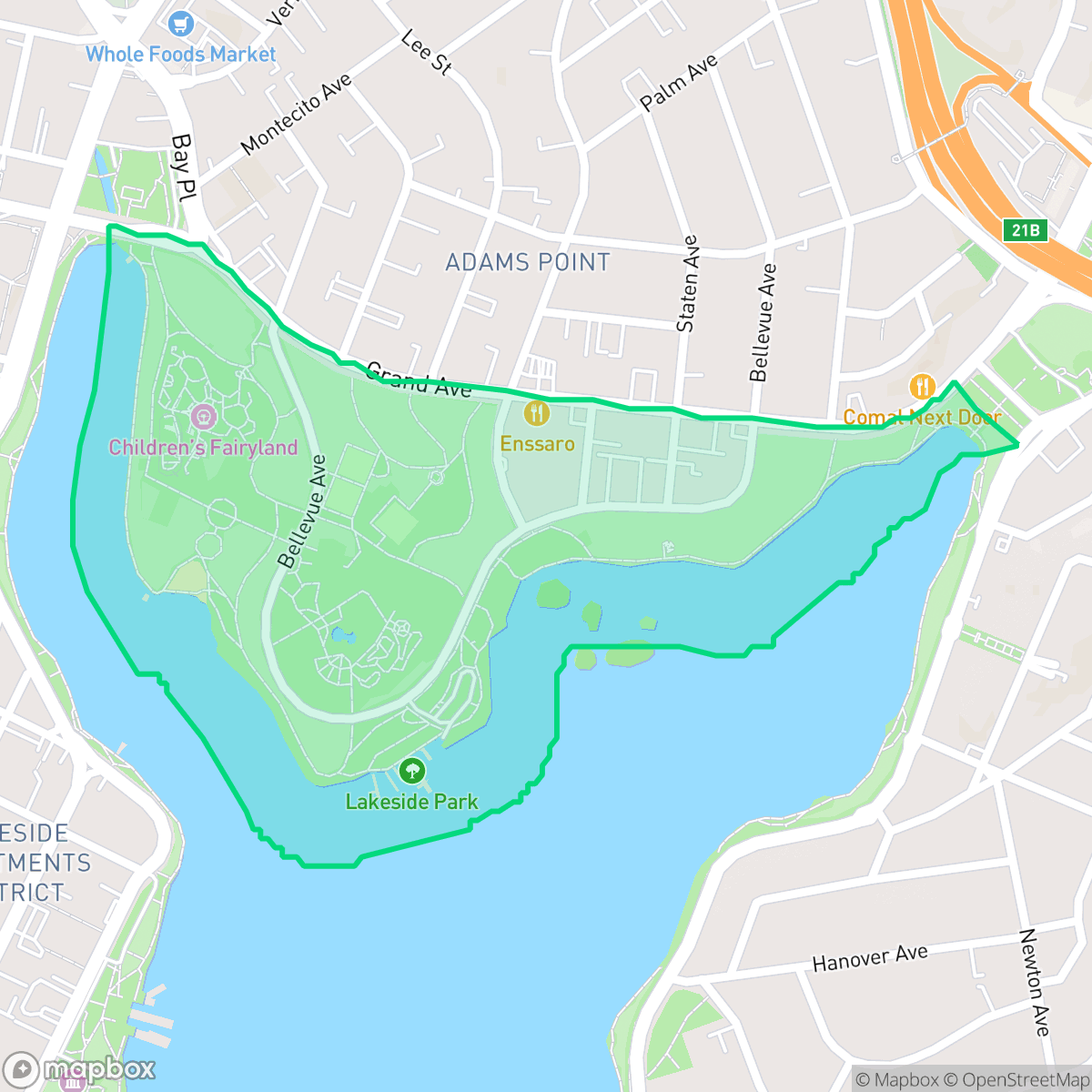
Centering on a historic tidal lagoon, Oakland’s Lake Merritt neighborhood is defined by its namesake lake, which became the United States' first official wildlife refuge in 1870 after Mayor Samuel Merritt dammed the estuary. Early 20th-century development, influenced by the City Beautiful movement, introduced Lakeside Park, the 1913 neoclassical Pergola and Colonnade, and the 1920s Italianate Cleveland Cascade. The neighborhood’s diverse architectural stock ranges from the Victorian-era Camron-Stanford House (1876) to the Art Deco Bellevue-Staten apartments (1929) and the mid-century Kaiser Center. Other local cultural landmarks include Children’s Fairyland—a whimsical 1950 theme park that inspired Walt Disney's vision for Disneyland—and the iconic "Necklace of Lights" streetlamps, which have illuminated the shoreline since 1925.
The neighborhood functions as a central hub for outdoor activity and urban living in Oakland. With a perfect walkability score according to iHuus data, the area allows residents to navigate between the shoreline trails, local parks like Pine Knoll, and a variety of commercial amenities without relying on a vehicle. The housing stock is tightly concentrated, creating a dense, low-to-mid-rise environment that balances urban intensity with the expansive green space of the lake.
Prospective residents should consider the trade-offs inherent in this high-density location, including reduced acoustic comfort from road traffic and minimal private outdoor space. While the area boasts excellent health insurance coverage and a strong sense of community, families should be aware of the ongoing challenges within the Oakland Unified School District. The neighborhood is best suited for individuals or couples who prioritize lifestyle access and outdoor recreation over suburban seclusion.
Neighborhood Scores Across 15 Qualities
Residential structures are positioned in close proximity with minimal separation between buildings. According to iHuus data, this level of density is slightly higher than the Oakland average, resulting in limited yard space and narrow alleys.
Pedestrian access is exceptional due to the dense street grid, wide sidewalks, and dedicated lakeside trails. This area offers significantly better walkability than the Oakland average, providing ample crosswalks and person-centered zones for easy movement on foot.
Standard urban density defines this area, featuring closely packed multi-unit housing and commercial towers. The visual variety is slightly below the Oakland average, characterized by functional rooflines and minimal private yard space.
Direct access to the expansive Lake Merritt parkland and its perimeter trails provides significantly more green space and walking area for pets than the Oakland average. According to iHuus data, the neighborhood features abundant open spaces and accessible paths for frequent exercise.
A blend of residential streets and significant parkland provides a suburban feel that is less dense than the Oakland average. According to iHuus data, the area features a mix of mid-rise buildings and integrated green spaces.
Social hubs and diverse dining options create a much more active atmosphere than the Oakland average. Residents can experience a mix of high-energy urban corridors near Snow Park and calmer, greener streets near the water.
Frequent sounds from nearby transit corridors and rail lines create an environment significantly louder than the Oakland average. According to iHuus data, residents can expect persistent acoustic disturbances from heavy traffic and surrounding infrastructure.
Air quality remains mostly clean with only rare instances of elevated readings. This level of air purity is roughly in line with the Oakland average, according to iHuus data.
Industrial presence is minimal within the neighborhood, featuring mainly residential, commercial, and parkland areas. According to iHuus data, the area lacks large warehouses or industrial hazards, though a Superfund site is located nearby.
Health insurance access is relatively stable in this area, though it remains slightly below the Oakland city average according to iHuus data.
Voting patterns and census indicators reflect a highly progressive political environment that is slightly more liberal than the Oakland average.
Residents encounter a diverse mix of young professionals, families, and seniors, representing a more balanced age distribution than the Oakland average. According to iHuus data, this demographic variety contributes to a multi-generational community atmosphere.
Flood risk levels remain undetermined because local studies are incomplete; however, this area presents a higher level of potential risk than the Oakland average according to iHuus data.
Address-Level Insights for Lake Merritt


iHuus Neighborhood Intelligence Insights
Get address-level neighborhood insights for Lake Merritt
- Street-level scores — see how individual blocks compare, not just neighborhood averages
- Micro-zone boundaries — identify quiet pockets, flood boundaries, and walkable clusters before you visit
- 15 dimensions in full — walkability, noise, air quality, school quality, insurance coverage, population age profile, urban/rural index, and more
- Boundary risk alerts — know if your address sits near a block boundary where scores drop, the kind of detail no listing will ever mention
- School insights — individual school ratings and insights, not just district-level data
- Compare before you commit — side-by-side data across neighborhoods, down to block precision
No credit card required
Compare with Any Neighborhood
| Dimension | Lake Merritt | Acorn |
|---|---|---|
| 🚶 Walkabilityavg 8.99 | ||
| 🔊 Acoustic Comfortavg 3.24 | ||
| 🤫 Privacy Indexavg 3.74 | ||
| 🎨 Visual Appealavg 6.28 | ||
| 🐕 Dog Friendlinessavg 5.74 | ||
| 🗺️ Urban-Rural Indexavg 6.02 | ||
| ✨ Neighborhood Vibeavg 5.22 | ||
| 🏥 Health Insurance Coverageavg 7.4 | ||
| 🌿 Air Qualityavg 8.06 | ||
| 🏭 Industrial Proximityavg 8.37 | ||
| 🌊 Flood Safetyavg 2.61 | ||
| 🗳️ Ideological Leanavg 9.95 | ||
| 👥 Population Age Profileavg 4.92 | ||
| 🔥 Fire Safetyavg 0.17 | ||
| 🏫 School Quality |
Lake Merritt Rankings
School Districts Serving Lake Merritt
School Insights for Lake Merritt
Below average outcomes; significant attendance and academic challenges.
School Insights
See what's really behind every school rating near Lake Merritt
- Individual school ratings — each school's own score with outcome context, not just a district average
- Enrollment & class size data — student-to-teacher ratio and how it compares to the state average
- Full demographics breakdown — ethnicity and gender composition for every school in the enrollment zone
- Every school in the district — all schools within the enrollment boundary ranked by rating, not just the closest one
- Grade levels & benchmarks — elementary through high school, with below/above state-average flags
No credit card required