Joaquin Miller Park, Oakland
Updated · 538 residents
Joaquin Miller Park is a serene, rural enclave in the Oakland Hills defined by its expansive redwood forests and quiet, nature-oriented atmosphere. According to iHuus data, the area offers exceptional dog-friendliness and high air quality, though residents trade off urban convenience and walkability for a secluded, park-like lifestyle.
Key Highlights
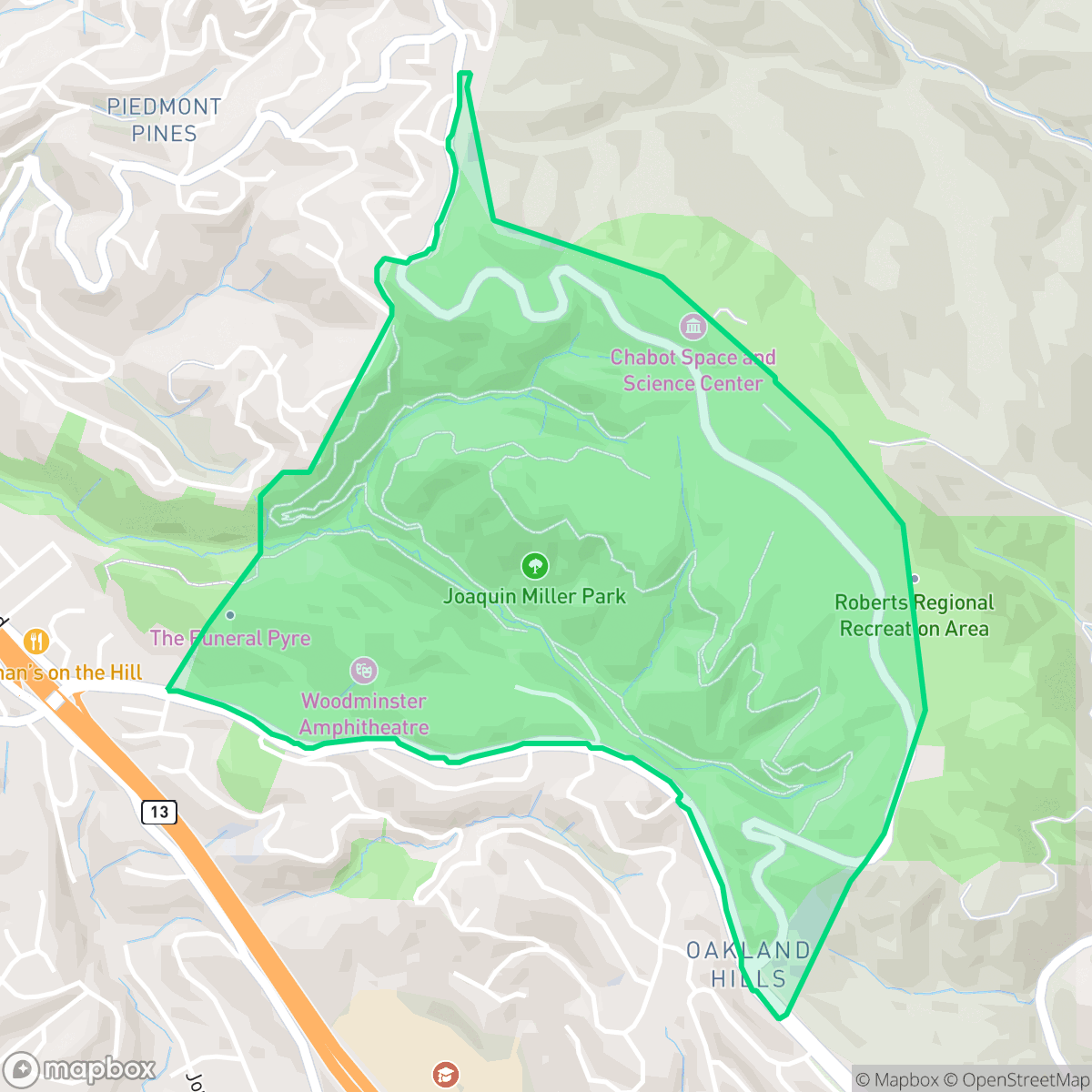
About Joaquin Miller Park
The Joaquin Miller Park neighborhood in the Oakland Hills is deeply rooted in the legacy of 19th-century poet Cincinnatus Hiner "Joaquin" Miller, the "Poet of the Sierras." In 1886, Miller purchased 70 acres of bare, logged hillside he named "The Hights," where he planted over 75,000 Monterey pine, cypress, and eucalyptus trees. He constructed a rustic, Gothic-influenced home known as "The Abbey" alongside idiosyncratic stone monuments dedicated to historical and literary figures. Following his death, the City of Oakland purchased the estate in 1917 to establish the park. During the Great Depression, the Works Progress Administration (WPA) constructed the 2,000-seat Woodminster Amphitheater and its signature Cascade waterfall feature. Today, the surrounding neighborhood is defined by this historic 500-acre urban redwood forest and its rich literary heritage.
The neighborhood functions as a quiet, rural landscape characterized by vast open areas and minimal development. It provides a peaceful retreat from the density of the city, with the Sequoia Bayview Trail serving as a central feature for local recreation and outdoor activity. Residents benefit from high levels of health insurance coverage and excellent air quality, maintaining a lifestyle that prioritizes tranquility and direct access to the natural environment. The area is largely residential, with very few commercial services, contributing to its low-key, private atmosphere. Living here involves specific trade-offs, particularly regarding accessibility and safety. The neighborhood is not designed for those seeking high walkability or proximity to diverse urban amenities, as daily errands typically require a vehicle. Additionally, the dense forest environment presents a significant fire safety risk, necessitating a high level of preparedness from residents. This location is best suited for nature enthusiasts, dog owners, and those who prioritize environmental quality and a low-traffic setting over the convenience of a traditional urban center.
Neighborhood Scores Across 15 Qualities
Residential spacing provides a moderate level of buffer between neighbors, which is notably higher than the Oakland average according to iHuus data.
Sidewalks are available on only one side of the street and feature safe crossings. Walking for daily errands is notably less convenient here than the Oakland average.
Large residential properties and premium amenities define the local landscape, offering a level of aesthetic quality significantly higher than the Oakland average according to iHuus data.
Extensive trail networks and vast open spaces provide exceptional opportunities for pet owners. This area offers significantly more recreational space for dogs than the Oakland average, according to iHuus data.
Extensive woodland and natural terrain characterize this area, offering a significantly more rural environment than the typical Oakland landscape. According to iHuus data, the landscape is dominated by forest and open space with very little building density.
This low-density area offers a serene, rural landscape characterized by vast open spaces and minimal commercial activity. According to iHuus data, the neighborhood is significantly less active than the Oakland average, serving primarily as a quiet residential setting with very few local businesses.
Steady traffic sounds from a nearby busy street are common here. This level of acoustic activity is higher than the average found throughout Oakland.
Air quality is consistently good with infrequent periods of poor air. This level of cleanliness is nearly identical to the Oakland average, according to iHuus data.
Industrial activity is absent from this area, which consists entirely of residential zones and green spaces. This lack of warehouse or manufacturing presence is significantly lower than the Oakland average, according to iHuus data.
Health insurance access is exceptionally high for residents in this area. According to iHuus data, coverage rates here are significantly above the Oakland average.
Voting patterns and census indicators show a predominantly liberal political leaning, which is consistent with the city average according to iHuus data.
A balanced demographic of young adults, families, and seniors defines the area. According to iHuus data, this age distribution is more varied than the typical Oakland profile.
Residual flood risk exists within the area as it falls within a designated floodplain, though safety levels are considerably higher than the Oakland average according to iHuus data.
Extreme wildfire hazards are present in this area, representing a significantly higher risk than the Oakland average. According to iHuus data, residents must prioritize maximum protection measures and emergency preparedness.
Address-Level Insights for Joaquin Miller Park


iHuus Neighborhood Intelligence Insights
Get address-level neighborhood insights for Joaquin Miller Park
- Street-level scores — see how individual blocks compare, not just neighborhood averages
- Micro-zone boundaries — identify quiet pockets, flood boundaries, and walkable clusters before you visit
- 15 dimensions in full — walkability, noise, air quality, school quality, insurance coverage, population age profile, urban/rural index, and more
- Boundary risk alerts — know if your address sits near a block boundary where scores drop, the kind of detail no listing will ever mention
- School insights — individual school ratings and insights, not just district-level data
- Compare before you commit — side-by-side data across neighborhoods, down to block precision
No credit card required
Compare with Any Neighborhood
| Dimension | Joaquin Miller Park | Acorn |
|---|---|---|
| 🚶 Walkabilityavg 8.99 | ||
| 🔊 Acoustic Comfortavg 3.24 | ||
| 🤫 Privacy Indexavg 3.74 | ||
| 🎨 Visual Appealavg 6.28 | ||
| 🐕 Dog Friendlinessavg 5.74 | ||
| 🗺️ Urban-Rural Indexavg 6.02 | ||
| ✨ Neighborhood Vibeavg 5.22 | ||
| 🏥 Health Insurance Coverageavg 7.4 | ||
| 🌿 Air Qualityavg 8.06 | ||
| 🏭 Industrial Proximityavg 8.37 | ||
| 🌊 Flood Safetyavg 2.61 | ||
| 🗳️ Ideological Leanavg 9.95 | ||
| 👥 Population Age Profileavg 4.92 | ||
| 🔥 Fire Safetyavg 0.17 | ||
| 🏫 School Quality |
Joaquin Miller Park Rankings
School Districts Serving Joaquin Miller Park
School Insights for Joaquin Miller Park
Below average outcomes; significant attendance and academic challenges.
School Insights
See what's really behind every school rating near Joaquin Miller Park
- Individual school ratings — each school's own score with outcome context, not just a district average
- Enrollment & class size data — student-to-teacher ratio and how it compares to the state average
- Full demographics breakdown — ethnicity and gender composition for every school in the enrollment zone
- Every school in the district — all schools within the enrollment boundary ranked by rating, not just the closest one
- Grade levels & benchmarks — elementary through high school, with below/above state-average flags
No credit card required