Jefferson, Oakland
Updated · 4,294 residents
Jefferson is a highly walkable neighborhood defined by its dense residential grid and proximity to historic community spaces. Residents enjoy a liberal-leaning environment with easy access to diverse local dining, though they navigate challenges related to steady traffic noise and limited private outdoor space.
Key Highlights
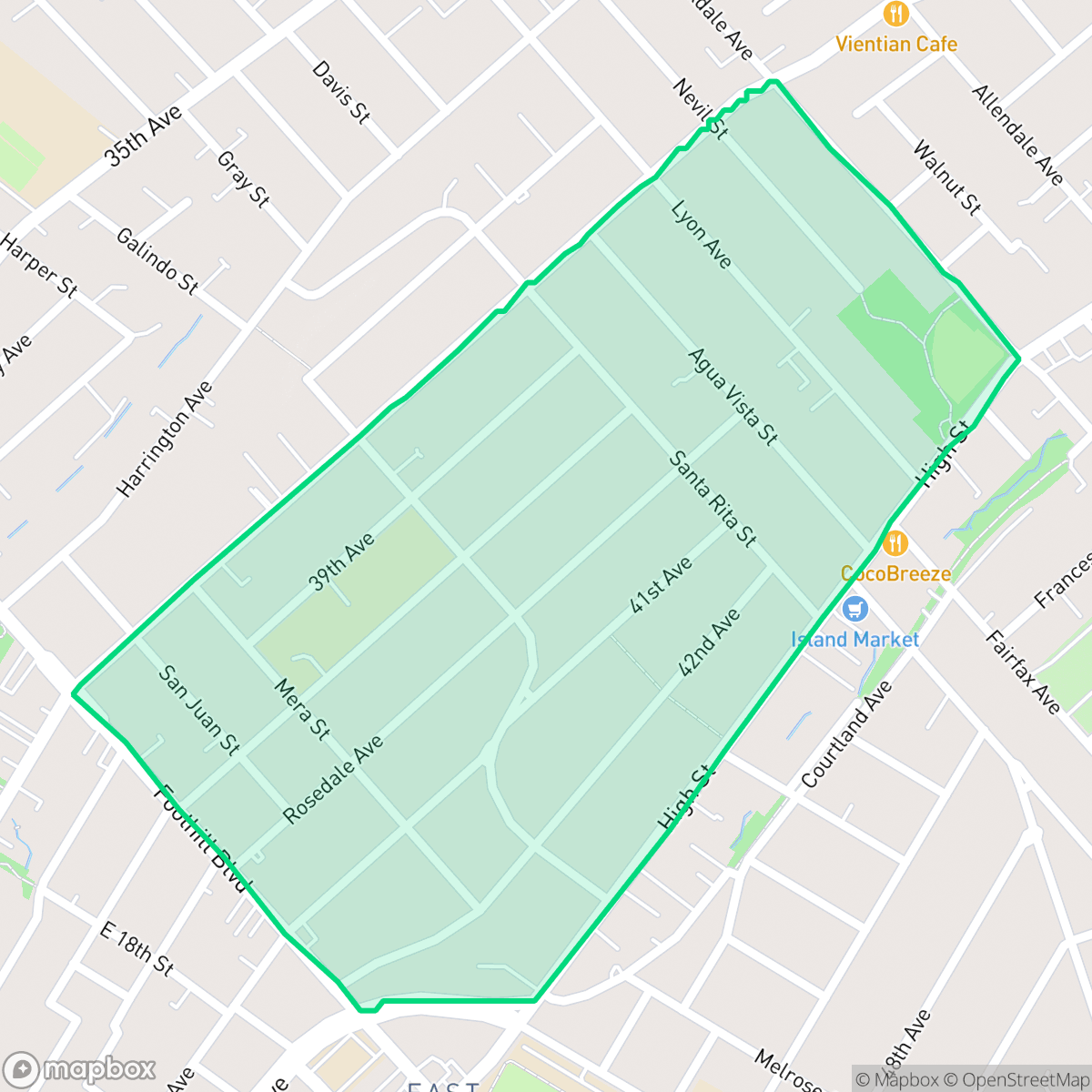
About Jefferson
The Jefferson area is anchored by Jefferson Square Park, one of seven historic 'green squares' established in Oakland’s original 1853 urban plan. Located between 6th and 7th Streets and Martin Luther King Jr. Way, the park served as a vital community hub for diverse populations, including Portuguese, Irish, and African American residents. Historically, the surrounding district was a vibrant residential and commercial corridor, though it faced significant disruption in the mid-20th century due to urban renewal, eminent domain, and the construction of the Grove Shafter Freeway. The area is noted for its high concentration of pre-1940s architecture and its legacy as a central gathering place that retains its status as a designated Oakland landmark, reflecting the city’s early efforts to integrate public plazas into its foundational design.
The neighborhood functions as a dense, pedestrian-oriented enclave where the street layout encourages movement on foot. While the area maintains a balanced urban and suburban feel, it is defined by a consistent, uniform housing stock that emphasizes community density over individual privacy. The local atmosphere is shaped by a strong liberal political identity and a lack of heavy industrial interference, creating a relatively quiet residential experience despite the presence of steady traffic noise from surrounding thoroughfares.
Prospective residents should be aware of specific environmental and infrastructural considerations. The area faces significant flood risks and offers limited public green space, making it better suited for those who prioritize neighborhood walkability and access to urban amenities over expansive private yards. Furthermore, families should consider that the local school district is currently navigating significant financial and structural challenges, which may impact long-term educational planning for those with school-aged children.
Neighborhood Scores Across 15 Qualities
Residential structures are positioned in close proximity with minimal separation between buildings. This density results in a level of privacy that is slightly lower than the Oakland average according to iHuus data.
Dense sidewalk networks and frequent crosswalks make most trips on foot easy. This neighborhood offers a more pedestrian-friendly environment than the Oakland average according to iHuus data.
Standard tract housing defines the area, featuring consistent boxy rooflines and small yards. This level of visual variety is slightly lower than the Oakland average, according to iHuus data.
Public parks and wide grassy verges are scarce in this area, as most greenery is confined to private backyards. According to iHuus data, the availability of open dog-friendly spaces is below the Oakland average.
Streets and green spaces are distributed in equal measure here, mirroring the typical urban-suburban balance found across Oakland. The landscape transitions between dense residential grids and larger commercial or industrial structures.
A mix of quiet residential streets and lively commercial pockets provides a level of activity that is slightly higher than the Oakland average. According to iHuus data, residents can access a diverse selection of international dining and social hubs, though many amenities are concentrated in specific clusters rather than being evenly distributed.
Steady traffic sounds from nearby busy streets are present. This level of acoustic activity is slightly higher than the Oakland average, according to iHuus data.
Air quality remains consistently high with infrequent instances of poor air readings. This level of cleanliness is roughly in line with the Oakland average according to iHuus data.
Residential and light commercial uses dominate the area, with a lack of heavy warehouses or significant industrial activity. This makes the neighborhood slightly more tranquil than the Oakland average regarding industrial noise and traffic.
Health insurance access among residents is relatively high, though slightly lower than the Oakland average according to iHuus data.
Voting patterns and census indicators show a predominantly liberal political environment, matching the overall trend seen across Oakland.
A balanced mix of young adults, families, and older residents characterizes the area. According to iHuus data, the age distribution is slightly more concentrated in specific age brackets than the Oakland average.
Significant flood risk characterizes this area, with vulnerability levels much higher than the Oakland average according to iHuus data.
Address-Level Insights for Jefferson


iHuus Neighborhood Intelligence Insights
Get address-level neighborhood insights for Jefferson
- Street-level scores — see how individual blocks compare, not just neighborhood averages
- Micro-zone boundaries — identify quiet pockets, flood boundaries, and walkable clusters before you visit
- 15 dimensions in full — walkability, noise, air quality, school quality, insurance coverage, population age profile, urban/rural index, and more
- Boundary risk alerts — know if your address sits near a block boundary where scores drop, the kind of detail no listing will ever mention
- School insights — individual school ratings and insights, not just district-level data
- Compare before you commit — side-by-side data across neighborhoods, down to block precision
No credit card required
Compare with Any Neighborhood
| Dimension | Jefferson | Acorn |
|---|---|---|
| 🚶 Walkabilityavg 8.99 | ||
| 🔊 Acoustic Comfortavg 3.24 | ||
| 🤫 Privacy Indexavg 3.74 | ||
| 🎨 Visual Appealavg 6.28 | ||
| 🐕 Dog Friendlinessavg 5.74 | ||
| 🗺️ Urban-Rural Indexavg 6.02 | ||
| ✨ Neighborhood Vibeavg 5.22 | ||
| 🏥 Health Insurance Coverageavg 7.4 | ||
| 🌿 Air Qualityavg 8.06 | ||
| 🏭 Industrial Proximityavg 8.37 | ||
| 🌊 Flood Safetyavg 2.61 | ||
| 🗳️ Ideological Leanavg 9.95 | ||
| 👥 Population Age Profileavg 4.92 | ||
| 🔥 Fire Safetyavg 0.17 | ||
| 🏫 School Quality |
Jefferson Rankings
School Districts Serving Jefferson
School Insights for Jefferson
Below average outcomes; significant attendance and academic challenges.
School Insights
See what's really behind every school rating near Jefferson
- Individual school ratings — each school's own score with outcome context, not just a district average
- Enrollment & class size data — student-to-teacher ratio and how it compares to the state average
- Full demographics breakdown — ethnicity and gender composition for every school in the enrollment zone
- Every school in the district — all schools within the enrollment boundary ranked by rating, not just the closest one
- Grade levels & benchmarks — elementary through high school, with below/above state-average flags
No credit card required