Ivy Hill, Oakland
Updated · 3,326 residents
Ivy Hill is an exceptionally walkable residential enclave characterized by its dense, grid-based street layout and proximity to Lake Merritt. While the area offers high air quality and strong health insurance coverage, residents should expect limited privacy due to the close proximity of neighboring buildings and moderate noise levels from road traffic.
Key Highlights
About Ivy Hill
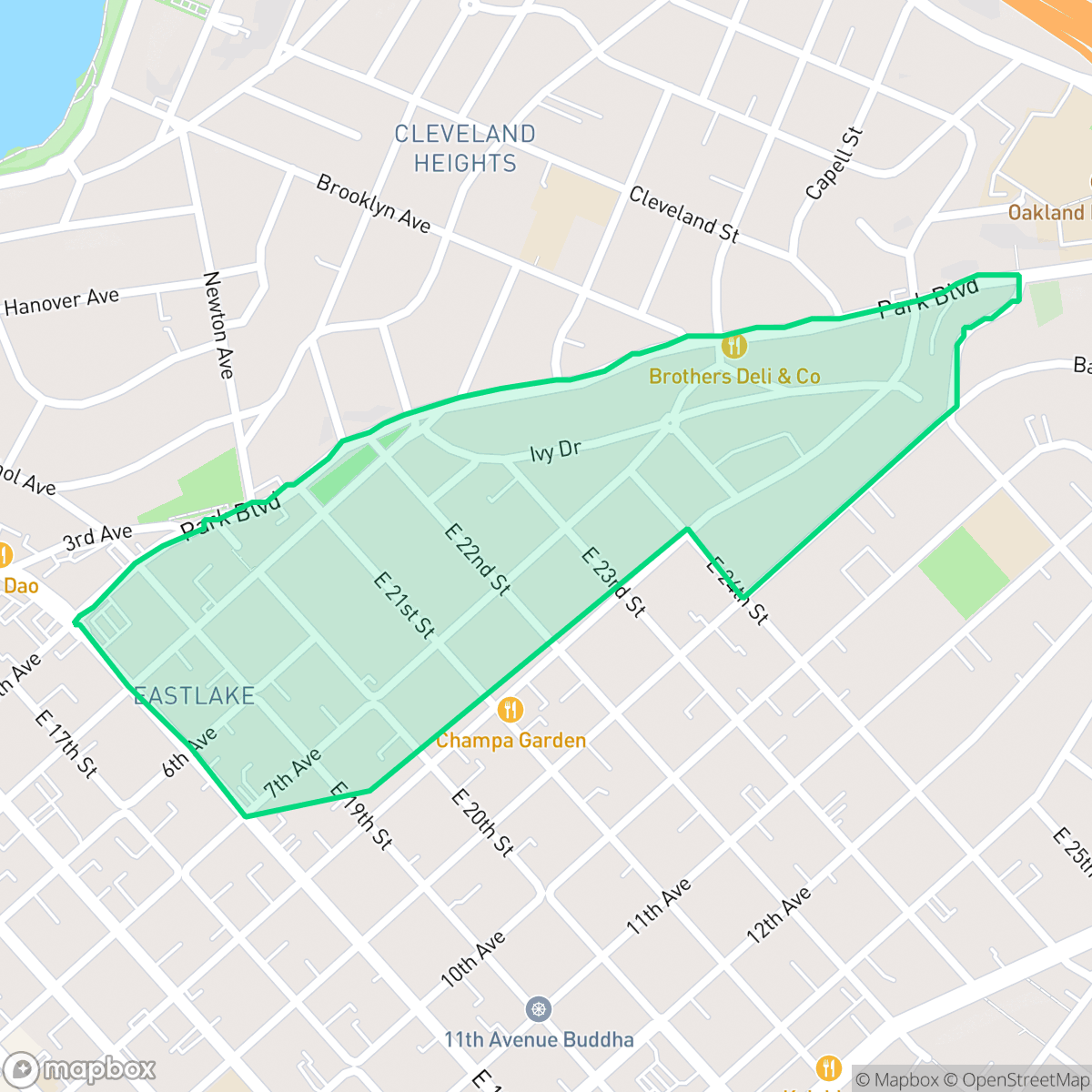
Located southeast of Lake Merritt, Oakland’s Ivy Hill neighborhood was once home to grand 19th-century estates. Its most famous landmark was Arbor Villa, a sprawling 50-acre, 42-room estate built in the 1890s by Francis Marion "Borax" Smith, which featured an observation tower and a miniature borax mine. While the mansion was demolished in 1931, its legacy survives in the historic, imported palm trees that still line Ninth Avenue. Named for Ivy Street, the neighborhood transitioned in the early-to-mid 20th century into a dense residential enclave. Today, Ivy Hill features a distinct architectural patchwork of early-1900s Victorians, Craftsman bungalows, and well-preserved vintage apartment buildings. This highly walkable, diverse community is also home to local landmarks like FM Smith Park and the renowned Laotian and Thai restaurant Champa Garden.
The neighborhood functions as a dense, urban residential environment that successfully avoids industrial hazards, creating a purely residential and light commercial atmosphere. Its grid system ensures excellent pedestrian access throughout the area, making it a highly convenient location for those who prefer to navigate the city on foot. According to iHuus data, the community maintains a consistent urban character that balances its quiet residential streets with access to local culinary landmarks and diverse dining options. It is a well-connected pocket of Oakland that benefits from its strategic location southeast of the lake.
Living in this area involves specific trade-offs, particularly regarding housing density and infrastructure. Because homes are often closely packed with shared walls, residents experience limited privacy and minimal private outdoor space. Furthermore, the local school district currently faces significant challenges, including budget deficits and maintenance backlogs, which may influence the experience of families in the district. According to iHuus, the neighborhood is best suited for individuals or households who prioritize walkability and proximity to central urban amenities over the seclusion of expansive private yards or suburban environments.
Neighborhood Scores Across 15 Qualities
Residential lots feature close proximity between homes with minimal separation between structures. According to iHuus data, this density results in less privacy than the Oakland average.
Pedestrian access is excellent due to a dense grid of continuous sidewalks and frequent, clear crosswalks. This level of connectivity for walkers and cyclists is even more pronounced here than in the rest of Oakland.
Typical tract housing dominates the area, featuring rectangular rooflines and small yards. This visual landscape is slightly less varied than the Oakland average according to iHuus data.
Narrow sidewalk verges and limited public green space make for fewer casual walking options, though nearby Lake Merritt and small urban pockets provide some access. According to iHuus data, overall dog friendliness is slightly below the Oakland average.
Residential streets and green spaces are distributed in equal measure, reflecting a landscape that is consistent with the Oakland average. According to iHuus data, the area features a blend of low-rise urban density and accessible parkland.
A steady rhythm of residential life and local dining exists alongside calmer, suburban blocks. According to iHuus data, the level of activity and service availability is slightly below the Oakland average.
Ongoing noise from nearby railroad tracks and major freeway corridors is a notable feature of this area. According to iHuus data, acoustic levels are slightly higher than the Oakland average.
Air quality remains consistently good with rare instances of elevated readings. Levels in Ivy Hill are largely comparable to the Oakland average, according to iHuus data.
No warehouses, heavy industrial facilities, or hazard sites are present in this area. According to iHuus data, the neighborhood is notably more free of industrial proximity than the Oakland average.
Health insurance access is strong among Ivy Hill residents, appearing slightly higher than the Oakland average according to iHuus data.
Voting patterns and census indicators reflect a deeply liberal political leaning, which is consistent with the broader Oakland area according to iHuus data.
Residents live alongside a balanced mix of young professionals, families, and older adults. This demographic distribution is largely in line with the broader Oakland area, according to iHuus data.
Frequent flooding risk exists because portions of the area fall within a designated floodplain; this level of risk is notably higher than the Oakland average. According to iHuus data, residents should expect that flood insurance is typically required for properties in this neighborhood.
Address-Level Insights for Ivy Hill


iHuus Neighborhood Intelligence Insights
Get address-level neighborhood insights for Ivy Hill
- Street-level scores — see how individual blocks compare, not just neighborhood averages
- Micro-zone boundaries — identify quiet pockets, flood boundaries, and walkable clusters before you visit
- 15 dimensions in full — walkability, noise, air quality, school quality, insurance coverage, population age profile, urban/rural index, and more
- Boundary risk alerts — know if your address sits near a block boundary where scores drop, the kind of detail no listing will ever mention
- School insights — individual school ratings and insights, not just district-level data
- Compare before you commit — side-by-side data across neighborhoods, down to block precision
No credit card required
Compare with Any Neighborhood
| Dimension | Ivy Hill | Acorn |
|---|---|---|
| 🚶 Walkabilityavg 8.99 | ||
| 🔊 Acoustic Comfortavg 3.24 | ||
| 🤫 Privacy Indexavg 3.74 | ||
| 🎨 Visual Appealavg 6.28 | ||
| 🐕 Dog Friendlinessavg 5.74 | ||
| 🗺️ Urban-Rural Indexavg 6.02 | ||
| ✨ Neighborhood Vibeavg 5.22 | ||
| 🏥 Health Insurance Coverageavg 7.4 | ||
| 🌿 Air Qualityavg 8.06 | ||
| 🏭 Industrial Proximityavg 8.37 | ||
| 🌊 Flood Safetyavg 2.61 | ||
| 🗳️ Ideological Leanavg 9.95 | ||
| 👥 Population Age Profileavg 4.92 | ||
| 🔥 Fire Safetyavg 0.17 | ||
| 🏫 School Quality |
Ivy Hill Rankings
School Districts Serving Ivy Hill
School Insights for Ivy Hill
Below average outcomes; significant attendance and academic challenges.
School Insights
See what's really behind every school rating near Ivy Hill
- Individual school ratings — each school's own score with outcome context, not just a district average
- Enrollment & class size data — student-to-teacher ratio and how it compares to the state average
- Full demographics breakdown — ethnicity and gender composition for every school in the enrollment zone
- Every school in the district — all schools within the enrollment boundary ranked by rating, not just the closest one
- Grade levels & benchmarks — elementary through high school, with below/above state-average flags
No credit card required