Hoover-Foster, Oakland
Updated · 3,904 residents
Hoover-Foster is a dense, highly walkable urban neighborhood in West Oakland defined by its consistent grid layout and historic Victorian architecture. While residents benefit from excellent air quality and easy access to local dining, the area experiences noticeable road noise and limited public green space.
Key Highlights
About Hoover-Foster
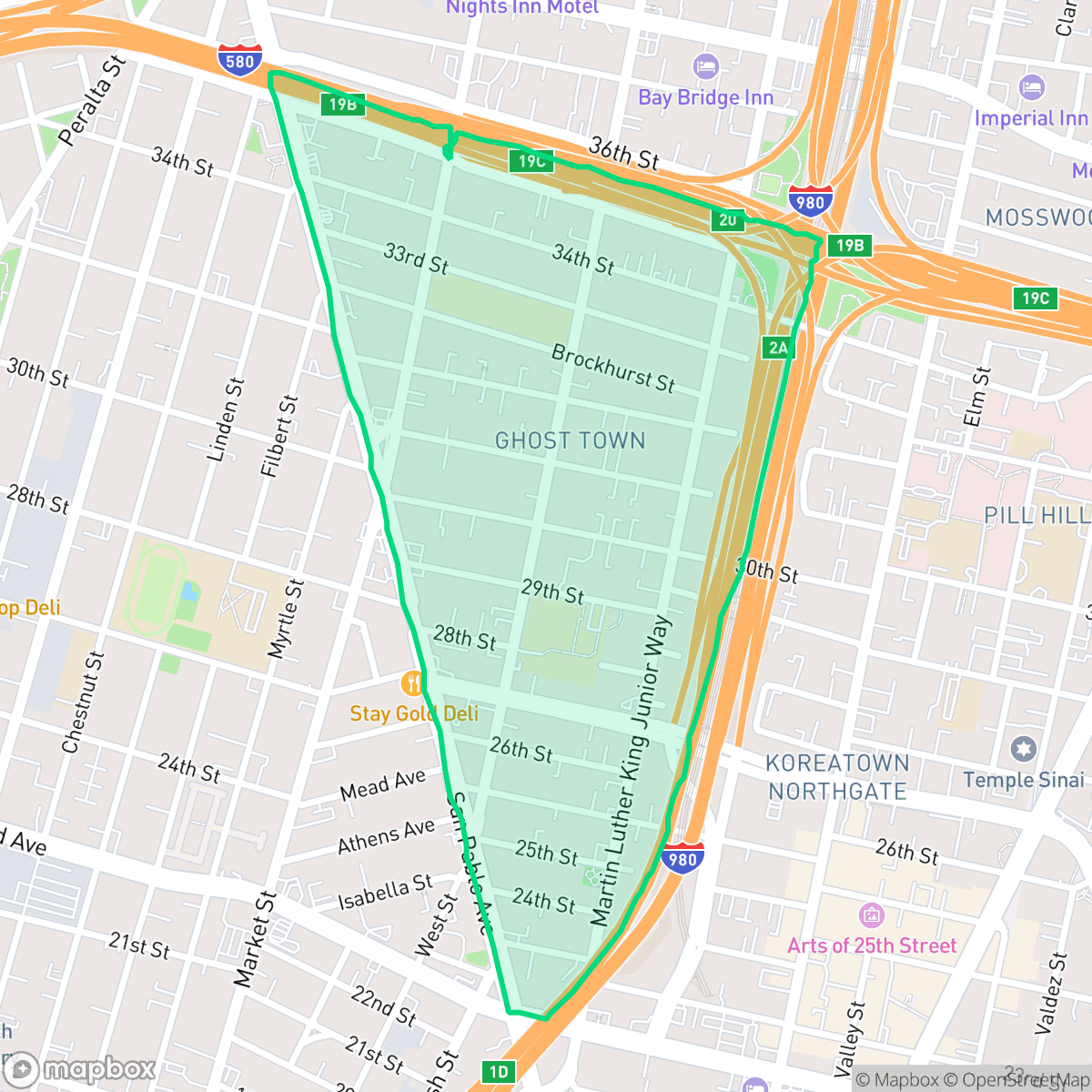
The Hoover-Foster neighborhood in West Oakland, historically known as "Ghost Town," is a culturally rich district named after Hoover Junior High and Marcus Foster Middle School. Developed primarily before 1940, the neighborhood boasts a high concentration of historic Victorian-era homes. During the mid-20th century, it became a vital hub for African American migrants fleeing the Jim Crow South to work in East Bay shipyards or as Pullman Porters, fostering a legacy of Black self-determination and civil rights activism. However, mid-century freeway construction heavily fractured the community, displacing thousands of residents. Today, Hoover-Foster’s resilient cultural identity is celebrated through initiatives like the Black Liberation Walking Tour, vibrant street murals along Martin Luther King Jr. Way, and local urban agriculture projects like Ghost Town Farms.
The neighborhood functions as a compact residential grid where high walkability makes daily errands manageable on foot. The built environment consists of standard middle-class housing on small lots, creating a dense atmosphere where homes are often positioned close to one another. Despite its urban density, the area maintains a distinct character through its mix of residential streets and light industrial pockets that host local businesses such as Stay Gold Deli and Nib's Restaurant.
Prospective residents should consider the trade-offs of living in this central location. The proximity to major transit corridors results in elevated traffic noise levels, and the lack of public parks may be challenging for pet owners. While the air quality is excellent, the broader school district faces ongoing institutional challenges that impact local academic options. This neighborhood is best suited for those who prioritize a central, highly walkable location over quiet suburban amenities or expansive private yards.
Neighborhood Scores Across 15 Qualities
Residential structures are positioned in close proximity with minimal separation between properties. According to iHuus data, this density of housing results in a sense of seclusion that is slightly lower than the Oakland average.
Pedestrians benefit from a consistent grid of wide sidewalks on both sides of most streets and numerous clear crossings. This level of accessibility is even higher than the Oakland average, according to iHuus data.
Standard housing layouts feature simple roof geometries and small yards without private luxury amenities. This visual profile is less varied than the Oakland average, according to iHuus data.
Minimal public green space and narrow sidewalks make walking dogs difficult, as most vegetation is restricted to private, fenced backyards. According to iHuus data, this environment offers significantly fewer opportunities for outdoor pet exercise than the Oakland average.
Characterized by a dense urban grid, this area features a blend of multi-story apartments and single-family homes. According to iHuus data, the landscape is more urbanized than the Oakland average, with a significant presence of commercial blocks and highway-adjacent developments.
Frequent movement and a high concentration of diverse dining and local eateries create a more energetic atmosphere than the Oakland average. According to iHuus data, the area features lively blocks centered around various social hubs and urban landscapes.
Frequent noise from nearby freeway and railroad corridors makes this area significantly louder than the Oakland average. According to iHuus data, residents may experience persistent acoustic disturbances throughout the day.
Air quality remains consistently high and presents little to no health concern. According to iHuus data, the air quality in this area is notably better than the Oakland average.
Residential life is largely separated from heavy industry, though some commercial warehouses and a nearby EPA Superfund site exist. According to iHuus data, this area contains fewer industrial hazards than the Oakland average.
Health insurance coverage among residents is notably lower than the Oakland average. According to iHuus data, a significant portion of the population lacks employer or private medical coverage.
Voting patterns and census indicators reflect a predominantly liberal political landscape, which is consistent with the broader Oakland area according to iHuus data.
A balanced distribution of young adults, families, and older residents characterizes this area. This age profile is consistent with the broader Oakland average, according to iHuus data.
Address-Level Insights for Hoover-Foster


iHuus Neighborhood Intelligence Insights
Get address-level neighborhood insights for Hoover-Foster
- Street-level scores — see how individual blocks compare, not just neighborhood averages
- Micro-zone boundaries — identify quiet pockets, flood boundaries, and walkable clusters before you visit
- 15 dimensions in full — walkability, noise, air quality, school quality, insurance coverage, population age profile, urban/rural index, and more
- Boundary risk alerts — know if your address sits near a block boundary where scores drop, the kind of detail no listing will ever mention
- School insights — individual school ratings and insights, not just district-level data
- Compare before you commit — side-by-side data across neighborhoods, down to block precision
No credit card required
Compare with Any Neighborhood
| Dimension | Hoover-Foster | Acorn |
|---|---|---|
| 🚶 Walkabilityavg 8.99 | ||
| 🔊 Acoustic Comfortavg 3.24 | ||
| 🤫 Privacy Indexavg 3.74 | ||
| 🎨 Visual Appealavg 6.28 | ||
| 🐕 Dog Friendlinessavg 5.74 | ||
| 🗺️ Urban-Rural Indexavg 6.02 | ||
| ✨ Neighborhood Vibeavg 5.22 | ||
| 🏥 Health Insurance Coverageavg 7.4 | ||
| 🌿 Air Qualityavg 8.06 | ||
| 🏭 Industrial Proximityavg 8.37 | ||
| 🌊 Flood Safetyavg 2.61 | ||
| 🗳️ Ideological Leanavg 9.95 | ||
| 👥 Population Age Profileavg 4.92 | ||
| 🔥 Fire Safetyavg 0.17 | ||
| 🏫 School Quality |
Hoover-Foster Rankings
School Districts Serving Hoover-Foster
School Insights for Hoover-Foster
Below average outcomes; significant attendance and academic challenges.
School Insights
See what's really behind every school rating near Hoover-Foster
- Individual school ratings — each school's own score with outcome context, not just a district average
- Enrollment & class size data — student-to-teacher ratio and how it compares to the state average
- Full demographics breakdown — ethnicity and gender composition for every school in the enrollment zone
- Every school in the district — all schools within the enrollment boundary ranked by rating, not just the closest one
- Grade levels & benchmarks — elementary through high school, with below/above state-average flags
No credit card required