Hiller Highlands, Oakland
Updated · 878 residents
Hiller Highlands is a quiet, low-density residential enclave in the Oakland Hills known for its panoramic bay views and abundant open space. While the area offers excellent air quality and a high degree of dog friendliness, residents should expect limited walkability and noticeable noise from nearby highway traffic.
Key Highlights
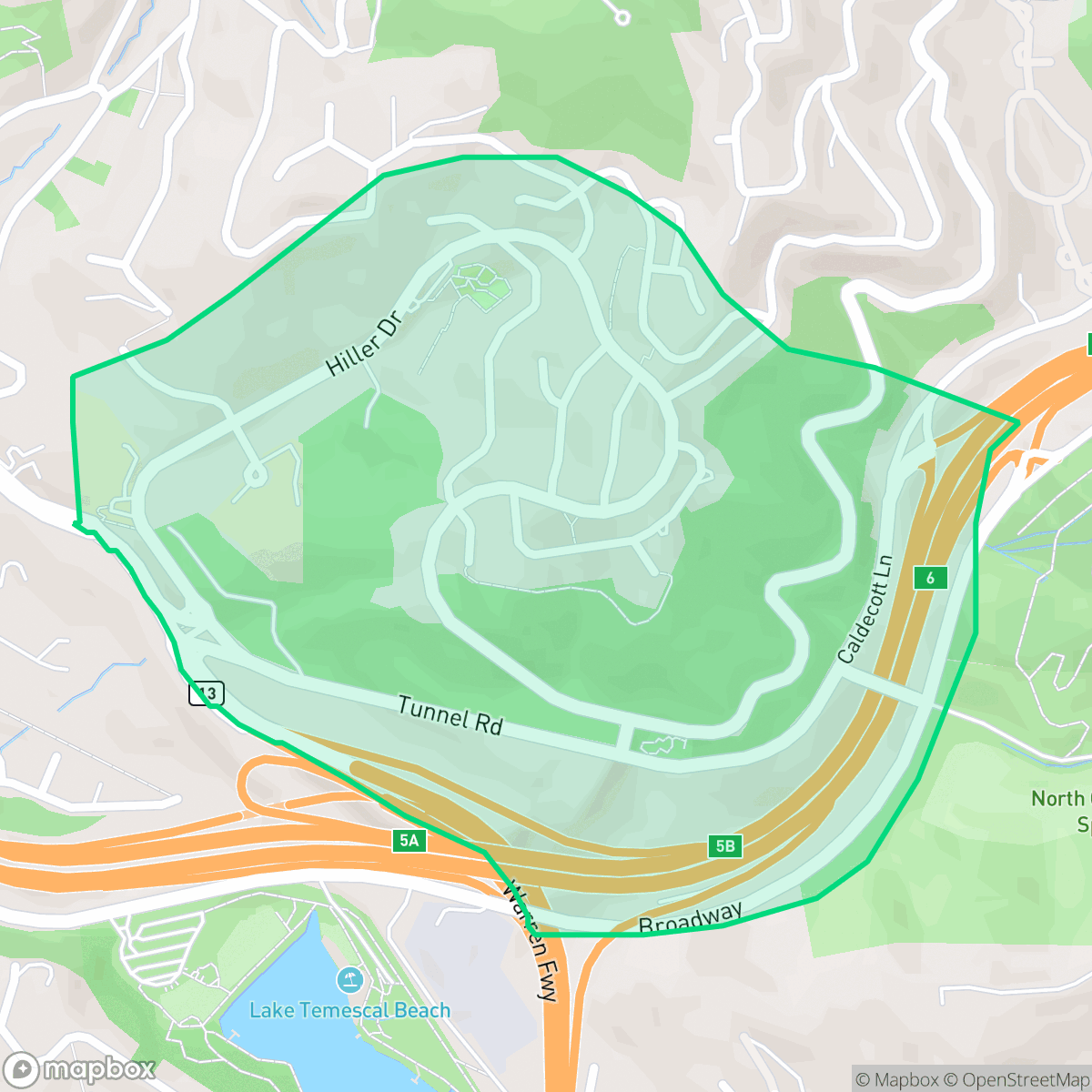
About Hiller Highlands
Located in the Oakland Hills, Hiller Highlands originated as the estate of inventor Stanley Hiller, Sr. In the 1950s, Hiller sought to prove the viability of his patented single-channel underground utility system by dividing his hillside property into 27 lots. Despite initial resistance from PG&E, utility connections were established in 1963, launching the neighborhood's development. Hiller’s historic mansion survived and now serves as the main building for the Bentley School. Originally built with townhouses and single-family homes along steep canyon inclines, the entire neighborhood was tragically destroyed in the 1991 Oakland-Berkeley Firestorm. Hiller Highlands was subsequently rebuilt with modern, fire-resistant materials like stucco, concrete, and metal, while preserving its signature panoramic views of the San Francisco Bay.
The neighborhood is defined by its secluded, hillside character and significant visual appeal, offering residents a tranquil environment removed from the dense urban core. According to iHuus data, the area maintains exceptional air quality and high levels of industrial isolation, making it a preferred location for those who prioritize privacy and proximity to nature over immediate access to commercial amenities. The landscape is characterized by scattered, modern structures integrated into steep, natural terrain, which preserves a sense of openness and provides expansive vistas of the San Francisco Bay.
Neighborhood Scores Across 15 Qualities
Residential spacing offers a reasonable buffer between neighbors, which is notably higher than the Oakland average. According to iHuus data, the area features a mixed density that balances closeness with some degree of separation.
Quiet streets provide a calm environment for walking, but the lack of sidewalks makes the area significantly less walkable than the Oakland average.
Large residences and well-maintained amenities create a highly attractive streetscape that is notably more polished than the Oakland average. According to iHuus data, the area features expansive driveways and frequent upscale infrastructure.
Extensive parklands, trails, and open spaces provide significantly more room for pets than the Oakland average. According to iHuus data, this area offers abundant opportunities for outdoor activity and exercise.
Dense vegetation and forested terrain characterize this area, offering a much more rural atmosphere than the Oakland average. According to iHuus data, the landscape is dominated by natural greenery and minimal built-up infrastructure.
Low density and significant open space create a much calmer environment than the Oakland average. Most areas consist of scattered structures and light industrial units near major highways, offering very little local commercial activity or social bustle.
Frequent auditory disturbances from nearby freeway and rail corridors are common here; according to iHuus data, these noise levels are significantly higher than the Oakland average.
Air quality is exceptionally high here, providing a much cleaner environment than the Oakland average. Residents can expect minimal exposure to pollutants and very few health concerns related to air particulate matter.
Industrial presence is virtually nonexistent here, offering a cleaner environment than the Oakland average. According to iHuus data, the area consists of residential streets and green spaces without proximity to warehouses or hazard sites.
Health insurance access is exceptionally high among residents, significantly surpassing the Oakland average according to iHuus data.
Voting patterns and census indicators show a predominantly liberal political leaning that is slightly more pronounced than the Oakland average.
A balanced demographic of young adults, families, and older residents characterizes this area. According to iHuus data, the community shows a more varied age distribution than the Oakland average.
Flood risk is significantly lower here than the Oakland average, though some residual risk remains within the 500-year floodplain according to iHuus data.
Significant fire hazards exist in this area, representing a much higher risk than the average Oakland neighborhood according to iHuus data.
Address-Level Insights for Hiller Highlands


iHuus Neighborhood Intelligence Insights
Get address-level neighborhood insights for Hiller Highlands
- Street-level scores — see how individual blocks compare, not just neighborhood averages
- Micro-zone boundaries — identify quiet pockets, flood boundaries, and walkable clusters before you visit
- 15 dimensions in full — walkability, noise, air quality, school quality, insurance coverage, population age profile, urban/rural index, and more
- Boundary risk alerts — know if your address sits near a block boundary where scores drop, the kind of detail no listing will ever mention
- School insights — individual school ratings and insights, not just district-level data
- Compare before you commit — side-by-side data across neighborhoods, down to block precision
No credit card required
Compare with Any Neighborhood
| Dimension | Hiller Highlands | Acorn |
|---|---|---|
| 🚶 Walkabilityavg 8.99 | ||
| 🔊 Acoustic Comfortavg 3.24 | ||
| 🤫 Privacy Indexavg 3.74 | ||
| 🎨 Visual Appealavg 6.28 | ||
| 🐕 Dog Friendlinessavg 5.74 | ||
| 🗺️ Urban-Rural Indexavg 6.02 | ||
| ✨ Neighborhood Vibeavg 5.22 | ||
| 🏥 Health Insurance Coverageavg 7.4 | ||
| 🌿 Air Qualityavg 8.06 | ||
| 🏭 Industrial Proximityavg 8.37 | ||
| 🌊 Flood Safetyavg 2.61 | ||
| 🗳️ Ideological Leanavg 9.95 | ||
| 👥 Population Age Profileavg 4.92 | ||
| 🔥 Fire Safetyavg 0.17 | ||
| 🏫 School Quality |
Hiller Highlands Rankings
School Districts Serving Hiller Highlands
School Insights for Hiller Highlands
Below average outcomes; significant attendance and academic challenges.
School Insights
See what's really behind every school rating near Hiller Highlands
- Individual school ratings — each school's own score with outcome context, not just a district average
- Enrollment & class size data — student-to-teacher ratio and how it compares to the state average
- Full demographics breakdown — ethnicity and gender composition for every school in the enrollment zone
- Every school in the district — all schools within the enrollment boundary ranked by rating, not just the closest one
- Grade levels & benchmarks — elementary through high school, with below/above state-average flags
No credit card required