Highland Terrace, Oakland
Updated · 4,178 residents
Highland Terrace is a highly walkable, dense urban neighborhood characterized by its historic architecture and grid-based street layout. Residents benefit from excellent air quality and a lack of industrial proximity, though the area faces challenges regarding local school district performance and environmental safety risks.
Key Highlights
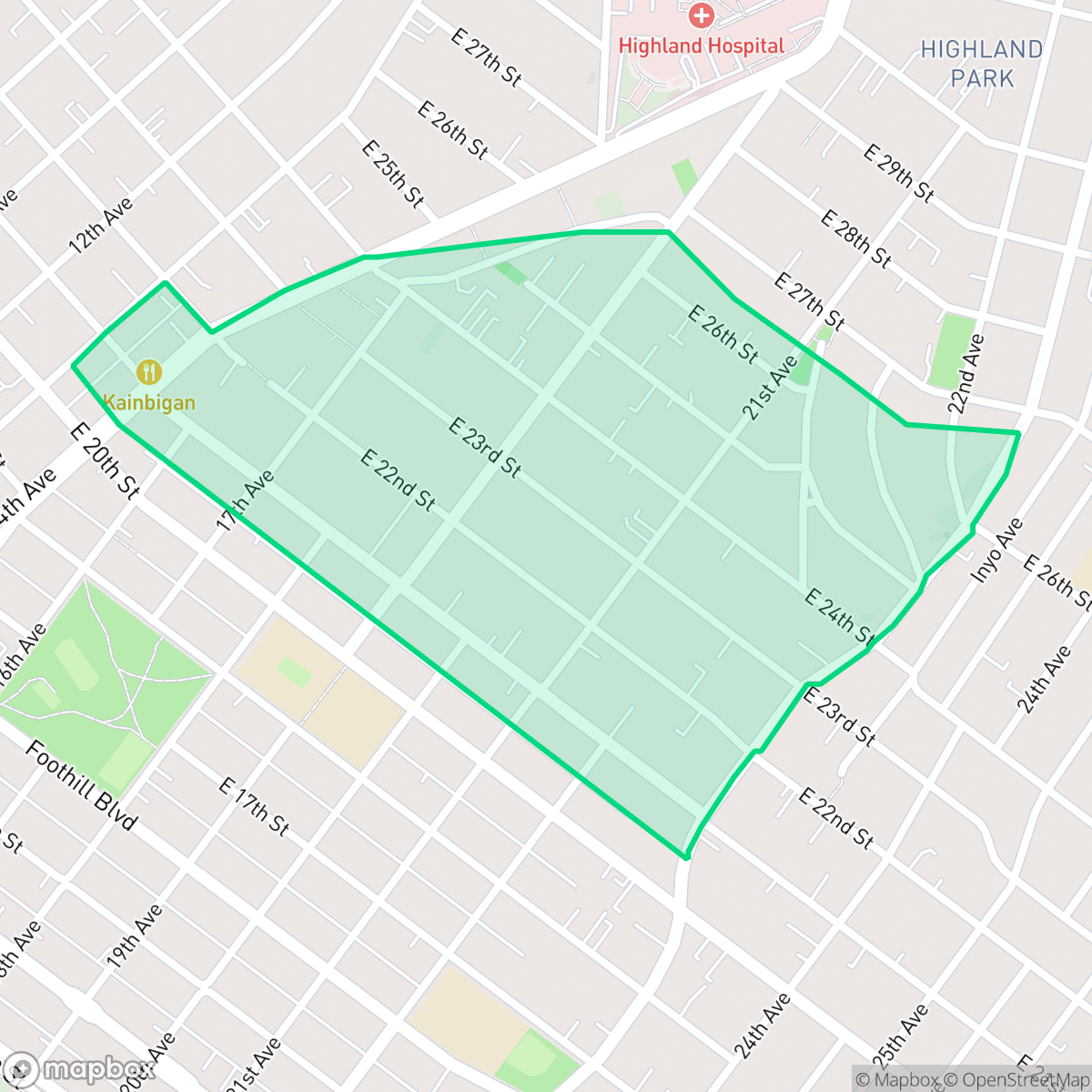
About Highland Terrace
Highland Terrace, a historic and densely populated neighborhood in Oakland, California, is bounded by East 21st Street, 14th Avenue, East 27th Street, and 23rd Avenue. Developed primarily in the early 20th century, the neighborhood features a diverse stock of antique residential architecture, including classic Craftsman bungalows, Mediterranean Revivals, and a unique cluster of ten "French-style" homes resembling a Normandy village near East 23rd Street and 19th Avenue. Positioned just south of Highland Hospital, the area is anchored by local public spaces like the Manzanita Recreation Center and Morgan Plaza. Historically a working-class enclave, Highland Terrace is recognized for its rich cultural diversity, notably hosting a prominent Asian-American community with a significant population of Cambodian (Mon-Khmer) speakers alongside residents of Sub-Saharan African heritage.
The area functions as a quiet residential enclave with a high building-to-land ratio, offering a consistent urban experience. According to iHuus data, the neighborhood maintains a perfect walkability score due to its accessible grid and well-maintained sidewalks. While the streets are relatively calm, the proximity of homes creates a dense living environment where private outdoor space is limited. The lack of heavy industry contributes to a clean air environment, making it a distinct pocket within the broader Oakland landscape.
Prospective residents should consider the trade-offs of living in this historic district. While the area offers a strong sense of community and architectural charm, the local school district is currently managing significant budget deficits and academic performance challenges. Additionally, the neighborhood faces elevated risks concerning flood and fire safety. It is best suited for those who prioritize pedestrian access and a central location over expansive private yards or immediate access to commercial amenities.
Neighborhood Scores Across 15 Qualities
Residential structures are situated in close quarters with minimal separation between homes. This density is slightly higher than the Oakland average, as many houses share property lines or are separated by very narrow gaps.
Pedestrians benefit from an excellent sidewalk network and frequent marked crosswalks throughout the residential blocks. This level of accessibility to the street grid is even higher than the Oakland average, according to iHuus data.
Standard tract-style homes with small yards and boxy roofs characterize the area. This level of visual variety is slightly below the Oakland average.
Access to public pet space is below the Oakland average, as most greenery is contained within private backyards. While a central park offers some walking paths, many residential streets feature narrow sidewalk verges and limited public park access according to iHuus data.
Residential streets and green spaces are distributed in roughly equal measure, mirroring the broader urban density found across Oakland. The area features a dense, low-rise environment characterized by a mix of single-family homes and multi-unit structures.
A mix of quiet residential blocks and occasional social hubs defines the area, though it offers slightly less commercial activity than the Oakland average. While some pockets feature local dining and churches, many daily errands may require a short drive due to the limited number of walkable businesses.
Steady traffic sounds from nearby busy streets are present, though the acoustic environment is notably quieter than the Oakland average.
Air quality remains consistently high with rare instances of elevated readings, performing nearly in line with the Oakland average according to iHuus data.
Heavy industry is absent from the neighborhood, though some light commercial zones and warehouse structures are located near major transit corridors. According to iHuus data, there is a slightly higher presence of commercial activity and associated noise compared to the Oakland average.
Health insurance access among residents is lower than the Oakland average, according to iHuus data.
Voting patterns and census indicators show a deeply liberal political landscape that is consistent with the rest of Oakland. Residents can expect a community with political views that align closely with the city average.
Residents live alongside a balanced distribution of young professionals, families, and seniors. This demographic spread is roughly in line with the overall Oakland average, according to iHuus data.
Address-Level Insights for Highland Terrace


iHuus Neighborhood Intelligence Insights
Get address-level neighborhood insights for Highland Terrace
- Street-level scores — see how individual blocks compare, not just neighborhood averages
- Micro-zone boundaries — identify quiet pockets, flood boundaries, and walkable clusters before you visit
- 15 dimensions in full — walkability, noise, air quality, school quality, insurance coverage, population age profile, urban/rural index, and more
- Boundary risk alerts — know if your address sits near a block boundary where scores drop, the kind of detail no listing will ever mention
- School insights — individual school ratings and insights, not just district-level data
- Compare before you commit — side-by-side data across neighborhoods, down to block precision
No credit card required
Compare with Any Neighborhood
| Dimension | Highland Terrace | Acorn |
|---|---|---|
| 🚶 Walkabilityavg 8.99 | ||
| 🔊 Acoustic Comfortavg 3.24 | ||
| 🤫 Privacy Indexavg 3.74 | ||
| 🎨 Visual Appealavg 6.28 | ||
| 🐕 Dog Friendlinessavg 5.74 | ||
| 🗺️ Urban-Rural Indexavg 6.02 | ||
| ✨ Neighborhood Vibeavg 5.22 | ||
| 🏥 Health Insurance Coverageavg 7.4 | ||
| 🌿 Air Qualityavg 8.06 | ||
| 🏭 Industrial Proximityavg 8.37 | ||
| 🌊 Flood Safetyavg 2.61 | ||
| 🗳️ Ideological Leanavg 9.95 | ||
| 👥 Population Age Profileavg 4.92 | ||
| 🔥 Fire Safetyavg 0.17 | ||
| 🏫 School Quality |
Highland Terrace Rankings
School Districts Serving Highland Terrace
School Insights for Highland Terrace
Below average outcomes; significant attendance and academic challenges.
School Insights
See what's really behind every school rating near Highland Terrace
- Individual school ratings — each school's own score with outcome context, not just a district average
- Enrollment & class size data — student-to-teacher ratio and how it compares to the state average
- Full demographics breakdown — ethnicity and gender composition for every school in the enrollment zone
- Every school in the district — all schools within the enrollment boundary ranked by rating, not just the closest one
- Grade levels & benchmarks — elementary through high school, with below/above state-average flags
No credit card required