Highland Park, Oakland
Updated · 1,532 residents
Highland Park is a quiet, highly walkable residential area defined by its dense collection of early twentieth-century cottages and bungalows. While the neighborhood offers clean air and a strong sense of community, residents should be aware of the high flood risk and limited access to public green spaces.
Key Highlights
About Highland Park
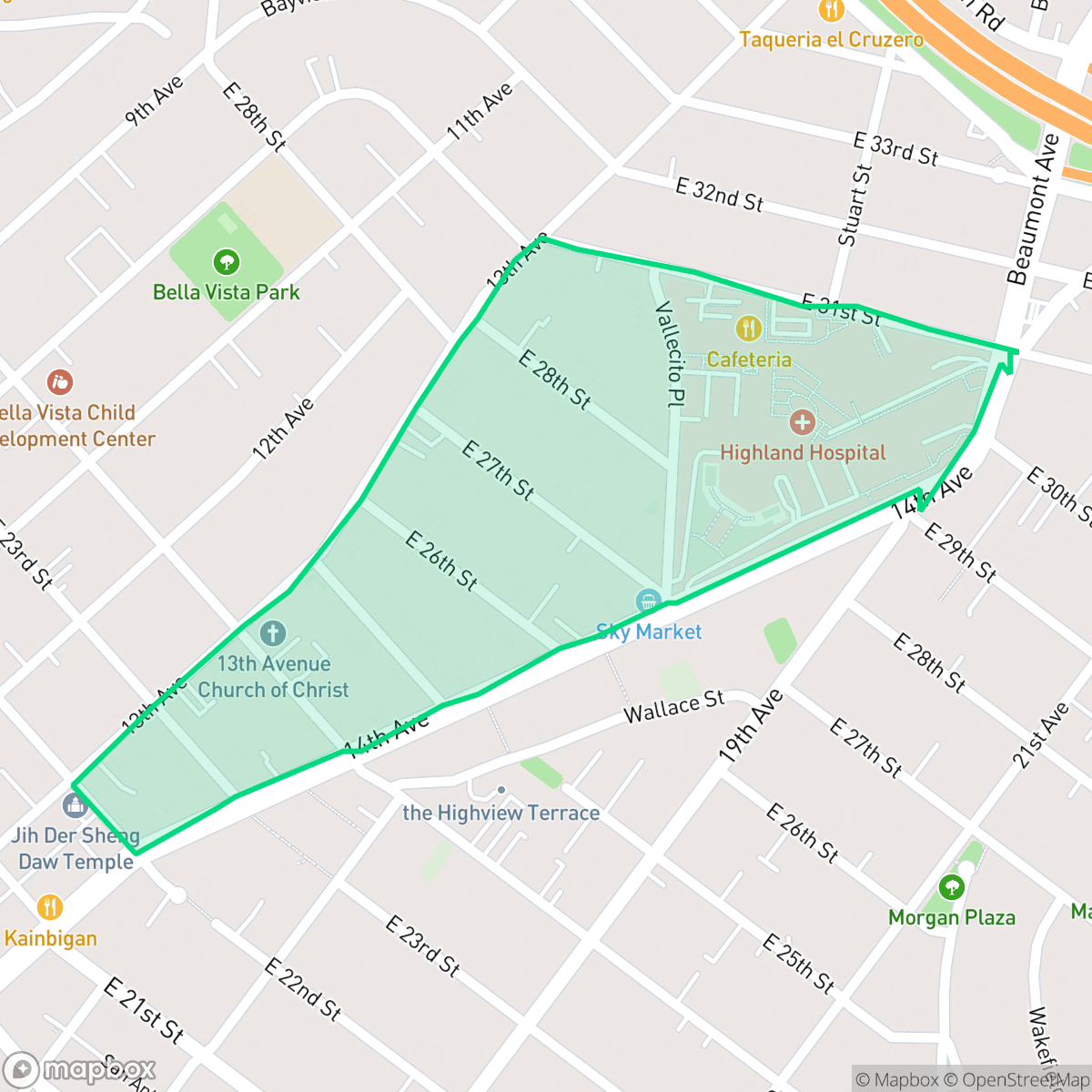
Highland Park, a neighborhood in Oakland, California, traces its origins to 1871 when E.C. Sessions first offered land tracts for development. Historically, the area was part of the town of Lynn, which later merged into the town of Brooklyn. The neighborhood is defined by its proximity to Highland Hospital, an institution that took its name from the surrounding community, which predates the hospital by over fifty years. The architectural character of the district features a blend of early-1900s cottages and 1920s bungalows. While the neighborhood has evolved into a utilitarian, medical-focused residential area, it maintains historical ties to Oakland's early expansion as part of the broader Brooklyn Township development.
The neighborhood maintains a consistent suburban feel characterized by its uniform, low-rise housing stock and a lack of heavy industrial presence. It is a predominantly liberal community where the street grid is designed for pedestrian ease, featuring continuous sidewalks and frequent crossings that make local navigation straightforward according to iHuus data. The visual landscape remains consistent, with small yards and closely packed homes that create a tight-knit residential environment.
Potential residents should consider that the area is situated within a designated floodplain, which may impact insurance requirements. While the internal street network is highly accessible, the neighborhood relies on a car for most commercial amenities, as local businesses are sparse. Furthermore, families should note that local schools within the Oakland Unified School District currently face significant budget instability and administrative challenges. This area is best suited for those who value a quiet, pedestrian-friendly residential environment and are prepared to manage the specific logistical considerations of living in a dense, flood-prone zone.
Neighborhood Scores Across 15 Qualities
Residential structures in this area are densely packed with minimal separation between adjacent homes. According to iHuus data, this level of density is slightly higher than the Oakland average.
Pedestrian infrastructure is exceptionally strong, featuring a continuous sidewalk grid and frequent marked crossings that surpass the Oakland average. Most residential blocks offer wide, well-connected paths on both sides of the street, though the nearby freeway corridor creates a significant break in the network.
Standard tract-style homes with small yards and uniform rooflines characterize this area. The visual landscape is slightly less varied than the Oakland average, as the neighborhood lacks large private amenities or luxury estates.
Public access to open green space is below the Oakland average, as much of the neighborhood's vegetation is confined to private backyards. While a central park offers some walking paths, many residential streets feature narrow sidewalks with minimal grassy verges.
Residential streets and green spaces are present in roughly equal measure, creating a landscape that is slightly less dense than the Oakland average. According to iHuus data, the area features a mix of single-family homes and multi-unit structures within a low-rise urban fabric.
Residential blocks offer a mix of calm streets and greenery, though the area feels slightly less active than the Oakland average. While unique dining options exist, many amenities require a car as there are few businesses within walking distance.
Steady hum from nearby busy streets creates a consistent acoustic presence, though levels are notably quieter than the Oakland average.
Air quality remains consistently high with infrequent periods of poor ventilation. According to iHuus data, levels are largely comparable to the Oakland city average.
Residential and light commercial uses dominate the area, with no visible warehouses, heavy industrial chimneys, or hazardous facilities detected. This neighborhood maintains a higher level of industrial separation than the Oakland average according to iHuus data.
Health insurance access among Highland Park residents is slightly lower than the Oakland average, according to iHuus data.
Voting patterns and census indicators show a predominantly liberal political landscape that is slightly more pronounced than the Oakland city average, according to iHuus data.
A varied mix of young adults, families, and older residents characterizes this area. According to iHuus data, this demographic distribution is largely consistent with the broader Oakland area.
Properties in this area are located within a designated floodplain, which indicates a significantly higher risk of flooding compared to the Oakland average. According to iHuus data, residents should be aware that flood insurance is typically required for homes in this zone.
Address-Level Insights for Highland Park


iHuus Neighborhood Intelligence Insights
Get address-level neighborhood insights for Highland Park
- Street-level scores — see how individual blocks compare, not just neighborhood averages
- Micro-zone boundaries — identify quiet pockets, flood boundaries, and walkable clusters before you visit
- 15 dimensions in full — walkability, noise, air quality, school quality, insurance coverage, population age profile, urban/rural index, and more
- Boundary risk alerts — know if your address sits near a block boundary where scores drop, the kind of detail no listing will ever mention
- School insights — individual school ratings and insights, not just district-level data
- Compare before you commit — side-by-side data across neighborhoods, down to block precision
No credit card required
Compare with Any Neighborhood
| Dimension | Highland Park | Acorn |
|---|---|---|
| 🚶 Walkabilityavg 8.99 | ||
| 🔊 Acoustic Comfortavg 3.24 | ||
| 🤫 Privacy Indexavg 3.74 | ||
| 🎨 Visual Appealavg 6.28 | ||
| 🐕 Dog Friendlinessavg 5.74 | ||
| 🗺️ Urban-Rural Indexavg 6.02 | ||
| ✨ Neighborhood Vibeavg 5.22 | ||
| 🏥 Health Insurance Coverageavg 7.4 | ||
| 🌿 Air Qualityavg 8.06 | ||
| 🏭 Industrial Proximityavg 8.37 | ||
| 🌊 Flood Safetyavg 2.61 | ||
| 🗳️ Ideological Leanavg 9.95 | ||
| 👥 Population Age Profileavg 4.92 | ||
| 🔥 Fire Safetyavg 0.17 | ||
| 🏫 School Quality |
Highland Park Rankings
School Districts Serving Highland Park
School Insights for Highland Park
Below average outcomes; significant attendance and academic challenges.
School Insights
See what's really behind every school rating near Highland Park
- Individual school ratings — each school's own score with outcome context, not just a district average
- Enrollment & class size data — student-to-teacher ratio and how it compares to the state average
- Full demographics breakdown — ethnicity and gender composition for every school in the enrollment zone
- Every school in the district — all schools within the enrollment boundary ranked by rating, not just the closest one
- Grade levels & benchmarks — elementary through high school, with below/above state-average flags
No credit card required