Hegenberger, Oakland
Updated · 1,659 residents
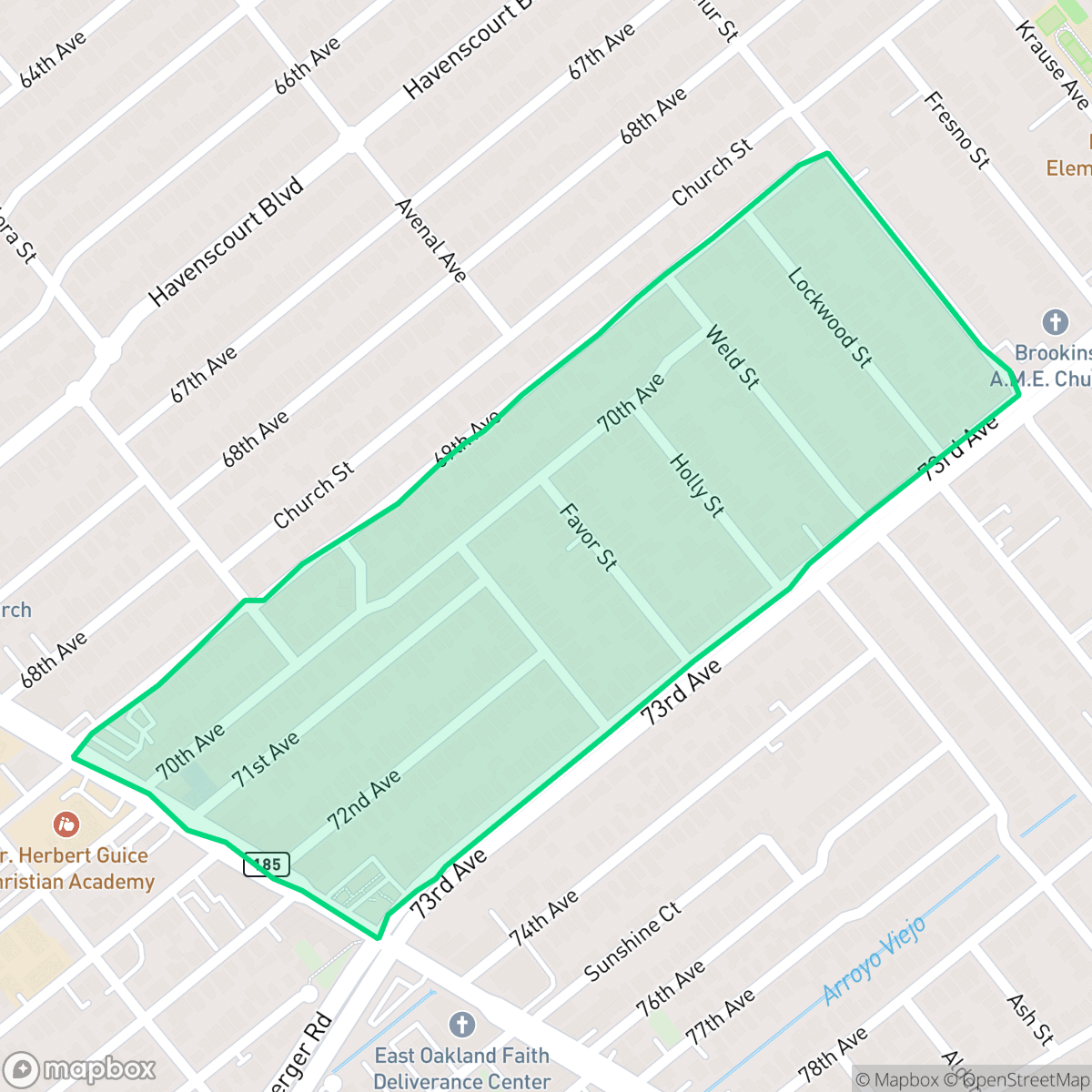
Hegenberger is a highly walkable, dense urban neighborhood in East Oakland defined by its proximity to major transit corridors and the airport. While the area offers convenient access to local amenities, residents experience significant noise from constant road traffic and limited access to public green space.
Key Highlights
About Hegenberger
Named after Lieutenant Albert F. Hegenberger, who co-piloted the historic first transpacific flight from Oakland to Hawaii in 1927, the Hegenberger neighborhood in East Oakland is a transit-oriented corridor with a rich industrial and residential history. Originally consisting of pre-1960 single-family homes and duplexes, the area underwent a major transformation in the 1960s. The construction of the Hegenberger Expressway, designed to connect Interstate 880 to the expanding Oakland International Airport, alongside the development of the Oakland Coliseum and BART station, led to the demolition of many local homes and buildings. Historically, the neighborhood has been a hub for industrial businesses, such as the century-old American Brass & Iron Foundry. In recent years, the Hegenberger Corridor has navigated economic transitions and environmental advocacy efforts led by local community organizations.
The area functions as a compact residential grid characterized by tightly packed single-family homes and duplexes. Its layout supports high pedestrian accessibility, with consistent sidewalks and clear intersections throughout the neighborhood. Local landmarks and service points, such as El Tacostao and the Lucky Dragon Cafe, provide neighborhood-level convenience, while the proximity to the Hegenberger Expressway ensures rapid transit connectivity for commuters heading toward the airport or the broader Bay Area.
Prospective residents should consider the trade-offs associated with this urban environment. The neighborhood experiences elevated noise levels primarily due to heavy road traffic, and the lack of public parks or spacious yards makes it less suitable for pet owners. Furthermore, the local school district faces systemic challenges, and the area carries higher risks related to flood and fire safety. It is best suited for individuals who prioritize transit accessibility and a central location over quiet surroundings or expansive outdoor amenities.
Neighborhood Scores Across 15 Qualities
Residential structures often feature very narrow separations between property lines, resulting in less privacy than the Oakland average. Many homes in this area are positioned in close quarters with minimal distance between adjacent buildings.
Pedestrian movement is easy due to a consistent grid system with wide sidewalks on both sides of most streets. According to iHuus data, the neighborhood features more marked crossings and pedestrian-priority areas than the Oakland average.
Standard tract housing characterizes this area with uniform rooflines and small yards. According to iHuus data, the visual landscape is slightly less diverse than the Oakland average.
Finding space for walks can be challenging due to narrow sidewalks and a lack of accessible public parks within the residential grid. According to iHuus data, the availability of green space for dogs is below the Oakland average.
Street layouts and green spaces are distributed in roughly equal measure, though the area feels more suburban than the denser Oakland average. According to iHuus data, the landscape is characterized by a mix of low-rise residential structures and developed commercial zones.
Mixed-use streets provide a balanced mix of residential life and light industrial units, though the overall activity level sits slightly below the Oakland average. Local dining options and community hubs offer a calm but functional environment for daily errands.
Frequent disturbances from nearby flight paths, railroad tracks, and freeway traffic characterize this area. According to iHuus data, acoustic comfort is slightly lower than the Oakland average.
Air quality levels fluctuate between acceptable and unhealthy ranges, presenting occasional concerns for sensitive groups. This visibility and air cleanliness is lower than the Oakland average, according to iHuus data.
Light industrial and warehouse facilities are interspersed with residential areas, resulting in lower levels of industrial density than the Oakland average. Residents may encounter increased truck traffic and noise from nearby loading docks and large commercial buildings.
Health insurance accessibility is notably higher than the Oakland average, according to iHuus data. Most residents in this area maintain active health coverage.
Voting patterns and census indicators show a very strong liberal leaning that is slightly above the Oakland average, according to iHuus data.
Residents of all ages live here, ranging from young adults to seniors. This age distribution is slightly lower than the Oakland average, indicating a less even spread of age groups across the area.
Flood vulnerability in this area is significantly higher than the Oakland average, according to iHuus data. Residents may face increased risks during heavy rain events or coastal surges.
Address-Level Insights for Hegenberger


iHuus Neighborhood Intelligence Insights
Get address-level neighborhood insights for Hegenberger
- Street-level scores — see how individual blocks compare, not just neighborhood averages
- Micro-zone boundaries — identify quiet pockets, flood boundaries, and walkable clusters before you visit
- 15 dimensions in full — walkability, noise, air quality, school quality, insurance coverage, population age profile, urban/rural index, and more
- Boundary risk alerts — know if your address sits near a block boundary where scores drop, the kind of detail no listing will ever mention
- School insights — individual school ratings and insights, not just district-level data
- Compare before you commit — side-by-side data across neighborhoods, down to block precision
No credit card required
Compare with Any Neighborhood
| Dimension | Hegenberger | Acorn |
|---|---|---|
| 🚶 Walkabilityavg 8.99 | ||
| 🔊 Acoustic Comfortavg 3.24 | ||
| 🤫 Privacy Indexavg 3.74 | ||
| 🎨 Visual Appealavg 6.28 | ||
| 🐕 Dog Friendlinessavg 5.74 | ||
| 🗺️ Urban-Rural Indexavg 6.02 | ||
| ✨ Neighborhood Vibeavg 5.22 | ||
| 🏥 Health Insurance Coverageavg 7.4 | ||
| 🌿 Air Qualityavg 8.06 | ||
| 🏭 Industrial Proximityavg 8.37 | ||
| 🌊 Flood Safetyavg 2.61 | ||
| 🗳️ Ideological Leanavg 9.95 | ||
| 👥 Population Age Profileavg 4.92 | ||
| 🔥 Fire Safetyavg 0.17 | ||
| 🏫 School Quality |
Hegenberger Rankings
School Districts Serving Hegenberger
School Insights for Hegenberger
Below average outcomes; significant attendance and academic challenges.
School Insights
See what's really behind every school rating near Hegenberger
- Individual school ratings — each school's own score with outcome context, not just a district average
- Enrollment & class size data — student-to-teacher ratio and how it compares to the state average
- Full demographics breakdown — ethnicity and gender composition for every school in the enrollment zone
- Every school in the district — all schools within the enrollment boundary ranked by rating, not just the closest one
- Grade levels & benchmarks — elementary through high school, with below/above state-average flags
No credit card required