Hawthorne, Oakland
Updated · 2,687 residents
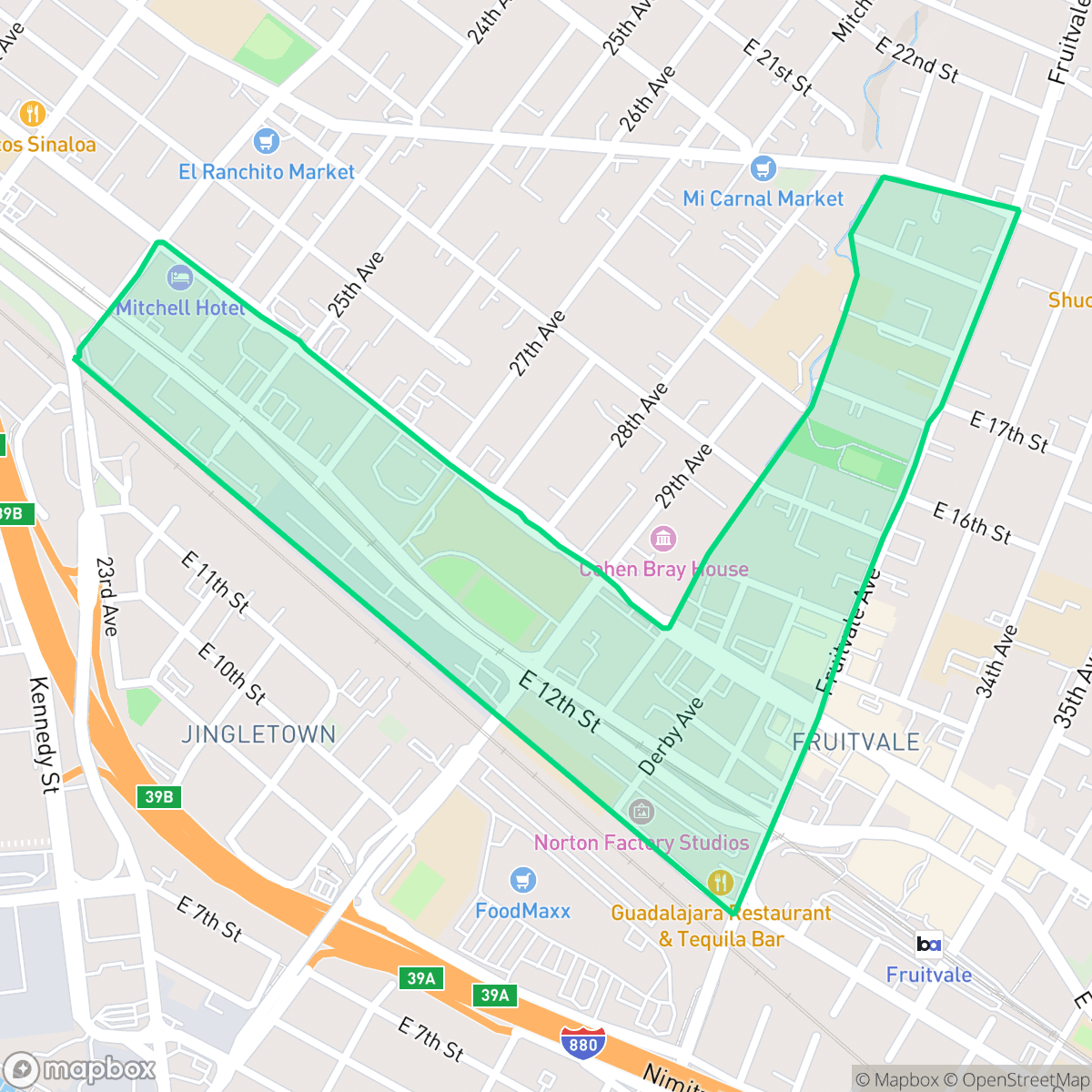
Hawthorne is a dense, highly walkable enclave within the Fruitvale district, defined by its grid layout and proximity to diverse local eateries. Residents benefit from excellent air quality, though the area is notably loud due to heavy road traffic and its proximity to industrial corridors.
Key Highlights
About Hawthorne
Hawthorne is a historic sub-neighborhood within Oakland’s larger Fruitvale district, historically defined by its namesake school and local geography. Originally built in 1898 as Fruitvale School No. 2, the Italian Renaissance-style campus designed by D. Franklin Oliver was renamed Hawthorne School in 1913. A major fire destroyed the building in 1923, coinciding with the culverting and filling of nearby Sausal Creek. In 1924, renowned Oakland architect John J. Donovan designed a new school building at 28th Avenue and East 17th Street. This landmark school structure has long anchored the community’s educational and cultural life. Today, the historic campus houses Achieve Academy, a high-performing elementary school serving the neighborhood’s vibrant, predominantly Latino community.
The neighborhood functions as a compact, urban environment characterized by its high density and standard residential architecture. It serves as a social hub for the local community, featuring popular dining spots such as Taqueria Reynoso and Hornitos Cafe. According to iHuus data, the area maintains a high level of walkability, allowing residents to navigate the grid-based streets with ease. Its central location in Fruitvale provides convenient access to local commerce and transit routes, though this comes with the trade-off of significant noise levels from nearby road traffic.
Potential residents should note that the neighborhood is a dense urban setting with limited private outdoor space and minimal public greenery, which may pose challenges for pet owners. The area faces significant environmental risks regarding flood and fire safety, and the local school district currently experiences systemic instability. This location is best suited for individuals who prioritize extreme pedestrian accessibility and proximity to vibrant local food scenes over quiet, suburban-style tranquility.
Neighborhood Scores Across 15 Qualities
Residential spacing is mixed, with some apartment blocks and houses positioned very close to one another. According to iHuus data, the level of separation between neighbors is slightly higher than the Oakland average.
Pedestrian crossings and a consistent sidewalk grid facilitate easy movement throughout the residential blocks. While highly navigable, the area is slightly less walkable than the Oakland city average.
Standard multi-unit buildings and bungalows characterize the streetscape, which offers less visual variety than the Oakland average. Most properties feature boxy rooflines and small, functional yards according to iHuus data.
Dense urban streets and narrow sidewalks offer few grassy verges for walking pets. Public park access is restricted compared to the Oakland average, with most greenery found in private backyards according to iHuus data.
Streetscapes feature a balanced mix of green space and built infrastructure, closely mirroring the typical density found across Oakland. Some sectors transition into denser, low-rise urban grids with significant industrial and residential lot coverage.
Active social hubs and diverse dining options create a livelier atmosphere than the Oakland average. This energy fluctuates between high-density industrial corridors near the highway and quieter, more suburban residential blocks.
Frequent acoustic disruptions occur due to the proximity of major freeways and railroad tracks. According to iHuus data, noise levels in this area are higher than the Oakland average.
Air quality in this area is consistently good, remaining largely consistent with the average levels found across Oakland. According to iHuus data, residents can expect mostly clean air with only rare instances of elevated readings.
Residential areas exist alongside light commercial units and a railway corridor, resulting in less industrial density than the Oakland average. Residents may encounter intermittent loading activity and low-level operational hum near the southern edge of the neighborhood.
Health insurance access is notably lower in Hawthorne than the Oakland average, according to iHuus data.
Voting patterns and census indicators show a deeply liberal political leaning that is consistent with the broader Oakland average.
Residents live alongside a balanced spread of young adults, families, and older individuals. According to iHuus data, the age distribution in Hawthorne is slightly more concentrated toward younger demographics than the Oakland average.
Flood vulnerability in this area is significantly higher than the Oakland average, according to iHuus data. Residents should be aware of heightened exposure to water-related hazards compared to most other parts of the city.
Address-Level Insights for Hawthorne


iHuus Neighborhood Intelligence Insights
Get address-level neighborhood insights for Hawthorne
- Street-level scores — see how individual blocks compare, not just neighborhood averages
- Micro-zone boundaries — identify quiet pockets, flood boundaries, and walkable clusters before you visit
- 15 dimensions in full — walkability, noise, air quality, school quality, insurance coverage, population age profile, urban/rural index, and more
- Boundary risk alerts — know if your address sits near a block boundary where scores drop, the kind of detail no listing will ever mention
- School insights — individual school ratings and insights, not just district-level data
- Compare before you commit — side-by-side data across neighborhoods, down to block precision
No credit card required
Compare with Any Neighborhood
| Dimension | Hawthorne | Acorn |
|---|---|---|
| 🚶 Walkabilityavg 8.99 | ||
| 🔊 Acoustic Comfortavg 3.24 | ||
| 🤫 Privacy Indexavg 3.74 | ||
| 🎨 Visual Appealavg 6.28 | ||
| 🐕 Dog Friendlinessavg 5.74 | ||
| 🗺️ Urban-Rural Indexavg 6.02 | ||
| ✨ Neighborhood Vibeavg 5.22 | ||
| 🏥 Health Insurance Coverageavg 7.4 | ||
| 🌿 Air Qualityavg 8.06 | ||
| 🏭 Industrial Proximityavg 8.37 | ||
| 🌊 Flood Safetyavg 2.61 | ||
| 🗳️ Ideological Leanavg 9.95 | ||
| 👥 Population Age Profileavg 4.92 | ||
| 🔥 Fire Safetyavg 0.17 | ||
| 🏫 School Quality |
Hawthorne Rankings
School Districts Serving Hawthorne
School Insights for Hawthorne
Below average outcomes; significant attendance and academic challenges.
School Insights
See what's really behind every school rating near Hawthorne
- Individual school ratings — each school's own score with outcome context, not just a district average
- Enrollment & class size data — student-to-teacher ratio and how it compares to the state average
- Full demographics breakdown — ethnicity and gender composition for every school in the enrollment zone
- Every school in the district — all schools within the enrollment boundary ranked by rating, not just the closest one
- Grade levels & benchmarks — elementary through high school, with below/above state-average flags
No credit card required