Havenscourt, Oakland
Updated · 7,038 residents
Havenscourt is a transit-oriented neighborhood in East Oakland defined by its dense grid of historic California bungalows and high walkability. While the area offers excellent access to local amenities and transit, residents experience limited privacy due to closely spaced homes and elevated noise levels from road traffic.
Key Highlights
About Havenscourt
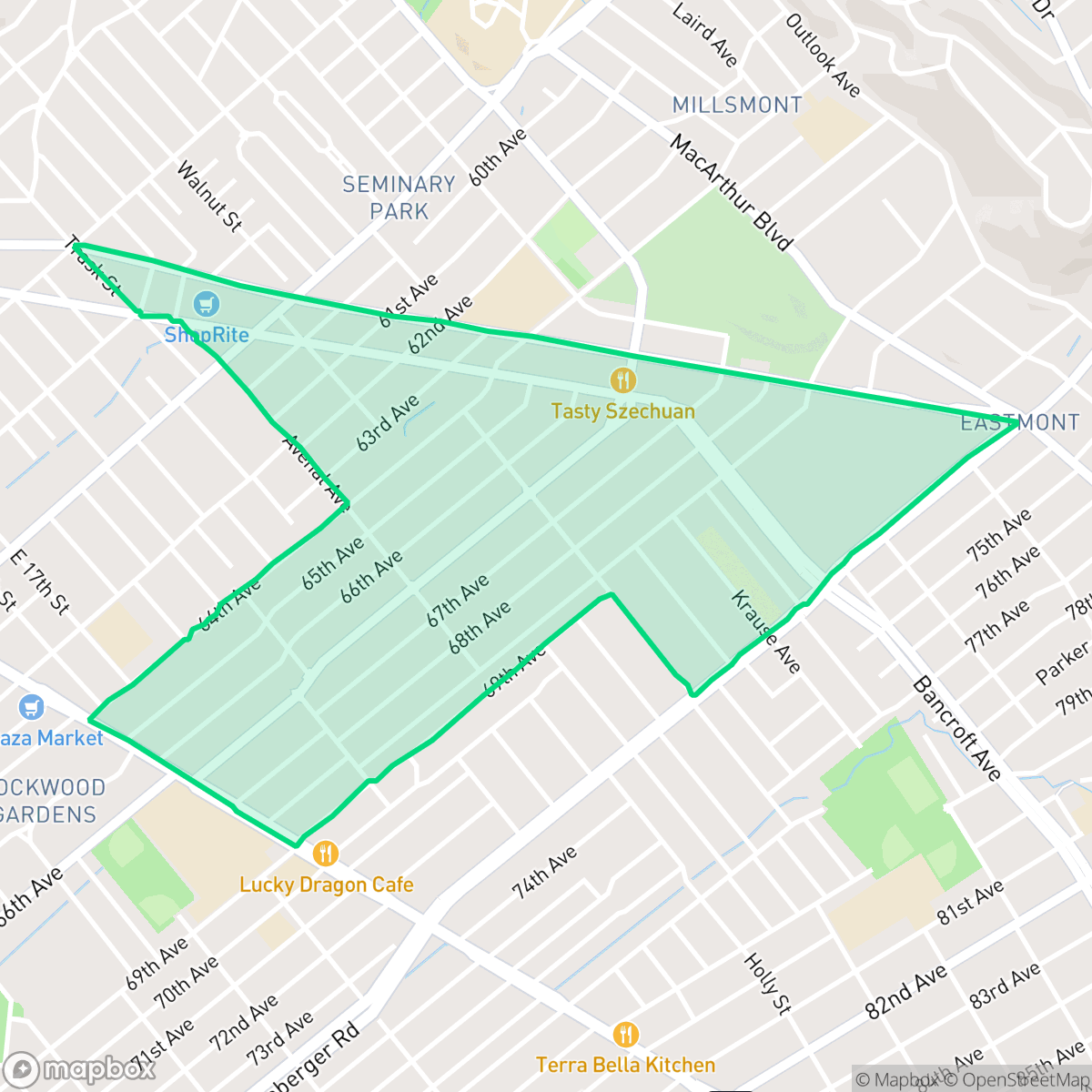
Developed starting in 1912 by the Wickham Havens Real Estate Company, Havenscourt was transformed from a 170-acre cattle-grazing field, formerly part of the Pope estate, into a master-planned residential tract. Annexed by Oakland in 1909 as part of Melrose, the neighborhood featured an official entrance at Havenscourt Boulevard and East 14th Street (now International Boulevard) marked by a prominent pergola and gazebo. A dedicated Southern Pacific train station and business district opened in 1913 at Bancroft Avenue. Early residents, many of whom commuted to the nearby Chevrolet plant, lived in California bungalows. Like many early 20th-century developments, the tract originally enforced racially restrictive covenants. Today, Havenscourt remains a distinct East Oakland neighborhood, with its historic street grid and bungalow architecture preserving its early transit-oriented suburban origins.
The neighborhood maintains a distinct urban character shaped by its early 20th-century master-planned layout. Residents benefit from a highly walkable grid with continuous sidewalks that connect the area to various local dining options, such as Egg Roll Kitchen and Mi Zacatecas. The landscape consists of tightly packed single-family bungalows and light commercial zones, which contribute to a functional, high-density environment. According to iHuus data, the area is well-suited for those who prioritize transit accessibility and proximity to urban amenities over suburban seclusion.
Prospective residents should weigh the benefits of the neighborhood against specific livability trade-offs. The local school system, managed by the Oakland Unified School District, faces significant operational and performance challenges, and environmental factors such as flood and fire safety require careful consideration. Because homes are situated in close proximity with limited private green space, the area is best suited for individuals who value a central, commuter-friendly location and a vibrant, walkable streetscape.
Neighborhood Scores Across 15 Qualities
Residential structures are positioned in close proximity with minimal separation between property lines. This level of density is slightly higher than the Oakland average, as many homes sit only a few meters apart.
Continuous sidewalks and frequent marked crosswalks make navigating the neighborhood easy on foot. This level of pedestrian infrastructure is even more comprehensive than the Oakland average.
Standard tract housing dominates the landscape with consistent rooflines and compact lot sizes. This area features slightly less visual variety than the Oakland average, characterized by tidy but small yards and a lack of visible luxury amenities.
Public park access and wide walking verges are scarce in this area, making it less dog friendly than the Oakland average. Most accessible green space is confined to private backyards or a single large park located in the northeast corner of the neighborhood.
Streetscapes and green spaces are distributed in roughly equal measure, matching the city average for this type of environment. According to iHuus data, the area consists of a dense grid of low-rise residential and commercial structures with limited open natural space.
A steady rhythm of residential life and light industrial units defines this area, which offers slightly less activity than the Oakland average. According to iHuus data, residents can find a moderate mix of local dining and social hubs within a walkable distance of certain blocks.
Steady traffic sounds from nearby busy streets are common here; however, levels are notably quieter than the Oakland average according to iHuus data.
Air quality remains mostly clean with rare instances of elevated readings, though levels are slightly lower than the Oakland average according to iHuus data.
Residential and light commercial zones dominate the area, though some warehouse-related traffic and noise may be present in the southwest corner. This level of industrial presence is slightly lower than the Oakland average, according to iHuus data.
Health insurance accessibility is lower in Havenscourt than the Oakland average. According to iHuus data, fewer residents in this area have verified coverage compared to the rest of the city.
Voting patterns and census indicators reflect a deeply liberal political landscape, which is very similar to the broader Oakland area according to iHuus data.
Residents live alongside a balanced spread of young adults, families, and older populations. This age distribution is slightly more varied than the Oakland average, according to iHuus data.
Significant flood hazards from coastal wave action exist here, which is substantially higher than the Oakland average. Residents should anticipate elevated or potentially prohibitive flood insurance costs according to iHuus data.
Address-Level Insights for Havenscourt


iHuus Neighborhood Intelligence Insights
Get address-level neighborhood insights for Havenscourt
- Street-level scores — see how individual blocks compare, not just neighborhood averages
- Micro-zone boundaries — identify quiet pockets, flood boundaries, and walkable clusters before you visit
- 15 dimensions in full — walkability, noise, air quality, school quality, insurance coverage, population age profile, urban/rural index, and more
- Boundary risk alerts — know if your address sits near a block boundary where scores drop, the kind of detail no listing will ever mention
- School insights — individual school ratings and insights, not just district-level data
- Compare before you commit — side-by-side data across neighborhoods, down to block precision
No credit card required
Compare with Any Neighborhood
| Dimension | Havenscourt | Acorn |
|---|---|---|
| 🚶 Walkabilityavg 8.99 | ||
| 🔊 Acoustic Comfortavg 3.24 | ||
| 🤫 Privacy Indexavg 3.74 | ||
| 🎨 Visual Appealavg 6.28 | ||
| 🐕 Dog Friendlinessavg 5.74 | ||
| 🗺️ Urban-Rural Indexavg 6.02 | ||
| ✨ Neighborhood Vibeavg 5.22 | ||
| 🏥 Health Insurance Coverageavg 7.4 | ||
| 🌿 Air Qualityavg 8.06 | ||
| 🏭 Industrial Proximityavg 8.37 | ||
| 🌊 Flood Safetyavg 2.61 | ||
| 🗳️ Ideological Leanavg 9.95 | ||
| 👥 Population Age Profileavg 4.92 | ||
| 🔥 Fire Safetyavg 0.17 | ||
| 🏫 School Quality |
Havenscourt Rankings
School Districts Serving Havenscourt
School Insights for Havenscourt
Below average outcomes; significant attendance and academic challenges.
School Insights
See what's really behind every school rating near Havenscourt
- Individual school ratings — each school's own score with outcome context, not just a district average
- Enrollment & class size data — student-to-teacher ratio and how it compares to the state average
- Full demographics breakdown — ethnicity and gender composition for every school in the enrollment zone
- Every school in the district — all schools within the enrollment boundary ranked by rating, not just the closest one
- Grade levels & benchmarks — elementary through high school, with below/above state-average flags
No credit card required