Golden Gate, Oakland
Updated · 1,621 residents
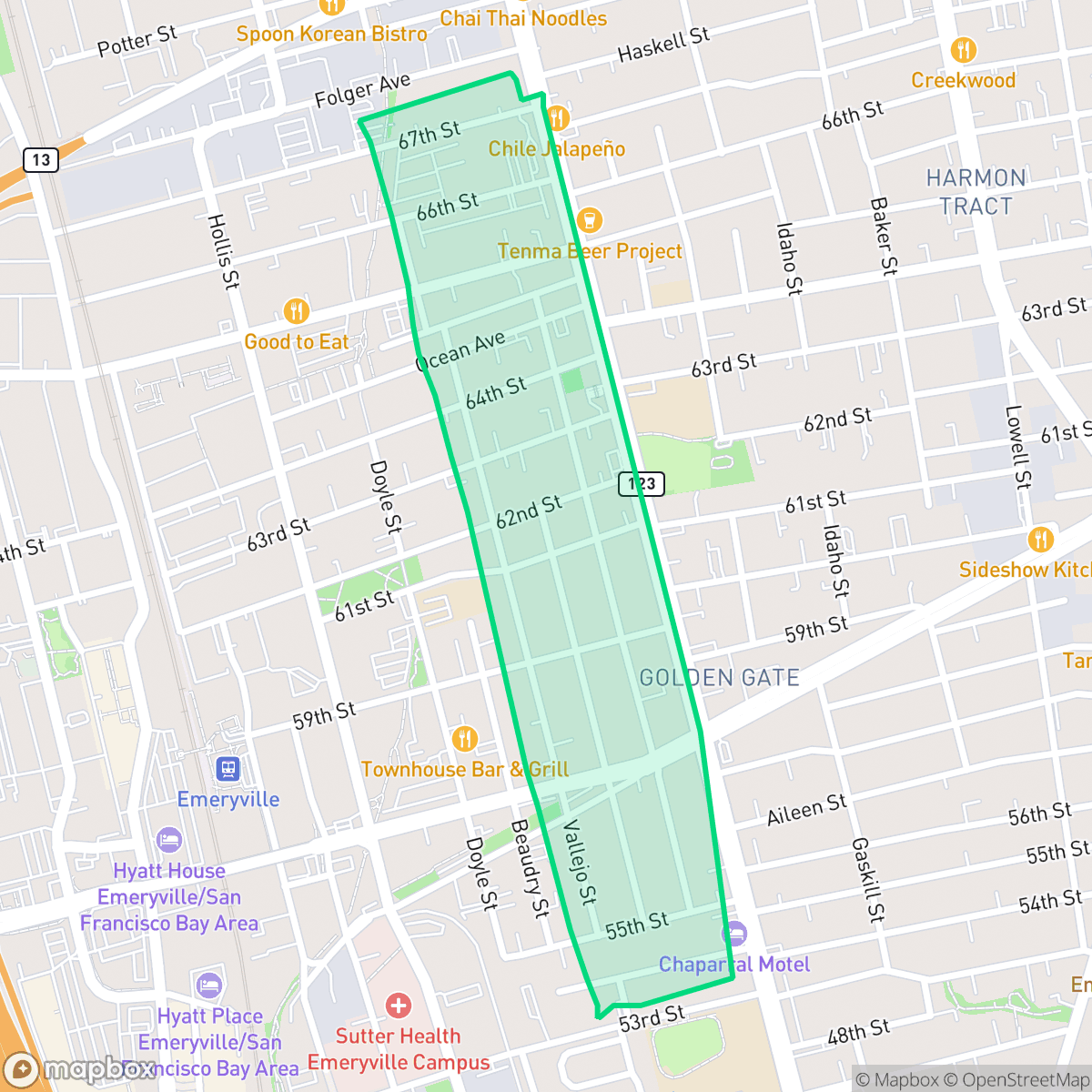
Golden Gate is a highly walkable neighborhood in northwest Oakland, characterized by a dense mix of residential housing and commercial activity along the San Pablo Avenue corridor. Residents benefit from exceptional air quality and high health insurance coverage, though the area experiences notable noise from nearby road and rail traffic.
Key Highlights
About Golden Gate
Initially founded in 1885 as "Klinknerville" by eccentric entrepreneur Charles Alexander Klinkner, this northwest Oakland neighborhood was renamed Golden Gate in 1888 and annexed to Oakland in 1897. In the early 20th century, the San Pablo Avenue corridor evolved into a bustling entertainment district featuring over 50 bars, including the original Trader Vic's, where the Mai Tai cocktail was invented in 1944. During the 1950s, Golden Gate became a predominantly African American community. A key cultural anchor is the 1918 Georgian Revival-style Golden Gate Branch Library, built with Carnegie funds. In 1982, the library welcomed the East Bay Negro Historical Society, establishing Oakland's first public library collection focused primarily on African American history.
The neighborhood functions as a dense urban environment where mid-rise apartments and single-family homes sit alongside commercial warehouses. Its layout creates a highly pedestrian-friendly atmosphere, supported by a grid of streets and sidewalks that connect residents to local social hubs like the Doyle Street Cafe and Mclaughlin Coffee Company. While the area maintains a distinct urban character, it offers a high degree of connectivity to the wider East Bay region.
Prospective residents should consider the trade-offs associated with this density, including limited residential privacy and elevated noise levels from road and rail infrastructure. While the neighborhood excels in air quality and health accessibility, the proximity to industrial zones and the current state of local school districts are important factors for families to evaluate. According to iHuus data, the area is best suited for individuals who prioritize walkability and access to urban amenities over quiet, suburban seclusion.
Neighborhood Scores Across 15 Qualities
Residential units are positioned in close quarters with significant building density and limited separation between properties. This level of density is slightly higher than the Oakland average, as noted by iHuus data.
Pedestrian movement is seamless due to a continuous grid of wide sidewalks and well-marked crosswalks. This level of accessibility and street connectivity is superior to the Oakland average.
Residential views consist of functional tract housing and small yards, which is slightly below the Oakland average for visual variety. The area features a mix of urban density and commercial warehouses without significant greenery or luxury estates.
Narrow sidewalks and a lack of large green spaces make frequent walks challenging; according to iHuus data, the availability of dog-friendly areas is slightly below the Oakland average.
Frequent open land and scattered homes amidst woodland or fields provide a more open landscape than most of Oakland. This blend of residential structures and green space creates a setting that is slightly more rural than the city average, according to iHuus data.
Residential blocks blend quiet green spaces with pockets of social activity near local cafes and eateries. This level of activity is roughly in line with the Oakland average, according to iHuus data.
Frequent acoustic disturbances from nearby railroad tracks and major freeways characterize this area. According to iHuus data, noise levels are significantly higher than the Oakland average.
Air quality in this area is exceptionally clean with minimal health concerns. According to iHuus data, levels of atmospheric pollutants are significantly better than the Oakland average.
Large warehouses and commercial logistics centers are concentrated in the western portions of the area. This presence of industrial infrastructure is more significant than in most other Oakland neighborhoods, which may result in increased truck activity and noise near residential zones.
Nearly all residents are covered by health insurance, a rate significantly higher than the Oakland average. According to iHuus data, access to healthcare coverage is exceptionally stable in this area.
Voting patterns and census indicators show a highly progressive political climate that is slightly more liberal than the Oakland average, according to iHuus data.
Residents live alongside a balanced mix of young adults, families, and older individuals. This demographic spread is consistent with the broader Oakland area, according to iHuus data.
Flood risk in this area is higher than the Oakland average, though a lack of detailed federal studies means the specific level of danger remains undetermined. Residents should exercise caution as official assessments for this neighborhood are currently incomplete.
Address-Level Insights for Golden Gate


iHuus Neighborhood Intelligence Insights
Get address-level neighborhood insights for Golden Gate
- Street-level scores — see how individual blocks compare, not just neighborhood averages
- Micro-zone boundaries — identify quiet pockets, flood boundaries, and walkable clusters before you visit
- 15 dimensions in full — walkability, noise, air quality, school quality, insurance coverage, population age profile, urban/rural index, and more
- Boundary risk alerts — know if your address sits near a block boundary where scores drop, the kind of detail no listing will ever mention
- School insights — individual school ratings and insights, not just district-level data
- Compare before you commit — side-by-side data across neighborhoods, down to block precision
No credit card required
Compare with Any Neighborhood
| Dimension | Golden Gate | Acorn |
|---|---|---|
| 🚶 Walkabilityavg 8.99 | ||
| 🔊 Acoustic Comfortavg 3.24 | ||
| 🤫 Privacy Indexavg 3.74 | ||
| 🎨 Visual Appealavg 6.28 | ||
| 🐕 Dog Friendlinessavg 5.74 | ||
| 🗺️ Urban-Rural Indexavg 6.02 | ||
| ✨ Neighborhood Vibeavg 5.22 | ||
| 🏥 Health Insurance Coverageavg 7.4 | ||
| 🌿 Air Qualityavg 8.06 | ||
| 🏭 Industrial Proximityavg 8.37 | ||
| 🌊 Flood Safetyavg 2.61 | ||
| 🗳️ Ideological Leanavg 9.95 | ||
| 👥 Population Age Profileavg 4.92 | ||
| 🔥 Fire Safetyavg 0.17 | ||
| 🏫 School Quality |
Golden Gate Rankings
School Districts Serving Golden Gate
School Insights for Golden Gate
Below average outcomes; significant attendance and academic challenges.
School Insights
See what's really behind every school rating near Golden Gate
- Individual school ratings — each school's own score with outcome context, not just a district average
- Enrollment & class size data — student-to-teacher ratio and how it compares to the state average
- Full demographics breakdown — ethnicity and gender composition for every school in the enrollment zone
- Every school in the district — all schools within the enrollment boundary ranked by rating, not just the closest one
- Grade levels & benchmarks — elementary through high school, with below/above state-average flags
No credit card required