Glenview, Oakland
Updated · 5,524 residents
Glenview is a vibrant Oakland foothills community defined by its historic architecture and a bustling commercial corridor along Park Boulevard. While the neighborhood offers a strong sense of community and excellent local schools, residents should be prepared for significant road noise from the adjacent highway and a dense residential layout that prioritizes proximity over privacy.
Key Highlights
About Glenview
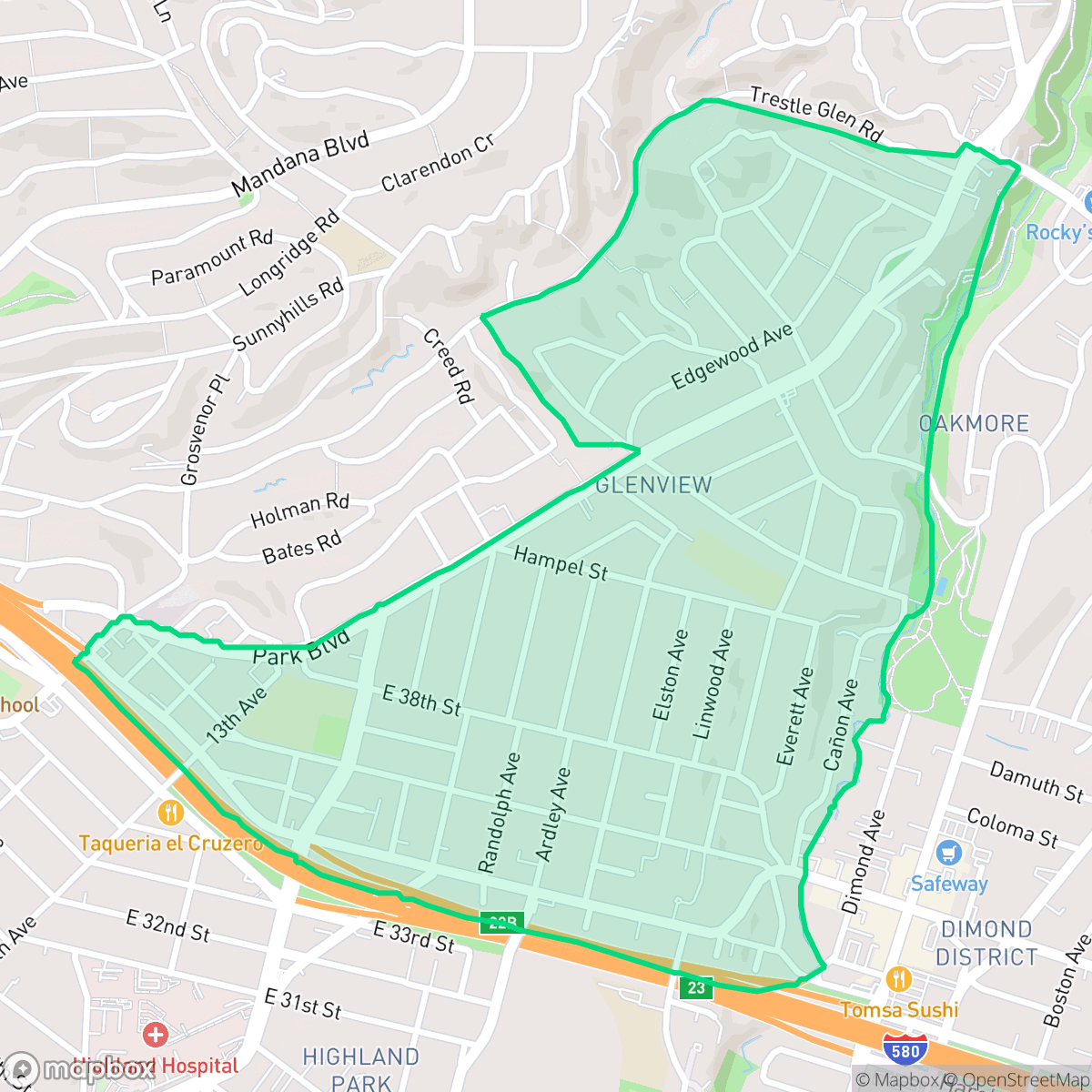
Nestled in the Oakland foothills, the Glenview neighborhood was subdivided in 1910 by Wickham Havens Inc. as "Fourth Avenue Terrace". Developed primarily in the 1920s and 1930s, the area is renowned for its well-preserved Craftsman bungalows, Spanish stucco, and Mission-style homes. Park Boulevard, the neighborhood’s commercial spine, historically served as a logging route for hauling redwoods from the hills. The district features notable architectural landmarks, including the 1927 Glenview Elementary School—which retains its historic Art Deco facade following a 2020 reconstruction—and the 1935 Spanish Colonial-style Glenview Branch Library, an official city landmark. Bordered by Dimond Park and Sausal Creek, Glenview evolved from early 20th-century ranch lands into a highly walkable, vibrant residential community.
The neighborhood functions as a dense, residential hub that balances its historic charm with the practical realities of urban living. With a high level of health insurance coverage and a strong commitment to local educational institutions like Glenview Elementary and Edna Brewer Middle, it attracts families and professionals who value academic stability and neighborhood engagement. The area maintains a lively atmosphere, supported by its proximity to green spaces like Dimond Park and the natural corridor of Sausal Creek, which provide essential relief from the surrounding urban density. Residents benefit from a highly accessible location, though the proximity to major transit arteries contributes to a notable acoustic environment that potential buyers should consider.
Living in this area requires navigating specific trade-offs, particularly regarding acoustic comfort and personal space. The housing stock is tightly packed, often resulting in limited privacy between neighbors, and the persistent sound of nearby road traffic is a defining characteristic of the local environment. Despite these factors, the neighborhood remains a highly desirable choice for those seeking a well-connected, established community with a clear ideological identity and a focus on long-term residential stability. It is best suited for individuals who prioritize a central location and access to high-performing schools over the quietude of a more secluded setting.
Neighborhood Scores Across 15 Qualities
Residential spacing provides more visual separation than the Oakland average. While some areas feature tightly clustered homes, many properties offer moderate yard buffers and mature trees for screening.
Consistent sidewalks and safe crosswalks characterize most residential streets, though the nearby high-traffic freeway creates a notable barrier for pedestrians. While the neighborhood offers good connectivity, walkability is slightly lower than the Oakland average due to steep hills and major highway corridors.
Large, well-maintained homes with complex rooflines and private amenities characterize this area. According to iHuus data, the visual landscape is notably more upscale than the Oakland average.
Abundant tree cover and proximity to large reservoir parks and wooded greenbelts provide much better access to pet-friendly spaces than the Oakland average. Wide verges and connected trails offer safe environments for walking dogs away from traffic.
Significant tree canopy and frequent open spaces provide a more semi-rural atmosphere than the Oakland average. According to iHuus data, the landscape features many detached single-family homes nestled within mature vegetation.
Local dining and wellness businesses provide a noticeable social energy that is more active than the Oakland average. While some residential blocks remain quiet and low density, many areas feature a steady concentration of cafes, eateries, and community spaces.
Frequent noise from nearby transit corridors and heavy traffic is a constant factor. According to iHuus data, acoustic levels in this area are significantly higher than the Oakland average.
Air quality remains consistently high with infrequent periods of poor air. This level of cleanliness is roughly in line with the Oakland average according to iHuus data.
No warehouses, heavy industry, or hazardous facilities are present within this area. According to iHuus data, this neighborhood is more free of industrial activity than the Oakland average.
Nearly all residents are covered by health insurance, a rate significantly higher than the Oakland average according to iHuus data.
Voting patterns and census indicators show a deeply progressive political leaning that is slightly more pronounced than the Oakland average, according to iHuus data.
Residents experience a diverse age distribution ranging from young adults to seniors. This demographic variety is slightly more balanced than the average found across Oakland, according to iHuus data.
Flood risk in this area is notably higher than the Oakland average, though a detailed FEMA study has not yet been completed for this specific location. According to iHuus data, the area carries a moderate level of undetermined risk.
Address-Level Insights for Glenview


iHuus Neighborhood Intelligence Insights
Get address-level neighborhood insights for Glenview
- Street-level scores — see how individual blocks compare, not just neighborhood averages
- Micro-zone boundaries — identify quiet pockets, flood boundaries, and walkable clusters before you visit
- 15 dimensions in full — walkability, noise, air quality, school quality, insurance coverage, population age profile, urban/rural index, and more
- Boundary risk alerts — know if your address sits near a block boundary where scores drop, the kind of detail no listing will ever mention
- School insights — individual school ratings and insights, not just district-level data
- Compare before you commit — side-by-side data across neighborhoods, down to block precision
No credit card required
Compare with Any Neighborhood
| Dimension | Glenview | Acorn |
|---|---|---|
| 🚶 Walkabilityavg 8.99 | ||
| 🔊 Acoustic Comfortavg 3.24 | ||
| 🤫 Privacy Indexavg 3.74 | ||
| 🎨 Visual Appealavg 6.28 | ||
| 🐕 Dog Friendlinessavg 5.74 | ||
| 🗺️ Urban-Rural Indexavg 6.02 | ||
| ✨ Neighborhood Vibeavg 5.22 | ||
| 🏥 Health Insurance Coverageavg 7.4 | ||
| 🌿 Air Qualityavg 8.06 | ||
| 🏭 Industrial Proximityavg 8.37 | ||
| 🌊 Flood Safetyavg 2.61 | ||
| 🗳️ Ideological Leanavg 9.95 | ||
| 👥 Population Age Profileavg 4.92 | ||
| 🔥 Fire Safetyavg 0.17 | ||
| 🏫 School Quality |
Glenview Rankings
School Districts Serving Glenview
School Insights for Glenview
Below average outcomes; significant attendance and academic challenges.
School Insights
See what's really behind every school rating near Glenview
- Individual school ratings — each school's own score with outcome context, not just a district average
- Enrollment & class size data — student-to-teacher ratio and how it compares to the state average
- Full demographics breakdown — ethnicity and gender composition for every school in the enrollment zone
- Every school in the district — all schools within the enrollment boundary ranked by rating, not just the closest one
- Grade levels & benchmarks — elementary through high school, with below/above state-average flags
No credit card required