Glen Highlands, Oakland
Updated · 1,940 residents
Glen Highlands is a scenic, wooded enclave in the Oakland Hills defined by its dramatic topography and a blend of historic and modern architecture. While the area offers high visual appeal and excellent health insurance coverage, it is notably loud due to its proximity to major road traffic. Residents enjoy a quiet, suburban atmosphere that remains largely detached from the city's primary commercial hubs.
Key Highlights
About Glen Highlands
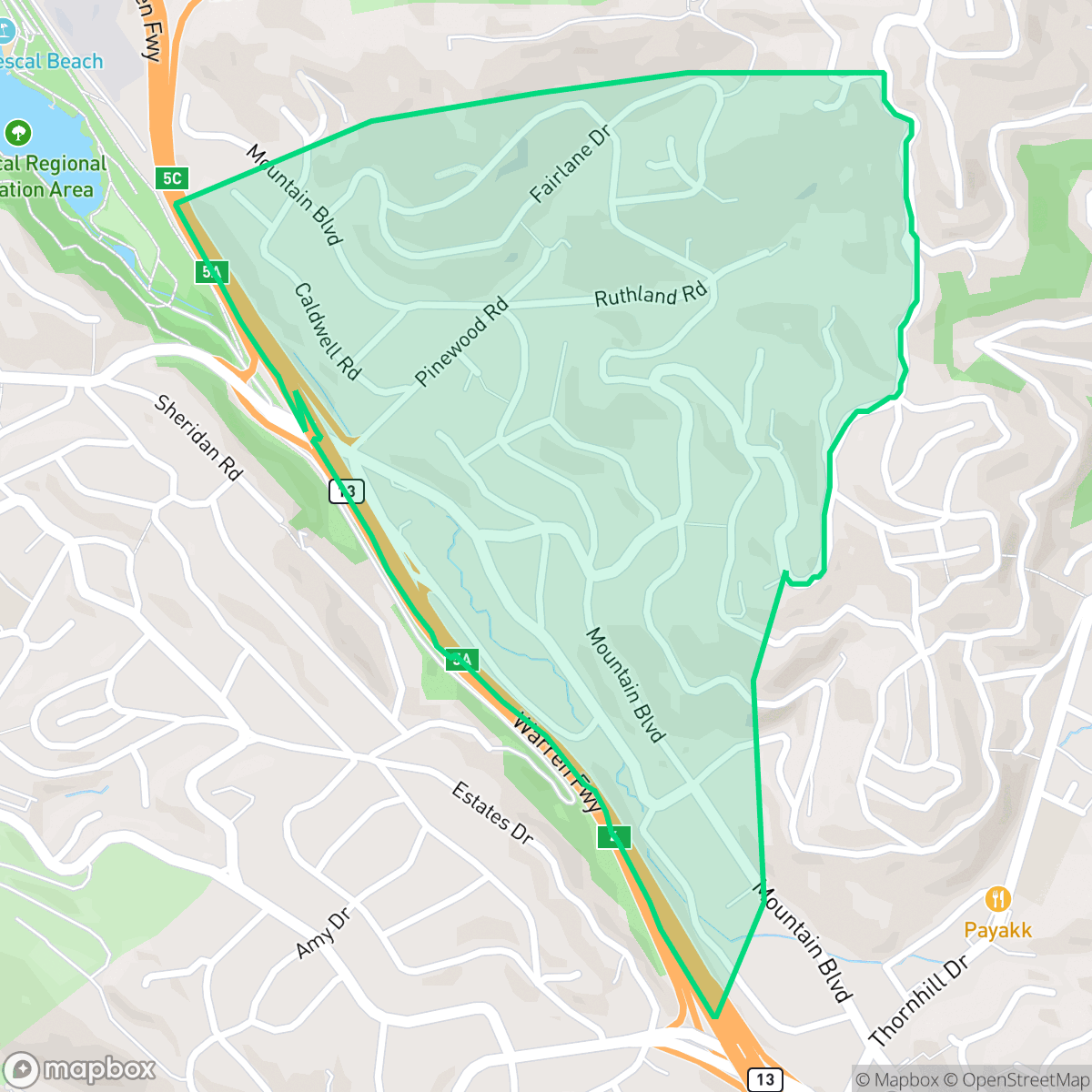
Located in the Oakland Hills near Lake Temescal, Glen Highlands is a rustic, wooded neighborhood originally formed by merging several 1920s subdivisions, including Glenwood, Glenwood Extension, and Glenwood Park. Marketed heavily in the early 1920s by the Villa Site Sales Company (a subsidiary of the Realty Syndicate), the area was promoted for its scenic, pine-filled acreage. Broadway Terrace serves as the neighborhood's primary thoroughfare. Glen Highlands was profoundly impacted by the devastating 1991 Oakland Hills Firestorm, which destroyed many of its original structures. The subsequent rebuilding effort transformed the neighborhood, leaving it with a distinctive architectural blend of surviving early-20th-century traditional homes and modern, fire-resistant residences built in the decades following the disaster.
Situated near Lake Temescal, the neighborhood is characterized by its steep, pine-filled terrain and a distinct architectural profile shaped by post-fire reconstruction. The area provides a serene, residential environment that prioritizes natural beauty and privacy over urban convenience. According to iHuus data, the community maintains a high standard of health insurance coverage, reflecting a stable demographic profile that values the quiet, semi-rural character of the hills.
Living in this area requires navigating specific trade-offs, particularly regarding noise levels and local infrastructure. The neighborhood experiences significant acoustic impact from nearby road traffic, and its walkability remains limited compared to the city average. Furthermore, families should be aware that local schools within the Oakland Unified School District currently face significant budgetary and operational challenges. While the area offers a unique aesthetic experience, prospective residents should prioritize personal transportation and evaluate the specific fire safety considerations inherent to the Oakland Hills.
Neighborhood Scores Across 15 Qualities
Residential spacing is moderate with a mix of structures that provide more separation than is typical for Oakland. According to iHuus data, neighbors are neither overly crowded nor excessively isolated.
Low sidewalk availability characterizes the area, though the quiet streets remain suitable for walking. This level of walkability is significantly lower than the Oakland average, according to iHuus data.
Large residential properties and well-maintained amenities provide a highly aesthetic streetscape. According to iHuus data, the visual quality of this area is notably higher than the Oakland average.
Integrated green spaces and wide, low-traffic paths make this area significantly more accommodating for pet owners than the Oakland average. According to iHuus data, the landscape offers ample opportunities for safe, off-street movement.
Frequent open land and scattered homes amidst woodland characterize this area. According to iHuus data, the landscape is significantly more open and less densely developed than the Oakland average.
Low-density residential and industrial spaces characterize this area, resulting in a much calmer atmosphere than the Oakland average. Social activity is minimal, as most local amenities are limited to a few scattered spots near major transit corridors.
Frequent disturbances from nearby freeway and railroad traffic characterize this area. According to iHuus data, acoustic comfort is notably lower than the Oakland average.
Air quality remains consistently high with infrequent periods of poor ventilation. According to iHuus data, these levels are slightly better than the Oakland average.
Industrial activity is virtually non-existent here, providing a cleaner environment than much of Oakland. According to iHuus data, the area is free from warehouses, manufacturing plants, or hazardous industrial sites.
Health insurance access is exceptionally high among residents, significantly exceeding the Oakland average according to iHuus data.
Voting patterns and census indicators reflect a deeply liberal political leaning that is consistent with the broader Oakland area. According to iHuus data, this neighborhood shares the highly progressive political character seen throughout the city.
A balanced mix of young adults, families, and older residents characterizes the area. According to iHuus data, this age distribution is slightly more varied than the average found across Oakland.
Flood risk levels in this area are higher than the Oakland average, though FEMA has not yet completed a detailed study to confirm specific vulnerabilities. Residents should remain aware that the precise level of exposure to flooding remains unverified.
Elevated fire hazards are present in this area, representing a significantly higher risk than the Oakland average according to iHuus data. Residents should prioritize enhanced mitigation measures and wildfire preparedness.
Address-Level Insights for Glen Highlands


iHuus Neighborhood Intelligence Insights
Get address-level neighborhood insights for Glen Highlands
- Street-level scores — see how individual blocks compare, not just neighborhood averages
- Micro-zone boundaries — identify quiet pockets, flood boundaries, and walkable clusters before you visit
- 15 dimensions in full — walkability, noise, air quality, school quality, insurance coverage, population age profile, urban/rural index, and more
- Boundary risk alerts — know if your address sits near a block boundary where scores drop, the kind of detail no listing will ever mention
- School insights — individual school ratings and insights, not just district-level data
- Compare before you commit — side-by-side data across neighborhoods, down to block precision
No credit card required
Compare with Any Neighborhood
| Dimension | Glen Highlands | Acorn |
|---|---|---|
| 🚶 Walkabilityavg 8.99 | ||
| 🔊 Acoustic Comfortavg 3.24 | ||
| 🤫 Privacy Indexavg 3.74 | ||
| 🎨 Visual Appealavg 6.28 | ||
| 🐕 Dog Friendlinessavg 5.74 | ||
| 🗺️ Urban-Rural Indexavg 6.02 | ||
| ✨ Neighborhood Vibeavg 5.22 | ||
| 🏥 Health Insurance Coverageavg 7.4 | ||
| 🌿 Air Qualityavg 8.06 | ||
| 🏭 Industrial Proximityavg 8.37 | ||
| 🌊 Flood Safetyavg 2.61 | ||
| 🗳️ Ideological Leanavg 9.95 | ||
| 👥 Population Age Profileavg 4.92 | ||
| 🔥 Fire Safetyavg 0.17 | ||
| 🏫 School Quality |
Glen Highlands Rankings
School Districts Serving Glen Highlands
School Insights for Glen Highlands
Below average outcomes; significant attendance and academic challenges.
School Insights
See what's really behind every school rating near Glen Highlands
- Individual school ratings — each school's own score with outcome context, not just a district average
- Enrollment & class size data — student-to-teacher ratio and how it compares to the state average
- Full demographics breakdown — ethnicity and gender composition for every school in the enrollment zone
- Every school in the district — all schools within the enrollment boundary ranked by rating, not just the closest one
- Grade levels & benchmarks — elementary through high school, with below/above state-average flags
No credit card required