Gaskill, Oakland
Updated · 1,627 residents
Gaskill is a historic North Oakland enclave defined by its high concentration of preserved Victorian and Craftsman homes. Residents enjoy a highly walkable urban environment with a complete grid of sidewalks, though the area features tightly packed housing with limited privacy.
Key Highlights
About Gaskill
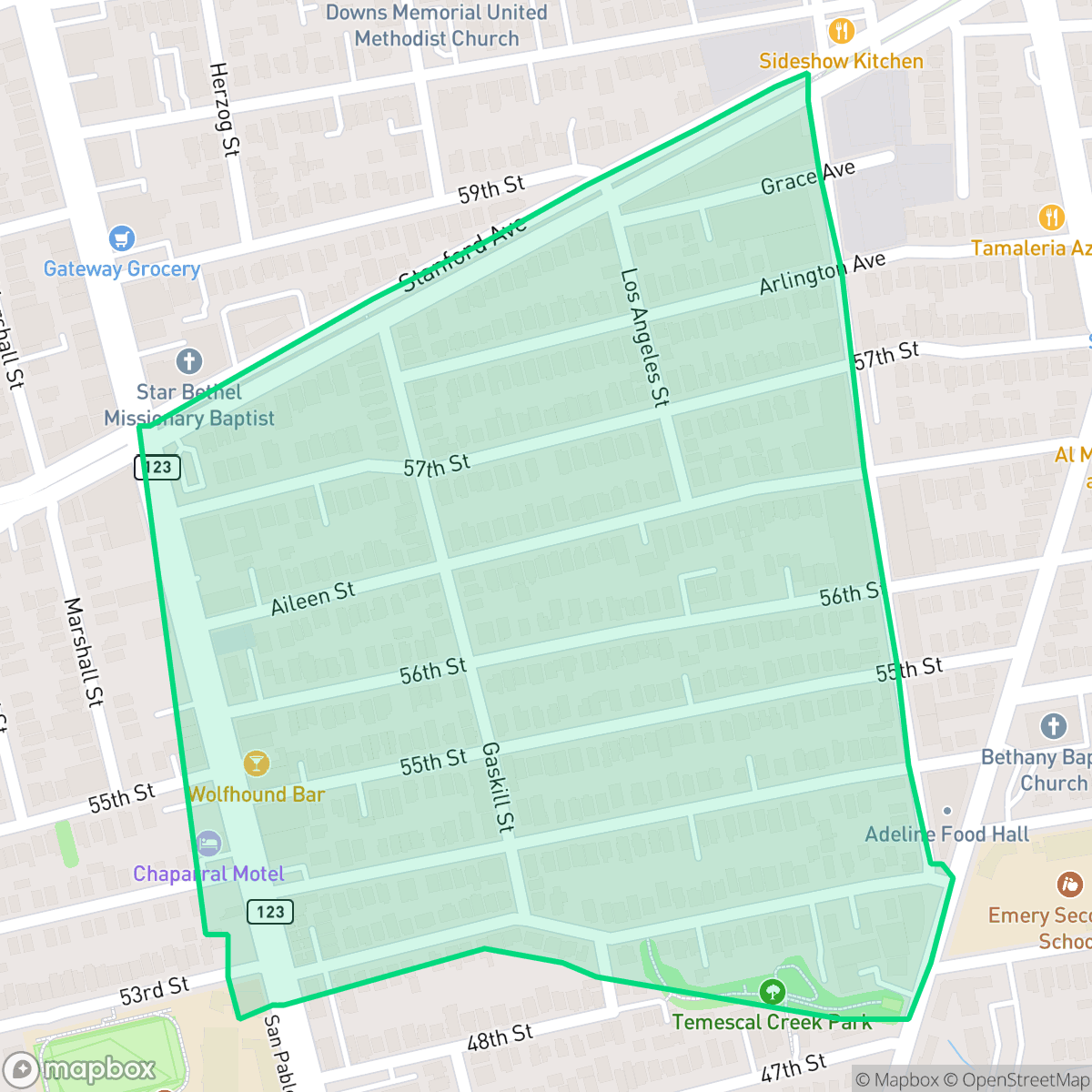
The Gaskill neighborhood in North Oakland originated in 1869 when Vermont immigrant brothers Rollin and DeWitt Clinton Gaskill purchased 17 acres of land from pioneer farmer George Parsons. DeWitt Gaskill subdivided the tract in 1877, establishing Menlo, Sutter, Parsons, and Park streets. Following the area's annexation to Oakland in 1897, the city renamed these thoroughfares to conform to its grid, transforming them into Aileen, 56th, 55th, and Gaskill streets. Today, Gaskill is characterized by its exceptionally high concentration of historic housing stock, with over 70 percent of its residences—including restored Victorian and Craftsman-style homes—dating to 1939 or earlier.
The neighborhood functions as a dense, low-rise urban grid characterized by its residential focus and lack of heavy industrial presence. It maintains a calm atmosphere, offering local social hubs and accessible dining options like Sideshow Kitchen and Tamaleria Azteca. The area benefits from excellent air quality and high health insurance coverage among its residents, contributing to a stable living environment within the broader Oakland landscape.
Prospective residents should note that the area presents specific trade-offs regarding noise and density. With a consistent volume of road traffic, acoustic comfort is moderate, and the close proximity of buildings results in limited personal yard space and privacy. While the neighborhood is exceptionally walkable, pet owners may find the lack of significant public green space and narrow sidewalk verges challenging. It is best suited for individuals who prioritize architectural character and pedestrian accessibility over expansive outdoor amenities or complete quiet.
Neighborhood Scores Across 15 Qualities
Residential structures are positioned in close quarters with very little separation between buildings. This level of density and shared-wall proximity is notably higher than the Oakland average, according to iHuus data.
Continuous sidewalks and clearly marked crosswalks exist on nearly every street corner throughout the area. This level of connectivity for pedestrians is notably higher than the Oakland average, according to iHuus data.
Residential views consist of functional tract housing and commercial warehouses with limited greenery or private luxury amenities. This landscape is slightly less visually diverse than the Oakland average.
Public green space and wide sidewalk verges are scarce in Gaskill, making it less dog friendly than most of Oakland. Residents primarily rely on small local parks or private yards due to the dense residential layout.
Open land and scattered homes amidst woodland provide a slightly more rural feel than the typical Oakland urban landscape. According to iHuus data, this area offers more natural space and less pavement coverage than the city average.
Social activity is more concentrated here than the Oakland average, with notable clusters of cafes, bakeries, and diverse eateries scattered throughout the area. While some suburban blocks remain quiet, many residents benefit from accessible local dining and community gathering spots according to iHuus data.
Frequent sounds from nearby railroad lines and heavy freeway traffic characterize the area. According to iHuus data, acoustic disturbances in Gaskill are slightly more prevalent than the Oakland average.
Air quality in Gaskill remains consistently high with minimal health concerns. This level of air purity is notably better than the average found throughout Oakland, according to iHuus data.
Residential and light commercial buildings dominate the landscape, meaning residents will encounter very little heavy industrial activity. This lack of large warehouses or significant industrial hazards is consistent with the city average.
Health insurance access is exceptionally high among Gaskill residents, significantly surpassing the Oakland city average according to iHuus data.
Voting patterns and census indicators show a highly liberal political leaning that is slightly more pronounced than the Oakland average.
Residents live alongside a balanced mix of young professionals, families, and older adults. This demographic spread is consistent with the broader Oakland area, according to iHuus data.
Flood risk is significantly higher than the Oakland average because portions of the neighborhood sit within a designated 100-year floodplain. According to iHuus data, residents may find that flood insurance is a typical requirement for properties in this area.
Address-Level Insights for Gaskill


iHuus Neighborhood Intelligence Insights
Get address-level neighborhood insights for Gaskill
- Street-level scores — see how individual blocks compare, not just neighborhood averages
- Micro-zone boundaries — identify quiet pockets, flood boundaries, and walkable clusters before you visit
- 15 dimensions in full — walkability, noise, air quality, school quality, insurance coverage, population age profile, urban/rural index, and more
- Boundary risk alerts — know if your address sits near a block boundary where scores drop, the kind of detail no listing will ever mention
- School insights — individual school ratings and insights, not just district-level data
- Compare before you commit — side-by-side data across neighborhoods, down to block precision
No credit card required
Compare with Any Neighborhood
| Dimension | Gaskill | Acorn |
|---|---|---|
| 🚶 Walkabilityavg 8.99 | ||
| 🔊 Acoustic Comfortavg 3.24 | ||
| 🤫 Privacy Indexavg 3.74 | ||
| 🎨 Visual Appealavg 6.28 | ||
| 🐕 Dog Friendlinessavg 5.74 | ||
| 🗺️ Urban-Rural Indexavg 6.02 | ||
| ✨ Neighborhood Vibeavg 5.22 | ||
| 🏥 Health Insurance Coverageavg 7.4 | ||
| 🌿 Air Qualityavg 8.06 | ||
| 🏭 Industrial Proximityavg 8.37 | ||
| 🌊 Flood Safetyavg 2.61 | ||
| 🗳️ Ideological Leanavg 9.95 | ||
| 👥 Population Age Profileavg 4.92 | ||
| 🔥 Fire Safetyavg 0.17 | ||
| 🏫 School Quality |
Gaskill Rankings
School Districts Serving Gaskill
School Insights for Gaskill
Below average outcomes; significant attendance and academic challenges.
School Insights
See what's really behind every school rating near Gaskill
- Individual school ratings — each school's own score with outcome context, not just a district average
- Enrollment & class size data — student-to-teacher ratio and how it compares to the state average
- Full demographics breakdown — ethnicity and gender composition for every school in the enrollment zone
- Every school in the district — all schools within the enrollment boundary ranked by rating, not just the closest one
- Grade levels & benchmarks — elementary through high school, with below/above state-average flags
No credit card required