Fruitvale Station, Oakland
Updated · 2,207 residents
Fruitvale Station is a transit-oriented hub defined by its dense urban grid and vibrant Latino cultural presence. While the area offers high walkability and diverse local dining, residents should expect significant noise from heavy road traffic and a high-density environment with limited private outdoor space.
Key Highlights
About Fruitvale Station
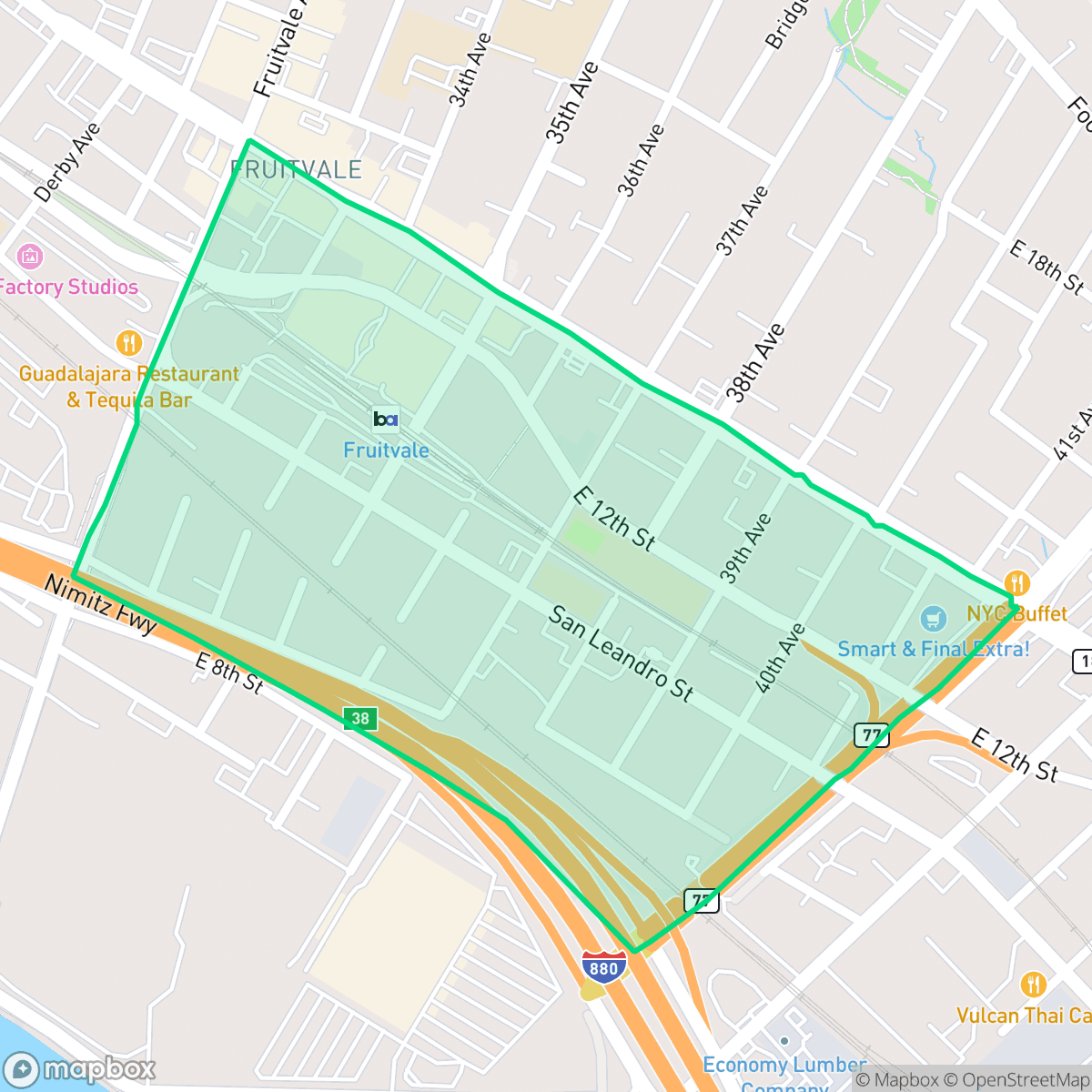
Centered around the Fruitvale BART station in East Oakland, the Fruitvale Station neighborhood evolved from 19th-century fruit orchards planted by horticulturist Henderson Luelling. During the 1950s and 1960s, urban renewal projects and freeway construction in West Oakland displaced many African American and Latino residents to the area. This demographic shift transformed the neighborhood into a vibrant cultural hub and a crucible for the Chicano Movement. In response to a 1991 BART proposal to build a massive parking lot, the community-based Unity Council successfully advocated for and developed the Fruitvale Transit Village. Opened in 2003, this pioneering transit-oriented development features affordable housing, a public market, and the Cesar Chavez Library. Today, the neighborhood remains a culturally rich Latino enclave celebrated for its legacy of community activism.
The area functions as a central transit node, characterized by a mix of modest multi-unit housing and industrial structures. It maintains a distinct urban identity, with local businesses like Pena's Bakery and Ilava Hawaiian Barbecue contributing to a lively street-level atmosphere. The proximity to the BART station provides significant connectivity, making it a functional choice for those who prioritize public transit access over quiet suburban living.
Prospective residents should weigh the benefits of transit access against the reality of the local environment. The neighborhood experiences high levels of road noise and lacks significant public park space, which may be challenging for pet owners. While the local school district faces systemic challenges, high-performing options like Ascend and Arise High provide alternatives for families. Overall, the area is best suited for commuters and those who value a culturally rich, transit-connected lifestyle in a dense urban setting.
Neighborhood Scores Across 15 Qualities
Buildings are situated with varying levels of separation, featuring both shared walls and moderate spacing between structures. This level of privacy is slightly higher than the Oakland average according to iHuus data.
A consistent grid system with visible sidewalks and frequent crosswalks makes navigating residential blocks easy. This level of pedestrian accessibility is nearly comparable to the city average according to iHuus data.
Residential views consist primarily of modest bungalows and multi-unit buildings with small, tidy yards. According to iHuus data, the visual landscape is slightly less varied than the Oakland city average.
Limited access to public parks and narrow, paved sidewalks make long walks difficult for pet owners. According to iHuus data, the area has significantly less greenery and open space for dogs compared to the rest of Oakland.
Dense low-rise urban structures and significant grey infrastructure define this area, which feels more developed than the average Oakland neighborhood. According to iHuus data, the landscape consists of a mix of residential pockets and large-scale commercial or industrial facilities.
Social hubs and diverse dining options exist alongside quieter industrial and suburban patches. According to iHuus data, the level of activity and amenity access is slightly higher than the Oakland average.
Constant sound from heavy rail and transit infrastructure creates significant acoustic disturbance. According to iHuus data, noise levels in this area are considerably higher than the Oakland average.
Air quality remains consistently good with rare instances of elevated readings. This level of air cleanliness is roughly in line with the average for Oakland.
Active warehouses and heavy rail infrastructure contribute to higher levels of industrial activity and truck traffic than is typical for Oakland. Residents may experience more frequent noise from logistics hubs and shipping operations near the neighborhood's edge.
Health insurance access is notably lower than the Oakland average, according to iHuus data. This indicates a higher proportion of uninsured residents within the local community.
Voting patterns and census indicators reflect a deeply liberal political landscape that is slightly more pronounced than the Oakland average, according to iHuus data.
A balanced distribution of young adults, families, and older residents defines the area. This demographic spread is slightly lower than the Oakland average, according to iHuus data.
Flood risk in this area is significantly higher than the Oakland average. Residents should be aware of increased vulnerability to water-related hazards according to iHuus data.
Address-Level Insights for Fruitvale Station


iHuus Neighborhood Intelligence Insights
Get address-level neighborhood insights for Fruitvale Station
- Street-level scores — see how individual blocks compare, not just neighborhood averages
- Micro-zone boundaries — identify quiet pockets, flood boundaries, and walkable clusters before you visit
- 15 dimensions in full — walkability, noise, air quality, school quality, insurance coverage, population age profile, urban/rural index, and more
- Boundary risk alerts — know if your address sits near a block boundary where scores drop, the kind of detail no listing will ever mention
- School insights — individual school ratings and insights, not just district-level data
- Compare before you commit — side-by-side data across neighborhoods, down to block precision
No credit card required
Compare with Any Neighborhood
| Dimension | Fruitvale Station | Acorn |
|---|---|---|
| 🚶 Walkabilityavg 8.99 | ||
| 🔊 Acoustic Comfortavg 3.24 | ||
| 🤫 Privacy Indexavg 3.74 | ||
| 🎨 Visual Appealavg 6.28 | ||
| 🐕 Dog Friendlinessavg 5.74 | ||
| 🗺️ Urban-Rural Indexavg 6.02 | ||
| ✨ Neighborhood Vibeavg 5.22 | ||
| 🏥 Health Insurance Coverageavg 7.4 | ||
| 🌿 Air Qualityavg 8.06 | ||
| 🏭 Industrial Proximityavg 8.37 | ||
| 🌊 Flood Safetyavg 2.61 | ||
| 🗳️ Ideological Leanavg 9.95 | ||
| 👥 Population Age Profileavg 4.92 | ||
| 🔥 Fire Safetyavg 0.17 | ||
| 🏫 School Quality |
Fruitvale Station Rankings
School Districts Serving Fruitvale Station
School Insights for Fruitvale Station
Below average outcomes; significant attendance and academic challenges.
School Insights
See what's really behind every school rating near Fruitvale Station
- Individual school ratings — each school's own score with outcome context, not just a district average
- Enrollment & class size data — student-to-teacher ratio and how it compares to the state average
- Full demographics breakdown — ethnicity and gender composition for every school in the enrollment zone
- Every school in the district — all schools within the enrollment boundary ranked by rating, not just the closest one
- Grade levels & benchmarks — elementary through high school, with below/above state-average flags
No credit card required