Frick, Oakland
Updated · 3,850 residents
Frick is an exceptionally walkable residential enclave in East Oakland, defined by its dense grid of early 20th-century bungalows and Mediterranean homes. According to iHuus data, the area offers a quiet atmosphere with minimal industrial presence, though residents should expect limited privacy due to the close proximity of neighboring houses.
Key Highlights
About Frick
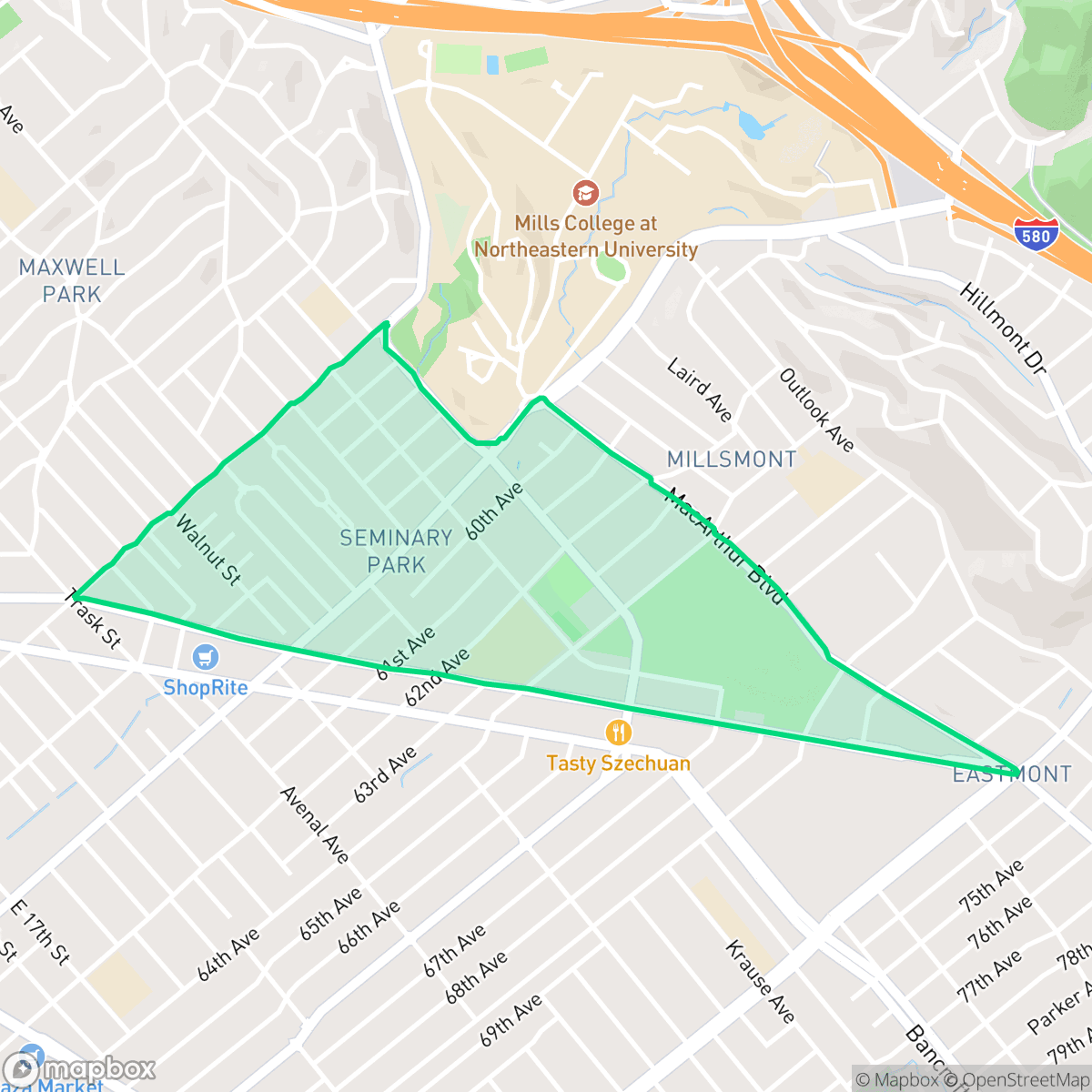
Located in East Oakland, the Frick neighborhood originated as a semi-rural community in the early 1900s. The neighborhood is named after local mining and lumber magnate Walter P. Frick, who donated land to the cash-strapped Lockwood School District in 1908. The W. P. Frick School opened at Foothill Boulevard and 62nd Avenue in 1909, and the surrounding area was annexed into the City of Oakland just months later. The school eventually transitioned into Frick Junior High in 1923. Architecturally, this quiet residential enclave is defined by its early 20th-century housing stock, which predominantly features well-preserved Craftsman-style bungalows and Mediterranean Revival single-family homes.
The neighborhood functions as a stable residential zone, characterized by its consistent street grid and a lack of heavy industrial activity. Local amenities include popular spots like Sweetfingers, Grind Coffee House, and Cafe La Fong, which contribute to a moderate level of local activity. While the area maintains a high walkability score, the housing density results in closely spaced properties, which limits individual privacy for homeowners. Air quality remains relatively high compared to other parts of the city, and the neighborhood benefits from a quiet acoustic environment with an average noise level of 54 decibels.
Prospective residents should weigh the benefits of a highly walkable, community-focused layout against the challenges of the local school district, which faces significant budgetary and academic hurdles. While the neighborhood provides a strong sense of community and access to basic services, it is situated in a zone with high flood and fire risk profiles. According to iHuus, the area is best suited for those prioritizing pedestrian access and a quiet, established neighborhood feel over proximity to high-performing public schools or expansive private lots.
Neighborhood Scores Across 15 Qualities
Residential spacing is comparable to the Oakland average, featuring a mix of building densities where some structures sit in close proximity to neighbors. According to iHuus data, certain pockets of the neighborhood contain high-density housing with houses situated very near to one another or sharing property lines.
Extensive sidewalk networks and marked crosswalks exist throughout the residential grid and near commercial centers. Pedestrian access is consistent across the neighborhood, matching the level of walkability found elsewhere in Oakland.
Dense tract housing with small yards and consistent roof patterns characterizes this area. According to iHuus data, the visual variety in the neighborhood is slightly below the Oakland average.
Access to pet-friendly space is consistent with the city average. While some areas feature large parks and campus greens for walking, other parts of the neighborhood consist of dense housing with limited public green space.
A blend of dense urban grids and low-density residential pockets characterizes this area, presenting a more semi-rural feel than the typical Oakland landscape according to iHuus data.
Mixes quiet residential streets and green spaces with lively pockets of diverse dining and local coffee shops. This level of activity is largely consistent with the Oakland average, though some areas near the highway or industrial units are noticeably more secluded.
Steady traffic sounds from nearby busy streets create a consistent hum. According to iHuus data, this level of acoustic activity is notably higher than the average for Oakland.
Air quality is generally good with infrequent periods of elevated readings. This level of cleanliness is slightly lower than the average found throughout Oakland.
Minimal industrial presence characterizes this area, with only scattered light commercial or warehouse buildings visible in certain corners. According to iHuus data, the neighborhood remains very similar to the Oakland average in terms of its lack of heavy industrial zones.
Health insurance coverage among residents is relatively high, though slightly below the Oakland average according to iHuus data.
Voting patterns and census indicators show a highly progressive political landscape that is consistent with the rest of Oakland. Residents will find a community with very strong liberal leanings according to iHuus data.
Residents live alongside a balanced mix of young professionals, families, and seniors. This demographic distribution is roughly in line with the average found across Oakland.
Located in a coastal high-hazard zone, this area faces significant risks from wave action and flooding. According to iHuus data, these conditions represent a much higher level of vulnerability compared to the Oakland average and may result in elevated insurance costs.
Address-Level Insights for Frick


iHuus Neighborhood Intelligence Insights
Get address-level neighborhood insights for Frick
- Street-level scores — see how individual blocks compare, not just neighborhood averages
- Micro-zone boundaries — identify quiet pockets, flood boundaries, and walkable clusters before you visit
- 15 dimensions in full — walkability, noise, air quality, school quality, insurance coverage, population age profile, urban/rural index, and more
- Boundary risk alerts — know if your address sits near a block boundary where scores drop, the kind of detail no listing will ever mention
- School insights — individual school ratings and insights, not just district-level data
- Compare before you commit — side-by-side data across neighborhoods, down to block precision
No credit card required
Compare with Any Neighborhood
| Dimension | Frick | Acorn |
|---|---|---|
| 🚶 Walkabilityavg 8.99 | ||
| 🔊 Acoustic Comfortavg 3.24 | ||
| 🤫 Privacy Indexavg 3.74 | ||
| 🎨 Visual Appealavg 6.28 | ||
| 🐕 Dog Friendlinessavg 5.74 | ||
| 🗺️ Urban-Rural Indexavg 6.02 | ||
| ✨ Neighborhood Vibeavg 5.22 | ||
| 🏥 Health Insurance Coverageavg 7.4 | ||
| 🌿 Air Qualityavg 8.06 | ||
| 🏭 Industrial Proximityavg 8.37 | ||
| 🌊 Flood Safetyavg 2.61 | ||
| 🗳️ Ideological Leanavg 9.95 | ||
| 👥 Population Age Profileavg 4.92 | ||
| 🔥 Fire Safetyavg 0.17 | ||
| 🏫 School Quality |
Frick Rankings
School Districts Serving Frick
School Insights for Frick
Below average outcomes; significant attendance and academic challenges.
School Insights
See what's really behind every school rating near Frick
- Individual school ratings — each school's own score with outcome context, not just a district average
- Enrollment & class size data — student-to-teacher ratio and how it compares to the state average
- Full demographics breakdown — ethnicity and gender composition for every school in the enrollment zone
- Every school in the district — all schools within the enrollment boundary ranked by rating, not just the closest one
- Grade levels & benchmarks — elementary through high school, with below/above state-average flags
No credit card required