Foothill Square, Oakland
Updated · 1,480 residents
Foothill Square is an exceptionally walkable residential enclave in East Oakland, defined by its consistent grid-based street layout and proximity to established commercial centers. While the area offers high health insurance coverage and convenient access to local dining, residents should be prepared for significant noise from nearby road traffic.
Key Highlights
About Foothill Square
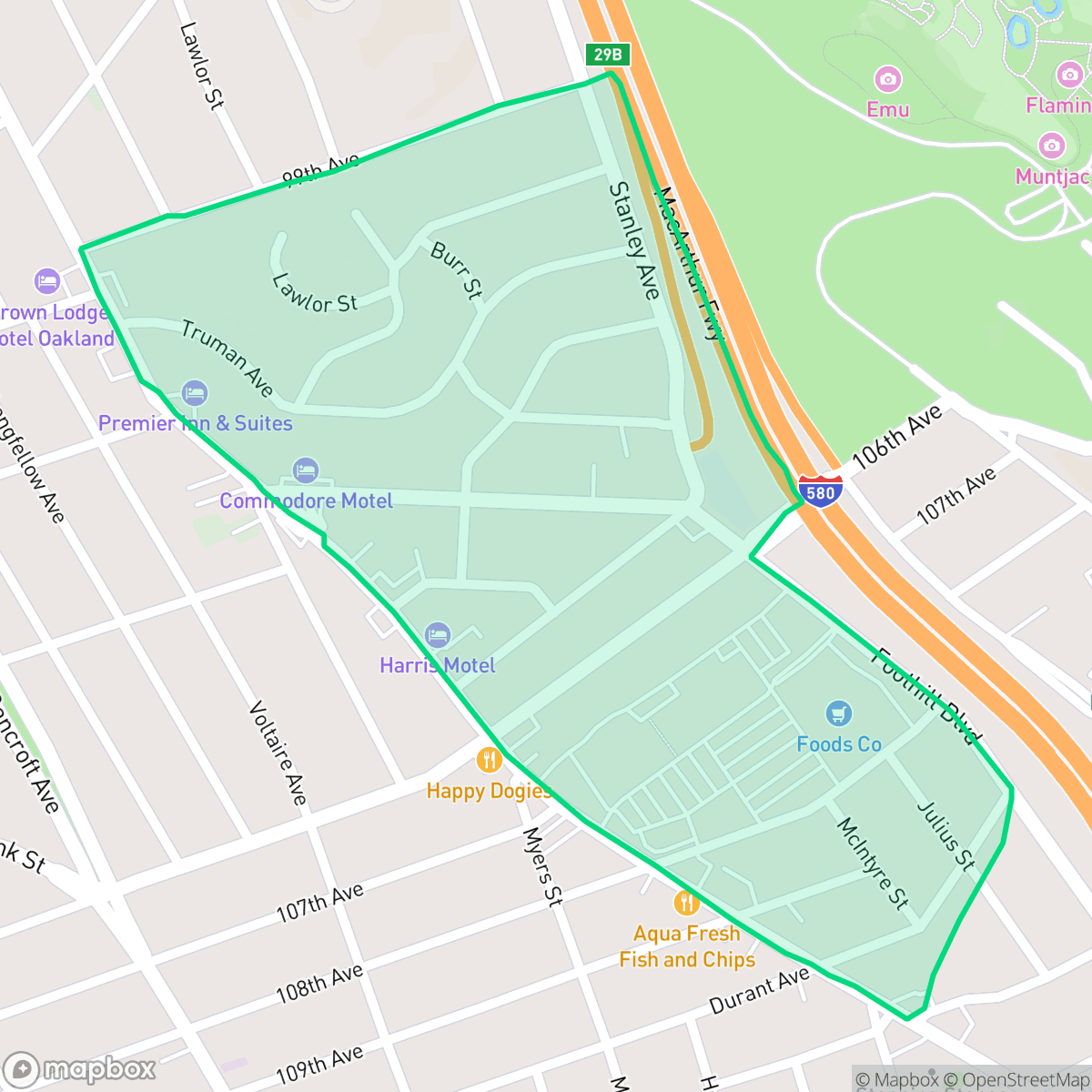
Located in East Oakland near the San Leandro border, the Foothill Square neighborhood developed around a rich industrial and commercial history. The area was originally home to the Fageol Motors Company (later Peterbilt) factory. In 1962, this site was transformed into the Foothill Square Shopping Center, designed by the renowned architectural firm Welton Becket & Associates with landscaping by Lawrence Halprin. The modernist, pedestrian-focused mall was celebrated as a suburban dream, marked by a ceremonial 'burying of a parking meter' to symbolize free parking forever. Demographically, Foothill Square evolved after World War II to become a vital hub for East Oakland’s African American community, historically holding one of the city's highest concentrations of Black residents.
The neighborhood is characterized by a low-density urban landscape featuring single-family homes and a highly accessible grid system. It maintains a calm, suburban atmosphere despite its proximity to major transportation corridors. Residents benefit from high walkability and easy access to local amenities, including popular neighborhood dining options such as Aqua Fresh Seafoods and Happy Hot Dog. The area serves as a stable residential hub, supported by strong community health insurance coverage and a layout that prioritizes pedestrian movement.
Potential residents should consider specific livability trade-offs when evaluating the area. While the neighborhood is highly functional for daily errands, it faces challenges regarding acoustic comfort due to persistent road noise. Furthermore, the area is subject to elevated risks concerning flood and fire safety. It is best suited for those who prioritize walkability and community access over quiet surroundings or modern architectural aesthetics.
Neighborhood Scores Across 15 Qualities
Residential spacing provides more separation than the Oakland average, though many homes remain close together with shared property lines. According to iHuus data, the density remains high with some buffer between neighbors in certain sections.
Wide sidewalks and clear crosswalks define the residential grid, though the nearby freeway serves as a significant barrier to pedestrian movement. This level of walkability is slightly above the Oakland average according to iHuus data.
Standard tract housing defines the landscape, characterized by uniform rooflines and small yards. This area offers a typical urban residential aesthetic that is slightly below the Oakland average according to iHuus data.
Access to a large regional park and continuous sidewalks provides ample space for pet exercise. According to iHuus data, the availability of green space and connected paths in this area is notably higher than the Oakland average.
Open land and scattered greenery provide a more semi-rural atmosphere than the typical Oakland urban landscape. Residents can expect more frequent sightings of fields or woodlands compared to the denser city average, according to iHuus data.
Suburban blocks and open green spaces provide a low-density environment, though activity levels are lower than the Oakland average. Most residents will find a calm atmosphere characterized by scattered local services and a reliance on vehicles for frequent errands.
Frequent sound disturbances from nearby railroad tracks and heavy freeway traffic are common here. This level of acoustic activity is consistent with the average experienced across Oakland.
Air quality levels fluctuate between acceptable and unhealthy periods, appearing lower than the Oakland average according to iHuus data. Sensitive groups may experience occasional concerns on certain days.
Industrial presence is significantly lower than the Oakland average, as the area is almost entirely composed of residential and institutional spaces. According to iHuus data, there are no detected warehouses or heavy industrial facilities within the neighborhood boundaries.
Health insurance access among residents is slightly below the Oakland average, according to iHuus data.
Voting patterns and census indicators in Foothill Square show a highly liberal political leaning that is consistent with the broader Oakland area.
A balanced demographic of young adults, families, and older residents characterizes this area. This age distribution is roughly in line with the average found across Oakland.
Properties in this area are located within a designated floodplain, which may necessitate flood insurance. According to iHuus data, the risk level here is higher than the Oakland city average.
Address-Level Insights for Foothill Square


iHuus Neighborhood Intelligence Insights
Get address-level neighborhood insights for Foothill Square
- Street-level scores — see how individual blocks compare, not just neighborhood averages
- Micro-zone boundaries — identify quiet pockets, flood boundaries, and walkable clusters before you visit
- 15 dimensions in full — walkability, noise, air quality, school quality, insurance coverage, population age profile, urban/rural index, and more
- Boundary risk alerts — know if your address sits near a block boundary where scores drop, the kind of detail no listing will ever mention
- School insights — individual school ratings and insights, not just district-level data
- Compare before you commit — side-by-side data across neighborhoods, down to block precision
No credit card required
Compare with Any Neighborhood
| Dimension | Foothill Square | Acorn |
|---|---|---|
| 🚶 Walkabilityavg 8.99 | ||
| 🔊 Acoustic Comfortavg 3.24 | ||
| 🤫 Privacy Indexavg 3.74 | ||
| 🎨 Visual Appealavg 6.28 | ||
| 🐕 Dog Friendlinessavg 5.74 | ||
| 🗺️ Urban-Rural Indexavg 6.02 | ||
| ✨ Neighborhood Vibeavg 5.22 | ||
| 🏥 Health Insurance Coverageavg 7.4 | ||
| 🌿 Air Qualityavg 8.06 | ||
| 🏭 Industrial Proximityavg 8.37 | ||
| 🌊 Flood Safetyavg 2.61 | ||
| 🗳️ Ideological Leanavg 9.95 | ||
| 👥 Population Age Profileavg 4.92 | ||
| 🔥 Fire Safetyavg 0.17 | ||
| 🏫 School Quality |
Foothill Square Rankings
School Districts Serving Foothill Square
School Insights for Foothill Square
Below average outcomes; significant attendance and academic challenges.
School Insights
See what's really behind every school rating near Foothill Square
- Individual school ratings — each school's own score with outcome context, not just a district average
- Enrollment & class size data — student-to-teacher ratio and how it compares to the state average
- Full demographics breakdown — ethnicity and gender composition for every school in the enrollment zone
- Every school in the district — all schools within the enrollment boundary ranked by rating, not just the closest one
- Grade levels & benchmarks — elementary through high school, with below/above state-average flags
No credit card required