Fitchburg, Oakland
Updated · 1,998 residents
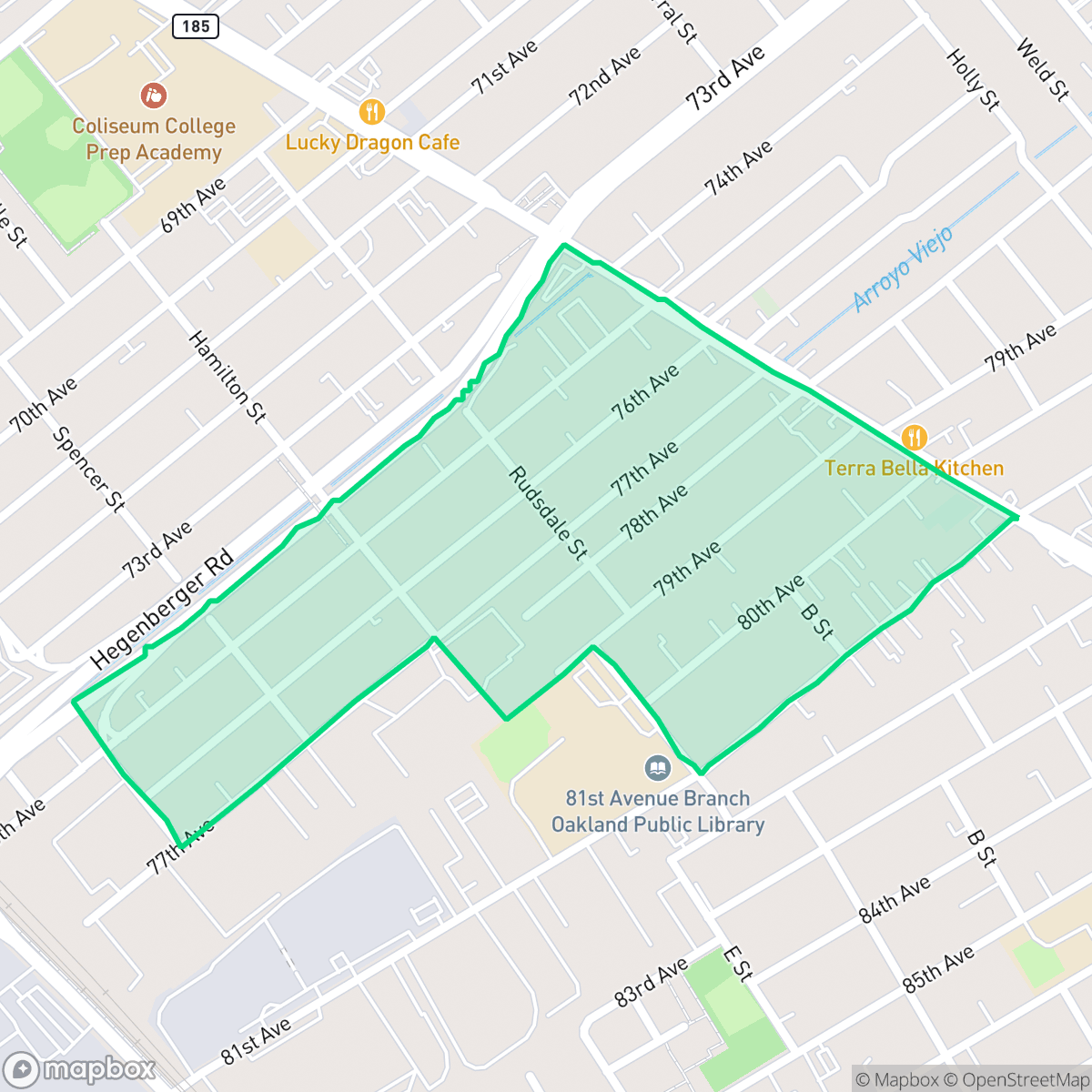
Fitchburg is a dense, highly walkable East Oakland neighborhood defined by a structured grid of single-family homes and proximity to industrial corridors. While it offers excellent pedestrian access to local services, residents experience significant road traffic noise and a limited amount of public green space.
Key Highlights
About Fitchburg
The East Oakland neighborhood of Fitchburg originated around 1850 when Henry S. Fitch purchased the land, officially plotting the town in 1870. Fitchburg was annexed by Oakland in December 1909. Historically bounded to the north by 69th Avenue, the neighborhood evolved into a prominent industrial hub during the 20th century. It was long anchored by major manufacturing facilities, most notably the AB&I Foundry (American Brass & Iron), which produced cast iron plumbing systems on San Leandro Street from 1906 until 2022, and the Sunshine Biscuit Factory, which operated from 1942 to 1995. Today, the former biscuit factory's iconic sign remains a local landmark visible from BART. Cultural and community life in modern Fitchburg centers around local assets like the Tassafaronga Recreation Center and the 81st Avenue Branch Library.
The neighborhood functions as a compact urban enclave where the consistent street grid facilitates easy movement for pedestrians. The area maintains a calm, mid-rise atmosphere, punctuated by local establishments such as El Tacostao and the Lucky Dragon Cafe. The architecture consists of standard middle-class tract housing situated on small lots, resulting in high residential density and limited privacy between properties. The presence of large warehouses and industrial facilities near the neighborhood perimeter contributes to a distinct, utilitarian character that defines the local landscape.
Prospective residents should weigh the benefits of high walkability against the realities of living in a dense, industrial-adjacent environment. The area faces notable challenges, including high levels of road traffic noise and environmental risks such as flood and fire hazards that exceed city averages. Additionally, the local school system, managed by the Oakland Unified School District, is currently navigating significant financial and structural instability. This neighborhood is best suited for individuals who prioritize central location and pedestrian access over quietude or expansive outdoor residential amenities.
Neighborhood Scores Across 15 Qualities
Residential structures are closely packed with minimal separation between properties. According to iHuus data, this neighborhood offers less privacy than the Oakland average due to the high density of houses sharing close property lines.
Pedestrian movement is highly efficient due to a dense grid pattern featuring continuous sidewalks and clearly marked crossings. This level of accessibility for walkers is notably higher than the Oakland average, according to iHuus data.
Standard tract housing and industrial warehouses characterize the landscape, making the visual variety lower than the Oakland average. Residential lots are typically small with uniform rooflines and very little visible greenery or luxury amenities.
Limited access to public parks and narrow sidewalk verges make for few convenient walking options for pet owners. According to iHuus data, the availability of green space for dogs is below the Oakland average.
Streetscapes feature a high density of low-rise buildings and industrial warehouses with limited open green space. This environment is more built-up and less suburban than the Oakland average, according to iHuus data.
Activity levels in Fitchburg are lower than the Oakland average, featuring a mix of calm mid-rise blocks and quiet industrial areas. Many parts of the neighborhood rely on vehicles due to a limited density of walkable businesses and services.
Frequent noise from nearby heavy transit corridors and rail lines makes this area significantly louder than the Oakland average. Constant acoustic disturbance from freeway and railroad traffic is a primary characteristic of this neighborhood according to iHuus data.
Air quality in this area fluctuates between acceptable and unhealthy levels, presenting occasional concerns for sensitive groups. This level of air quality is lower than the Oakland average according to iHuus data.
Residential areas predominate here with only occasional light commercial activity. This neighborhood experiences significantly less proximity to heavy industrial sites and large-scale logistics hubs than the Oakland average, according to iHuus data.
Health insurance access is slightly lower than the Oakland average, according to iHuus data. A significant portion of the population maintains coverage, though a notable segment of residents remains uninsured.
Voting patterns and census indicators show a deeply liberal political landscape that is consistent with the broader Oakland area. According to iHuus data, the neighborhood reflects the highly progressive lean characteristic of the city.
Residents live alongside a varied demographic of young adults, families, and seniors. This age distribution is slightly lower than the Oakland average, according to iHuus data.
Significant flood vulnerability exists in this area, representing a much higher risk level than the Oakland average. According to iHuus data, residents should be aware of much greater susceptibility to flooding compared to most other parts of the city.
Address-Level Insights for Fitchburg


iHuus Neighborhood Intelligence Insights
Get address-level neighborhood insights for Fitchburg
- Street-level scores — see how individual blocks compare, not just neighborhood averages
- Micro-zone boundaries — identify quiet pockets, flood boundaries, and walkable clusters before you visit
- 15 dimensions in full — walkability, noise, air quality, school quality, insurance coverage, population age profile, urban/rural index, and more
- Boundary risk alerts — know if your address sits near a block boundary where scores drop, the kind of detail no listing will ever mention
- School insights — individual school ratings and insights, not just district-level data
- Compare before you commit — side-by-side data across neighborhoods, down to block precision
No credit card required
Compare with Any Neighborhood
| Dimension | Fitchburg | Acorn |
|---|---|---|
| 🚶 Walkabilityavg 8.99 | ||
| 🔊 Acoustic Comfortavg 3.24 | ||
| 🤫 Privacy Indexavg 3.74 | ||
| 🎨 Visual Appealavg 6.28 | ||
| 🐕 Dog Friendlinessavg 5.74 | ||
| 🗺️ Urban-Rural Indexavg 6.02 | ||
| ✨ Neighborhood Vibeavg 5.22 | ||
| 🏥 Health Insurance Coverageavg 7.4 | ||
| 🌿 Air Qualityavg 8.06 | ||
| 🏭 Industrial Proximityavg 8.37 | ||
| 🌊 Flood Safetyavg 2.61 | ||
| 🗳️ Ideological Leanavg 9.95 | ||
| 👥 Population Age Profileavg 4.92 | ||
| 🔥 Fire Safetyavg 0.17 | ||
| 🏫 School Quality |
Fitchburg Rankings
School Districts Serving Fitchburg
School Insights for Fitchburg
Below average outcomes; significant attendance and academic challenges.
School Insights
See what's really behind every school rating near Fitchburg
- Individual school ratings — each school's own score with outcome context, not just a district average
- Enrollment & class size data — student-to-teacher ratio and how it compares to the state average
- Full demographics breakdown — ethnicity and gender composition for every school in the enrollment zone
- Every school in the district — all schools within the enrollment boundary ranked by rating, not just the closest one
- Grade levels & benchmarks — elementary through high school, with below/above state-average flags
No credit card required