Eastmont Hills, Oakland
Updated · 3,658 residents
Eastmont Hills is a quiet residential enclave in Oakland, characterized by its hilly terrain and proximity to the King Estate Open Space Preserve. The area features high walkability with consistent sidewalks, though residents experience a low-key atmosphere with limited local commercial activity.
Key Highlights
About Eastmont Hills
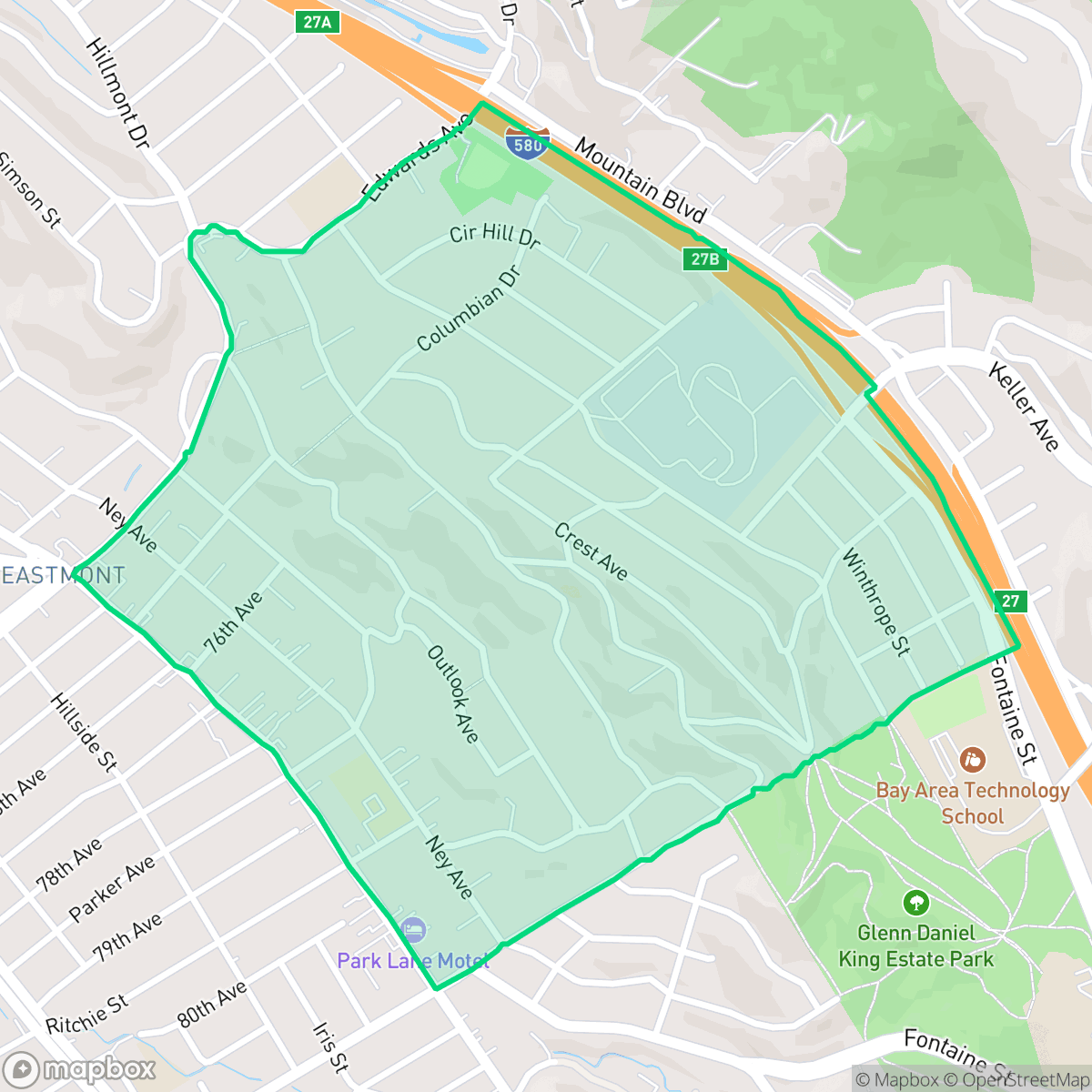
Originally part of the historic Peralta land grant, the Eastmont Hills area of Oakland initially served as the site of country estates for prominent families, including the Durants, Hellmans, and Kings. The neighborhood transitioned into a residential suburb during the 1920s and 1930s, spurred by the industrial boom of the nearby Chevrolet Oakland Assembly plant. Rising sharply east of MacArthur Boulevard, the neighborhood is characterized by narrow, winding streets like Outlook and Parker avenues. Its architectural stock features a diverse mix of 1930s cottages, California bungalows, and mid-century modern split-levels and ranch homes. Today, Eastmont Hills is bordered on its eastern edge by the King Estate Open Space Preserve, which offers expansive views of the San Francisco Bay.
This neighborhood offers a dense suburban environment defined by its winding streets and a diverse collection of mid-century and bungalow-style homes. Residents benefit from significant tree canopy coverage and easy access to outdoor recreation at the nearby preserve, which provides expansive views of the San Francisco Bay. While the area maintains a consistent grid of sidewalks that makes it highly walkable, it remains a quiet residential pocket with few businesses or social hubs within immediate walking distance.
Prospective residents should consider that the area faces specific challenges, including a 59 dB average noise level primarily driven by road traffic and significant concerns regarding fire and flood safety. The local school district, Oakland Unified, currently faces systemic instability, which may be a factor for families. While the neighborhood provides a peaceful retreat from the city's industrial zones, those seeking a vibrant, amenity-rich lifestyle may find the limited commercial options a notable trade-off.
Neighborhood Scores Across 15 Qualities
Residential spacing offers more separation between neighbors than the Oakland average. While some houses are positioned closely together, many properties maintain a modest buffer from adjacent structures.
Sidewalks are widely available along major roads and residential grids, though the neighborhood sits slightly below the Oakland average for pedestrian accessibility.
Residential streetscapes feature larger homes and spacious driveways, making the area slightly more visually appealing than the Oakland average. According to iHuus data, some sections also consist of more compact workforce housing with tighter lot spacing.
Green buffers and nearby school fields provide some space for pets, though the area features many private backyards and limited dedicated parkland. This level of accessibility is higher than the Oakland average according to iHuus data.
Frequent open land and scattered homes among woodland areas provide a more open environment than the typical Oakland urban landscape. According to iHuus data, this area features a higher prevalence of greenery and low-density residential pockets compared to the city average.
Suburban streets and green spaces predominate here, offering a more tranquil atmosphere than the Oakland average. While occasional local services exist, most commercial amenities are not within walking distance.
Frequent noise from nearby freeways and rail lines is a notable characteristic of this area. According to iHuus data, acoustic comfort levels in Eastmont Hills are roughly in line with the Oakland average.
Air quality levels fluctuate between acceptable and unhealthy, particularly for sensitive groups. This represents a notable decline compared to the Oakland average, according to iHuus data.
Residential and commercial uses dominate the area with no heavy industrial hazards or large warehouses detected. This absence of industrial activity is slightly more pronounced than in other parts of Oakland, according to iHuus data.
Health insurance enrollment among residents is slightly below the Oakland average. According to iHuus data, a significant portion of the population maintains coverage, though access is not as widespread as in other parts of the city.
Voting patterns and census indicators show a deeply liberal political leaning that is slightly more pronounced than the Oakland average, according to iHuus data.
A varied mix of young adults, families, and older residents characterizes the community. This demographic distribution is largely comparable to the broader Oakland area, according to iHuus data.
Property sits within a designated 100-year floodplain, which may necessitate flood insurance according to iHuus data. This level of risk is slightly higher than the Oakland city average.
Wildfire hazards are significantly higher here than in the rest of Oakland. Residents should prioritize maximum fire protection measures due to the extreme level of risk identified in iHuus data.
Address-Level Insights for Eastmont Hills


iHuus Neighborhood Intelligence Insights
Get address-level neighborhood insights for Eastmont Hills
- Street-level scores — see how individual blocks compare, not just neighborhood averages
- Micro-zone boundaries — identify quiet pockets, flood boundaries, and walkable clusters before you visit
- 15 dimensions in full — walkability, noise, air quality, school quality, insurance coverage, population age profile, urban/rural index, and more
- Boundary risk alerts — know if your address sits near a block boundary where scores drop, the kind of detail no listing will ever mention
- School insights — individual school ratings and insights, not just district-level data
- Compare before you commit — side-by-side data across neighborhoods, down to block precision
No credit card required
Compare with Any Neighborhood
| Dimension | Eastmont Hills | Acorn |
|---|---|---|
| 🚶 Walkabilityavg 8.99 | ||
| 🔊 Acoustic Comfortavg 3.24 | ||
| 🤫 Privacy Indexavg 3.74 | ||
| 🎨 Visual Appealavg 6.28 | ||
| 🐕 Dog Friendlinessavg 5.74 | ||
| 🗺️ Urban-Rural Indexavg 6.02 | ||
| ✨ Neighborhood Vibeavg 5.22 | ||
| 🏥 Health Insurance Coverageavg 7.4 | ||
| 🌿 Air Qualityavg 8.06 | ||
| 🏭 Industrial Proximityavg 8.37 | ||
| 🌊 Flood Safetyavg 2.61 | ||
| 🗳️ Ideological Leanavg 9.95 | ||
| 👥 Population Age Profileavg 4.92 | ||
| 🔥 Fire Safetyavg 0.17 | ||
| 🏫 School Quality |
Eastmont Hills Rankings
School Districts Serving Eastmont Hills
School Insights for Eastmont Hills
Below average outcomes; significant attendance and academic challenges.
School Insights
See what's really behind every school rating near Eastmont Hills
- Individual school ratings — each school's own score with outcome context, not just a district average
- Enrollment & class size data — student-to-teacher ratio and how it compares to the state average
- Full demographics breakdown — ethnicity and gender composition for every school in the enrollment zone
- Every school in the district — all schools within the enrollment boundary ranked by rating, not just the closest one
- Grade levels & benchmarks — elementary through high school, with below/above state-average flags
No credit card required