East Peralta, Oakland
Updated · 3,024 residents
East Peralta is a dense urban enclave known for its vibrant Little Saigon culinary scene and proximity to major industrial corridors. While the area offers a rich multicultural atmosphere, residents should be aware of high noise levels from nearby freeways and limited privacy in the tightly packed housing grid.
Key Highlights
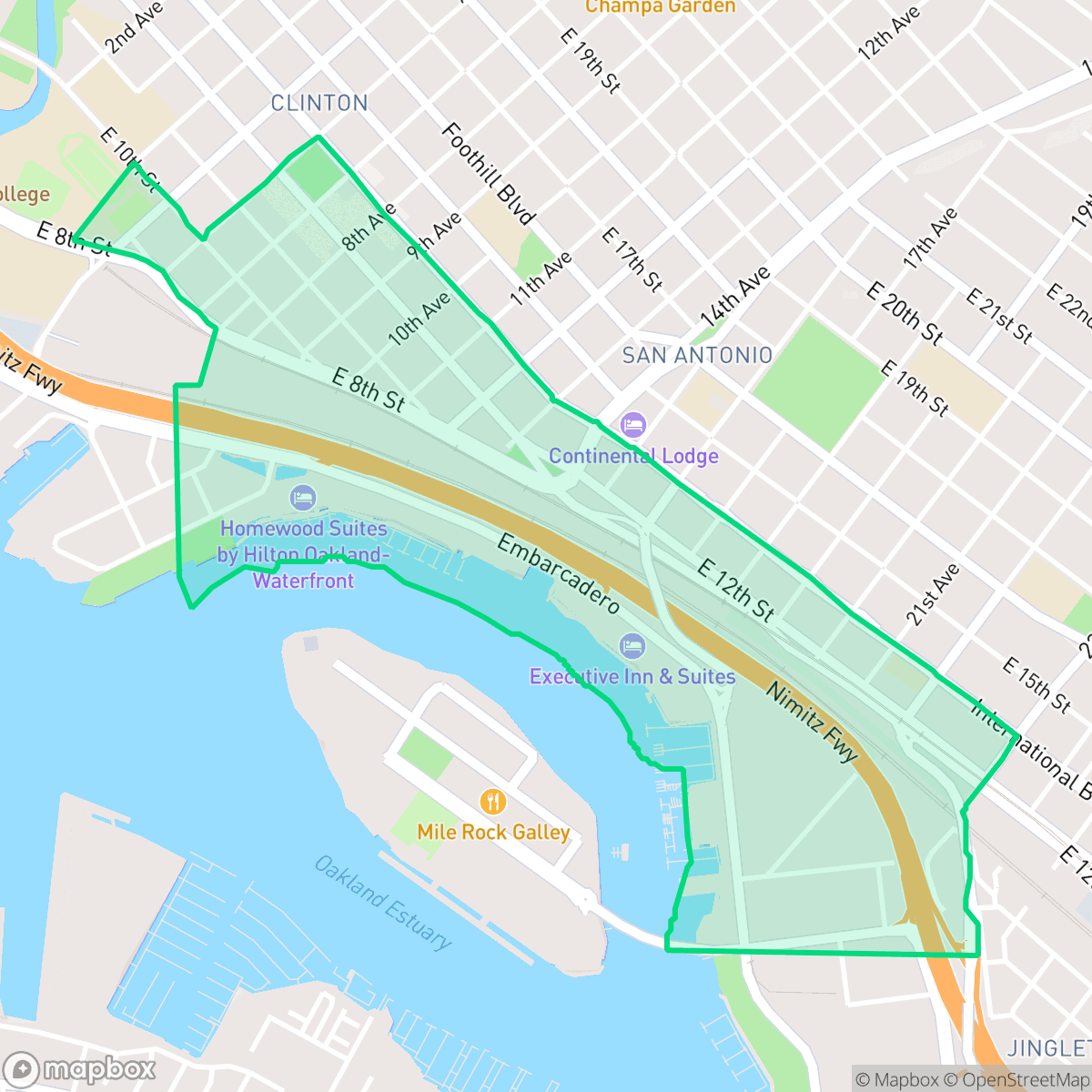
About East Peralta
Originally part of the 1820 Rancho San Antonio land grant to Luís María Peralta, the East Peralta neighborhood in Oakland's San Antonio district later became part of the town of Brooklyn before its 1872 annexation by Oakland. In the late 19th century, East Peralta developed into a thriving commercial hub. Notable architectural landmarks of this era on East 12th Street included the Italianate-style Central Block (built in 1880 by Charles Jurgens) and the 1885 Williams Block, featuring a distinctive pyramidal towered roof. Today, East Peralta (often associated with the broader Eastlake area) is characterized by its rich cultural diversity. The neighborhood is home to a prominent Southeast Asian immigrant community, particularly along East 12th Street and International Boulevard, which forms the heart of Oakland’s vibrant 'Little Saigon' cultural and culinary enclave.
The neighborhood serves as a significant cultural and culinary destination, anchored by the diverse businesses and eateries along East 12th Street and International Boulevard. The landscape is characterized by a mix of mid-rise apartment complexes and industrial infrastructure, creating a unique and gritty urban environment. According to iHuus data, the area maintains a high degree of ideological alignment, reflecting a community that is deeply integrated into the broader social fabric of Oakland. It is well-suited for those who prioritize proximity to transit and diverse local dining over quiet, suburban seclusion.
Prospective residents should consider the significant acoustic challenges associated with the area, as traffic and railway noise are prevalent. The neighborhood features a walkability score of 7.5 out of 10, though the presence of large logistics warehouses and multi-lane highways creates a fragmented pedestrian experience. Families evaluating the area should note the varying performance of local schools, with options ranging from the struggling Oakland Unified School District to high-performing charter alternatives like Downtown Charter Academy.
Neighborhood Scores Across 15 Qualities
Residential structures are closely spaced with minimal separation between properties. This density results in lower privacy levels than the Oakland average, as buildings often share property lines or sit within very narrow gaps.
A dense grid of sidewalks and marked crosswalks facilitates easy movement on foot, though large highway corridors can disrupt continuity. While slightly below the Oakland average, the area provides reliable pedestrian infrastructure and bridges over local waterways.
Housing consists primarily of high-density, small-lot residences with minimal private green space. This visual landscape is less lush than the Oakland average, featuring typical urban structures and limited luxury amenities according to iHuus data.
Public green space access is inconsistent across the area, though proximity to Lake Merritt provides high-quality walking options for pet owners. Some parts of the neighborhood consist primarily of urban concrete with limited access to public parks.
A blend of residential grids and heavy industrial infrastructure defines this area, creating a landscape that is slightly more urban and dense than the Oakland average. Large warehouses and transit corridors neighbor multi-unit residential blocks, according to iHuus data.
A steady rhythm of residential life and light industrial units defines this area, though the energy is slightly below the Oakland average. While diverse dining options exist, many businesses are not within easy walking distance.
Steady traffic sounds from nearby busy streets are a common feature here; however, acoustic levels are relatively more stable than the city average according to iHuus data.
Air quality is consistently good with very few instances of elevated pollution levels. This rating is nearly identical to the Oakland average, according to iHuus data.
Active warehouses, rail corridors, and highway proximity introduce intermittent noise and heavy vehicle traffic to the area. This level of industrial integration is notably higher than the average for Oakland.
Health insurance accessibility is notably lower in East Peralta than the Oakland average. According to iHuus data, a minority of residents in this area are covered by health insurance plans.
Voting patterns and census indicators show a predominant liberal leaning, which is consistent with the broader Oakland area according to iHuus data.
Residents live alongside a balanced mix of young adults, families, and older populations. This age distribution is consistent with the broader Oakland area, according to iHuus data.
Located within a coastal high-hazard zone, this area faces significant risks from wave action and flooding. According to iHuus data, these conditions are much more severe than the Oakland average and may lead to elevated or prohibitive insurance costs.
Address-Level Insights for East Peralta


iHuus Neighborhood Intelligence Insights
Get address-level neighborhood insights for East Peralta
- Street-level scores — see how individual blocks compare, not just neighborhood averages
- Micro-zone boundaries — identify quiet pockets, flood boundaries, and walkable clusters before you visit
- 15 dimensions in full — walkability, noise, air quality, school quality, insurance coverage, population age profile, urban/rural index, and more
- Boundary risk alerts — know if your address sits near a block boundary where scores drop, the kind of detail no listing will ever mention
- School insights — individual school ratings and insights, not just district-level data
- Compare before you commit — side-by-side data across neighborhoods, down to block precision
No credit card required
Compare with Any Neighborhood
| Dimension | East Peralta | Acorn |
|---|---|---|
| 🚶 Walkabilityavg 8.99 | ||
| 🔊 Acoustic Comfortavg 3.24 | ||
| 🤫 Privacy Indexavg 3.74 | ||
| 🎨 Visual Appealavg 6.28 | ||
| 🐕 Dog Friendlinessavg 5.74 | ||
| 🗺️ Urban-Rural Indexavg 6.02 | ||
| ✨ Neighborhood Vibeavg 5.22 | ||
| 🏥 Health Insurance Coverageavg 7.4 | ||
| 🌿 Air Qualityavg 8.06 | ||
| 🏭 Industrial Proximityavg 8.37 | ||
| 🌊 Flood Safetyavg 2.61 | ||
| 🗳️ Ideological Leanavg 9.95 | ||
| 👥 Population Age Profileavg 4.92 | ||
| 🔥 Fire Safetyavg 0.17 | ||
| 🏫 School Quality |
East Peralta Rankings
School Districts Serving East Peralta
School Insights for East Peralta
Below average outcomes; significant attendance and academic challenges.
School Insights
See what's really behind every school rating near East Peralta
- Individual school ratings — each school's own score with outcome context, not just a district average
- Enrollment & class size data — student-to-teacher ratio and how it compares to the state average
- Full demographics breakdown — ethnicity and gender composition for every school in the enrollment zone
- Every school in the district — all schools within the enrollment boundary ranked by rating, not just the closest one
- Grade levels & benchmarks — elementary through high school, with below/above state-average flags
No credit card required