Durant Manor, Oakland
Updated · 2,045 residents
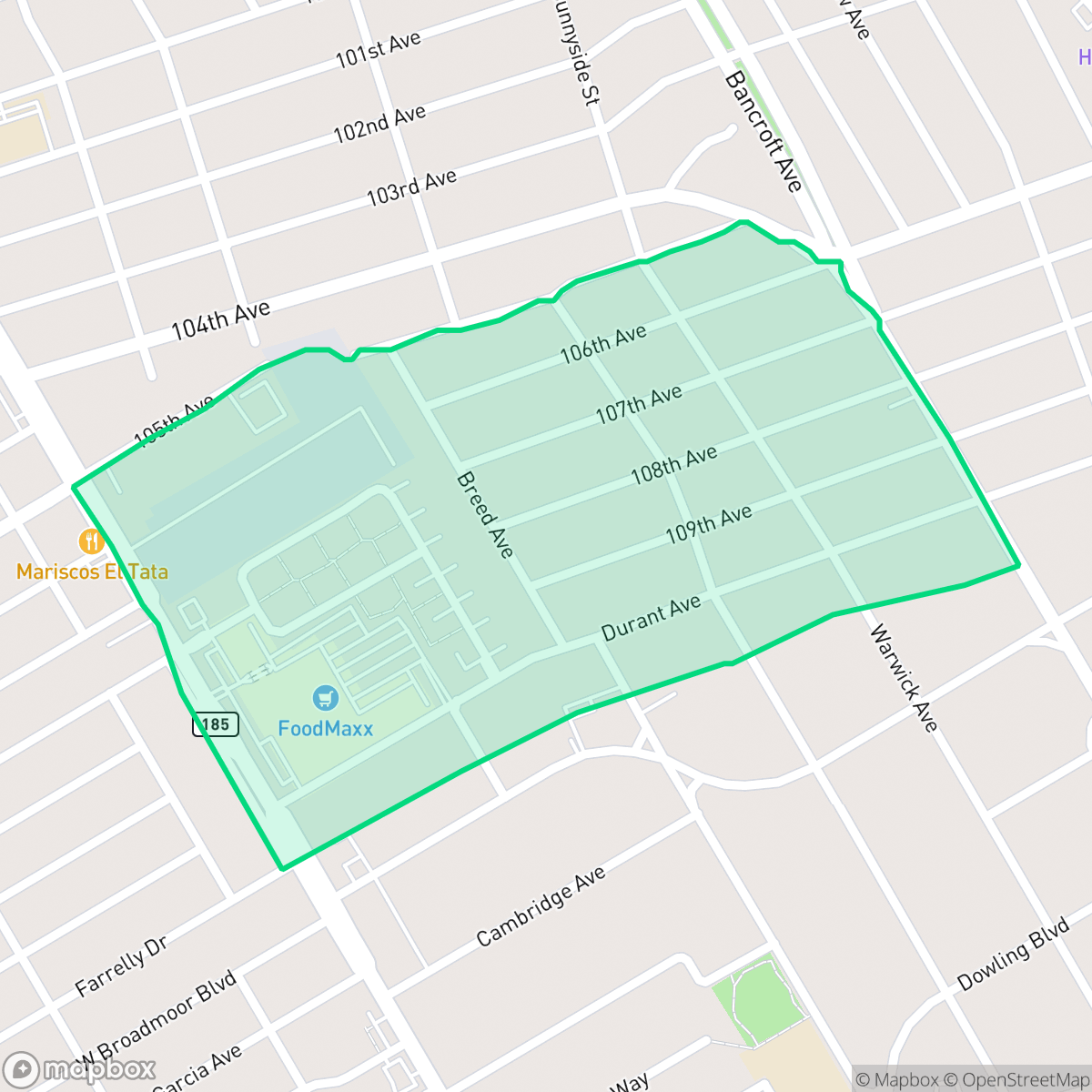
Durant Manor is a highly walkable neighborhood in East Oakland defined by its dense grid of residential streets and 1920s architectural character. While the area offers convenient access to local infrastructure, residents experience high levels of road traffic noise and limited private outdoor space due to the close proximity of homes.
Key Highlights
About Durant Manor
Located in East Oakland, the Durant Manor neighborhood owes its name and origins to Durant Motors, which established its Western automobile assembly factory and headquarters in the area in 1922. Following the factory's establishment, the Fred T. Wood Company began selling residential lots in 1927 and constructed homes starting in 1928. This initial development featured a distinct architectural stock of "fives and sixes"—five- and six-room single-family homes designed in Spanish and English revival styles. Today, while the neighborhood remains primarily residential, its industrial heritage is preserved at the former factory site, which has been restored and repurposed as the Durant Square shopping center, complete with historical photos and a restored 1920s Durant sedan on display.
The neighborhood is characterized by its consistent, high-density residential grid and excellent pedestrian accessibility. According to iHuus data, the streets are well-maintained with continuous sidewalks on both sides, making it easy for residents to navigate the area on foot. While the local landscape is dominated by single-family homes with minimal yard space, the area maintains a calm, suburban atmosphere that serves as a quiet retreat from the broader city environment.
Prospective residents should be aware of specific livability trade-offs. The area experiences significant ambient noise from road traffic, and the close spacing between houses results in limited privacy for homeowners. Additionally, while the neighborhood is free from heavy industrial hazards, it faces challenges regarding flood and fire safety risks. It is best suited for individuals who prioritize walkability and an established residential setting over expansive private outdoor amenities.
Neighborhood Scores Across 15 Qualities
Residential structures are positioned relatively close to one another, though some separation between neighbors remains. This level of density is roughly in line with the average for Oakland.
A complete grid of dedicated sidewalks and frequent crosswalks makes navigating the area on foot easy. According to iHuus data, the sidewalk connectivity here is superior to the Oakland average.
Standard tract housing characterizes the area with uniform rooflines and tight lot spacing. Visual variety is slightly lower than the Oakland average due to the consistent, boxy architecture and minimal private yard amenities.
Minimal park access and narrow grassy verges make outdoor activities for pets more restricted than in other parts of Oakland. According to iHuus data, many streets feature dense housing with very little public green space available for walking.
Frequent open land and scattered greenery provide a more semi-rural feel than most of Oakland. This area features a mix of single-family homes and low-rise residential clusters with more breathing room than the city average.
Diverse dining options and social hubs provide a level of activity that is higher than the Oakland average. While some blocks offer a calm suburban atmosphere near green spaces, other areas feature a mix of light industrial units and local markets.
Frequent noise from nearby freeway and railroad activity characterizes this area. According to iHuus data, acoustic comfort levels are slightly below the Oakland average.
Air quality fluctuates between acceptable and unhealthy levels, performing notably worse than the Oakland average. Sensitive groups should monitor local conditions, as occasional periods of concern occur according to iHuus data.
Industrial presence is minimal throughout the neighborhood, offering a cleaner environment than much of Oakland. While a railway line and some warehouse structures are located along the southern edge, the area remains almost entirely residential with no detectable heavy industrial hazards.
Health insurance access is notably higher here than the Oakland average, according to iHuus data. Most residents in this area maintain consistent medical coverage.
Voting patterns and census indicators reflect a highly liberal political leaning that is consistent with the broader Oakland area, according to iHuus data.
Residents experience a balanced demographic spread of young adults, families, and older individuals, aligning closely with the typical age distribution found across Oakland.
Address-Level Insights for Durant Manor


iHuus Neighborhood Intelligence Insights
Get address-level neighborhood insights for Durant Manor
- Street-level scores — see how individual blocks compare, not just neighborhood averages
- Micro-zone boundaries — identify quiet pockets, flood boundaries, and walkable clusters before you visit
- 15 dimensions in full — walkability, noise, air quality, school quality, insurance coverage, population age profile, urban/rural index, and more
- Boundary risk alerts — know if your address sits near a block boundary where scores drop, the kind of detail no listing will ever mention
- School insights — individual school ratings and insights, not just district-level data
- Compare before you commit — side-by-side data across neighborhoods, down to block precision
No credit card required
Compare with Any Neighborhood
| Dimension | Durant Manor | Acorn |
|---|---|---|
| 🚶 Walkabilityavg 8.99 | ||
| 🔊 Acoustic Comfortavg 3.24 | ||
| 🤫 Privacy Indexavg 3.74 | ||
| 🎨 Visual Appealavg 6.28 | ||
| 🐕 Dog Friendlinessavg 5.74 | ||
| 🗺️ Urban-Rural Indexavg 6.02 | ||
| ✨ Neighborhood Vibeavg 5.22 | ||
| 🏥 Health Insurance Coverageavg 7.4 | ||
| 🌿 Air Qualityavg 8.06 | ||
| 🏭 Industrial Proximityavg 8.37 | ||
| 🌊 Flood Safetyavg 2.61 | ||
| 🗳️ Ideological Leanavg 9.95 | ||
| 👥 Population Age Profileavg 4.92 | ||
| 🔥 Fire Safetyavg 0.17 | ||
| 🏫 School Quality |
Durant Manor Rankings
School Districts Serving Durant Manor
School Insights for Durant Manor
Below average outcomes; significant attendance and academic challenges.
School Insights
See what's really behind every school rating near Durant Manor
- Individual school ratings — each school's own score with outcome context, not just a district average
- Enrollment & class size data — student-to-teacher ratio and how it compares to the state average
- Full demographics breakdown — ethnicity and gender composition for every school in the enrollment zone
- Every school in the district — all schools within the enrollment boundary ranked by rating, not just the closest one
- Grade levels & benchmarks — elementary through high school, with below/above state-average flags
No credit card required