Downtown, Oakland
Updated · 3,387 residents
Downtown Oakland serves as a high-energy urban hub defined by its exceptional walkability and constant access to diverse dining and retail options. Residents benefit from a central location with a vibrant, diverse population, though the density results in limited private outdoor space and a notably loud environment due to nearby transit infrastructure.
Key Highlights
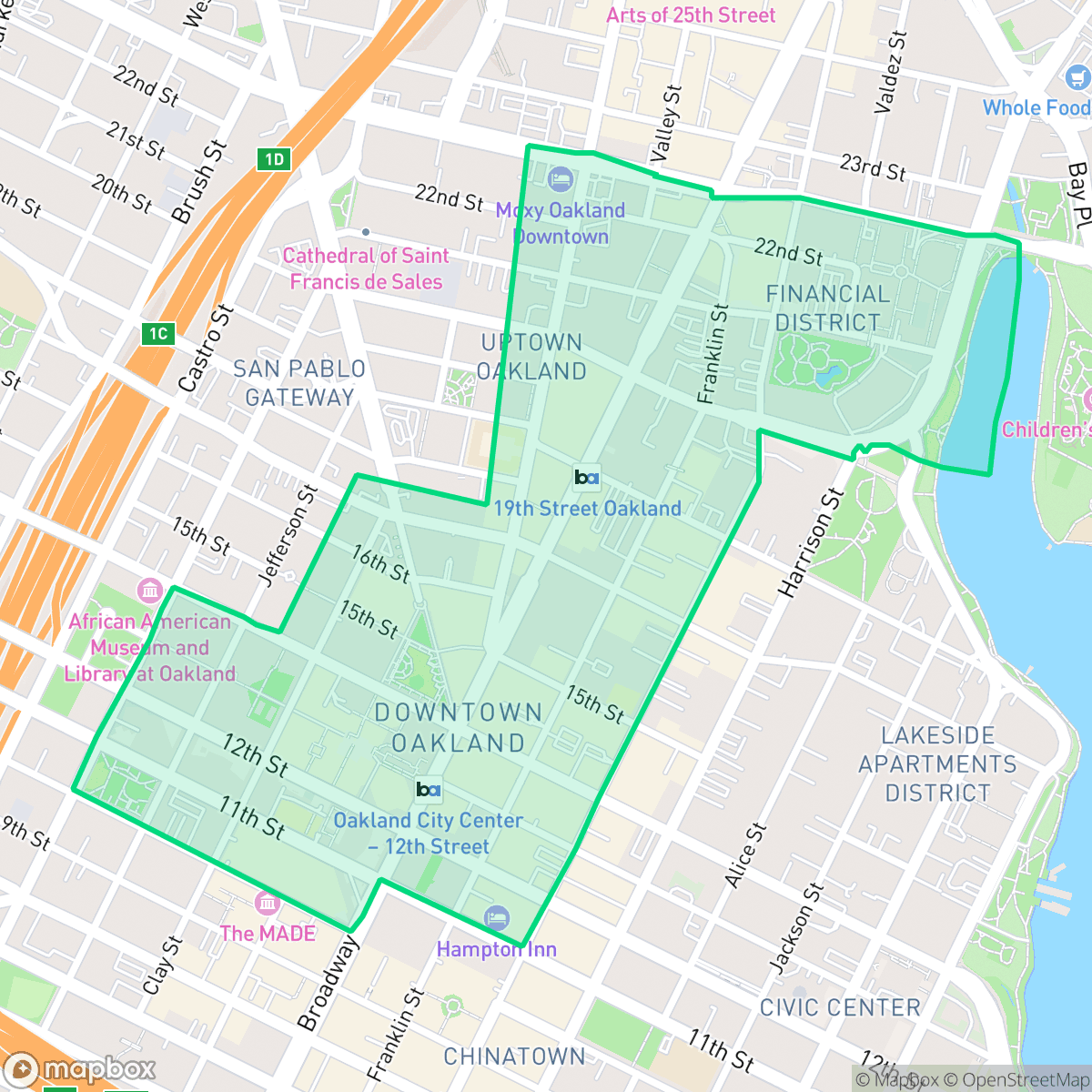
About Downtown
Downtown Oakland originated in 1852, with its urban grid laid out by Julius Kellersberger. Originally centered near the waterfront, the commercial core shifted northward to the 14th Street and Broadway corridor following the 1869 completion of the transcontinental railroad. The neighborhood experienced a major boom after the 1906 San Francisco earthquake, which spurred rapid growth and established the area as a regional financial and civic hub. Downtown is architecturally defined by its dense collection of early 20th-century steel-frame skyscrapers, Beaux-Arts landmarks like the 1914 City Hall, and iconic Art Deco theaters such as the Paramount and Fox. The district also preserves "Old Oakland," a collection of restored Victorian-era commercial buildings that reflect the neighborhood's 19th-century origins. These structures remain central to the district's identity, bridging its legacy as a transit-oriented metropolis with its modern urban character.
The area functions as the city's primary commercial and civic center, characterized by a dense grid that makes everyday errands easy to complete on foot. It maintains a high-energy atmosphere with a wide array of entertainment, restaurants, and cultural venues that attract a diverse mix of young professionals and long-term residents. According to iHuus data, the neighborhood provides a level of activity and commercial density that stands out within the broader city.
Prospective residents should weigh the benefits of urban convenience against specific livability trade-offs. The high-density environment means that privacy is limited, and the proximity to major rail and freeway infrastructure creates significant noise levels. Additionally, the area faces challenges regarding flood safety in coastal zones, and access to local health insurance coverage remains lower than the city average. Families considering the area should also note that the local school district currently faces significant financial instability and operational challenges.
Neighborhood Scores Across 15 Qualities
Buildings are densely packed with shared walls or narrow alleys between structures, resulting in significantly less privacy than the Oakland average. According to iHuus data, this high-density urban environment lacks the setbacks found in most other parts of the city.
Pedestrian movement is easy due to wide sidewalks and frequent crossings that remain more consistent than the Oakland average. Most areas feature a dense street network with dedicated pedestrian zones and continuous sidewalk access.
High-rise commercial towers and multi-unit apartment complexes create a functional urban landscape that is slightly below the city average for visual variety. According to iHuus data, the area lacks luxury estates and is characterized by standard-density urban architecture.
High-density concrete areas dominate the core, providing very few green verges or accessible parks for pets. While some lakeside access offers trails for walking, overall accessibility to dog-friendly space is slightly below the Oakland average, according to iHuus data.
High-rise buildings, major highway infrastructure, and wall-to-wall pavement define this area. This level of density and lack of greenery is significantly more intense than the Oakland average, according to iHuus data.
Constant movement and a dense concentration of diverse dining and retail options define this area. According to iHuus data, the level of activity and commercial density is significantly higher than the Oakland average.
Frequent auditory disturbances from nearby railroad tracks and heavy freeway traffic characterize this area. According to iHuus data, acoustic comfort in Downtown is lower than the Oakland city average.
Air quality remains mostly clean with rare instances of elevated readings. According to iHuus data, these levels are slightly better than the Oakland city average.
Heavy industrial activity is minimal in this area, though a nearby EPA Superfund site and occasional light commercial activity like a local brewery are present. This level of industrial proximity is lower than the city average.
Access to health insurance is significantly lower here than the Oakland average, according to iHuus data. Residents may face challenges finding local coverage options due to the critically low rates of insured individuals in the area.
Voting patterns and census indicators show a deeply liberal political landscape that is consistent with the rest of Oakland. According to iHuus data, this neighborhood aligns closely with the citywide trend of high liberal engagement.
A balanced mix of young professionals, families, and seniors defines the area. This demographic spread is more varied than the typical age distribution found across Oakland.
Significant flood hazards from wave action exist in this coastal zone, making it much more vulnerable than the Oakland average. Residents should expect elevated or potentially prohibitive insurance costs according to iHuus data.
Address-Level Insights for Downtown


iHuus Neighborhood Intelligence Insights
Get address-level neighborhood insights for Downtown
- Street-level scores — see how individual blocks compare, not just neighborhood averages
- Micro-zone boundaries — identify quiet pockets, flood boundaries, and walkable clusters before you visit
- 15 dimensions in full — walkability, noise, air quality, school quality, insurance coverage, population age profile, urban/rural index, and more
- Boundary risk alerts — know if your address sits near a block boundary where scores drop, the kind of detail no listing will ever mention
- School insights — individual school ratings and insights, not just district-level data
- Compare before you commit — side-by-side data across neighborhoods, down to block precision
No credit card required
Compare with Any Neighborhood
| Dimension | Downtown | Acorn |
|---|---|---|
| 🚶 Walkabilityavg 8.99 | ||
| 🔊 Acoustic Comfortavg 3.24 | ||
| 🤫 Privacy Indexavg 3.74 | ||
| 🎨 Visual Appealavg 6.28 | ||
| 🐕 Dog Friendlinessavg 5.74 | ||
| 🗺️ Urban-Rural Indexavg 6.02 | ||
| ✨ Neighborhood Vibeavg 5.22 | ||
| 🏥 Health Insurance Coverageavg 7.4 | ||
| 🌿 Air Qualityavg 8.06 | ||
| 🏭 Industrial Proximityavg 8.37 | ||
| 🌊 Flood Safetyavg 2.61 | ||
| 🗳️ Ideological Leanavg 9.95 | ||
| 👥 Population Age Profileavg 4.92 | ||
| 🔥 Fire Safetyavg 0.17 | ||
| 🏫 School Quality |
Downtown Rankings
School Districts Serving Downtown
School Insights for Downtown
Below average outcomes; significant attendance and academic challenges.
School Insights
See what's really behind every school rating near Downtown
- Individual school ratings — each school's own score with outcome context, not just a district average
- Enrollment & class size data — student-to-teacher ratio and how it compares to the state average
- Full demographics breakdown — ethnicity and gender composition for every school in the enrollment zone
- Every school in the district — all schools within the enrollment boundary ranked by rating, not just the closest one
- Grade levels & benchmarks — elementary through high school, with below/above state-average flags
No credit card required