Dimond, Oakland
Updated · 1,760 residents
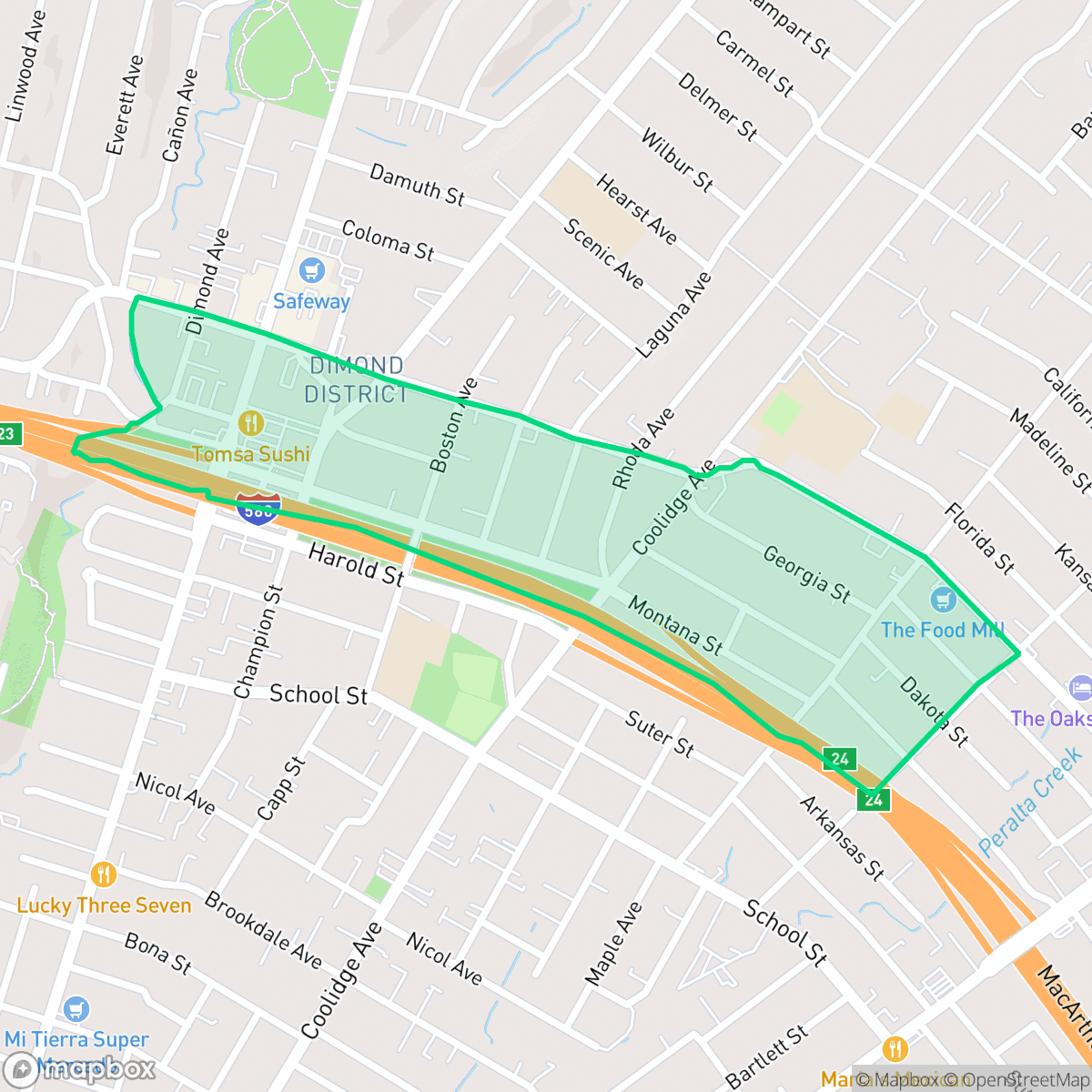
The Dimond District is a highly walkable Oakland neighborhood known for its lively urban atmosphere and proximity to major transit corridors. Residents enjoy a dense, interconnected grid with easy access to local amenities, though the area is notably loud due to consistent road traffic.
Key Highlights
About Dimond
Centered at the intersection of MacArthur Boulevard and Fruitvale Avenue, Oakland’s Dimond District originated as part of the Peralta family's Spanish land grant. In 1867, Gold Rush immigrant Hugh Dimond purchased the acreage, which was then known for its lush cherry orchards. By the early 1900s, the area developed into a distinct settlement nicknamed "Little Germany" due to an influx of German immigrants who established popular local resorts and beer gardens. This heritage is still celebrated today with the annual "Oaktoberfest" festival. Notable neighborhood landmarks include the 1909 Altenheim—originally a German-American retirement home designed by Oscar Haupt—and the historic 12-acre Dimond Park, which features Sausal Creek and a utility building constructed using historic adobe bricks from the Peralta era.
This neighborhood functions as a vibrant residential and commercial hub, defined by its dense urban layout and lack of heavy industrial interference. The community maintains a strong sense of activity, with diverse local businesses and frequent movement along the MacArthur Boulevard and Fruitvale Avenue corridors. While the area offers exceptional walkability and clean air quality, potential residents should be aware of the acoustic environment, as road noise is a persistent factor in daily life. The housing stock consists primarily of closely packed single-family homes, reflecting an urban density that prioritizes location and accessibility over private outdoor space.
Prospective residents should consider the trade-offs regarding privacy and noise levels, as homes are situated in close proximity to one another. The area is well-suited for those who value a central, walkable lifestyle and active streetscapes over suburban quietude. While the neighborhood benefits from excellent air quality and a lack of industrial hazards, families should be aware that the local school district currently faces significant budgetary and administrative challenges that may impact long-term educational stability.
Neighborhood Scores Across 15 Qualities
Residential structures are often situated in close proximity with minimal separation between homes. According to iHuus data, this density results in a privacy level slightly below the Oakland average.
A dense and interconnected street network with consistent sidewalks and well-marked crosswalks makes navigating the area easy on foot. This level of pedestrian accessibility is even higher than the average for Oakland.
Larger, well-maintained homes and upscale amenities are frequently found throughout the area, providing a visual landscape that is slightly more varied than the Oakland average. Some hilly sections feature complex architectural details and private pools, though other pockets consist of more dense, uniform urban housing.
Access to dog-friendly space varies significantly by street, ranging from dense residential blocks with limited greenery to large reservoir parks and trails. According to iHuus data, the availability of public green space for pets is slightly above the Oakland average.
Residential streets and green spaces are distributed in roughly equal measure, making the area feel similar to the Oakland average. The landscape features a blend of single-family homes, mid-sized apartment buildings, and accessible public parks.
Social hubs and local eateries provide a noticeably higher level of activity than the Oakland average. Residents can find a variety of dining and community spaces ranging from quiet suburban streets to lively, mid-rise urban pockets.
Frequent aircraft noise from nearby runway proximity and heavy rail activity defines the acoustic environment. According to iHuus data, sound levels here are significantly higher than the Oakland average.
Air quality remains consistently high with minimal health concerns. According to iHuus data, the atmosphere in Dimond is notably fresher than the Oakland average.
Residential and light commercial uses dominate the area, with no heavy industry or large warehouses detected. This lack of industrial presence is notably higher than the Oakland average, according to iHuus data.
Access to health insurance is more common among Dimond residents than the average Oakland resident, according to iHuus data.
Voting patterns and census indicators show a deeply liberal leaning that is very similar to the broader Oakland area. According to iHuus data, political preferences in this neighborhood are consistently aligned with the city average.
Residents live alongside a balanced mix of young professionals, families, and seniors. According to iHuus data, this demographic spread is more varied than the average found across Oakland.
Significant flood risk exists due to the neighborhood's location within a designated floodplain. According to iHuus data, this area is more susceptible to flooding than the Oakland average, and residents should expect that flood insurance is typically required.
Address-Level Insights for Dimond


iHuus Neighborhood Intelligence Insights
Get address-level neighborhood insights for Dimond
- Street-level scores — see how individual blocks compare, not just neighborhood averages
- Micro-zone boundaries — identify quiet pockets, flood boundaries, and walkable clusters before you visit
- 15 dimensions in full — walkability, noise, air quality, school quality, insurance coverage, population age profile, urban/rural index, and more
- Boundary risk alerts — know if your address sits near a block boundary where scores drop, the kind of detail no listing will ever mention
- School insights — individual school ratings and insights, not just district-level data
- Compare before you commit — side-by-side data across neighborhoods, down to block precision
No credit card required
Compare with Any Neighborhood
| Dimension | Dimond | Acorn |
|---|---|---|
| 🚶 Walkabilityavg 8.99 | ||
| 🔊 Acoustic Comfortavg 3.24 | ||
| 🤫 Privacy Indexavg 3.74 | ||
| 🎨 Visual Appealavg 6.28 | ||
| 🐕 Dog Friendlinessavg 5.74 | ||
| 🗺️ Urban-Rural Indexavg 6.02 | ||
| ✨ Neighborhood Vibeavg 5.22 | ||
| 🏥 Health Insurance Coverageavg 7.4 | ||
| 🌿 Air Qualityavg 8.06 | ||
| 🏭 Industrial Proximityavg 8.37 | ||
| 🌊 Flood Safetyavg 2.61 | ||
| 🗳️ Ideological Leanavg 9.95 | ||
| 👥 Population Age Profileavg 4.92 | ||
| 🔥 Fire Safetyavg 0.17 | ||
| 🏫 School Quality |
Dimond Rankings
School Districts Serving Dimond
School Insights for Dimond
Below average outcomes; significant attendance and academic challenges.
School Insights
See what's really behind every school rating near Dimond
- Individual school ratings — each school's own score with outcome context, not just a district average
- Enrollment & class size data — student-to-teacher ratio and how it compares to the state average
- Full demographics breakdown — ethnicity and gender composition for every school in the enrollment zone
- Every school in the district — all schools within the enrollment boundary ranked by rating, not just the closest one
- Grade levels & benchmarks — elementary through high school, with below/above state-average flags
No credit card required