Columbia Gardens, Oakland
Updated · 713 residents
Columbia Gardens is a compact residential neighborhood in Oakland defined by its integration with industrial logistics corridors and major highway infrastructure. While the area offers a steady, balanced atmosphere, residents encounter significant noise from nearby traffic and must navigate a landscape dominated by warehouses and shipping activity.
Key Highlights
About Columbia Gardens
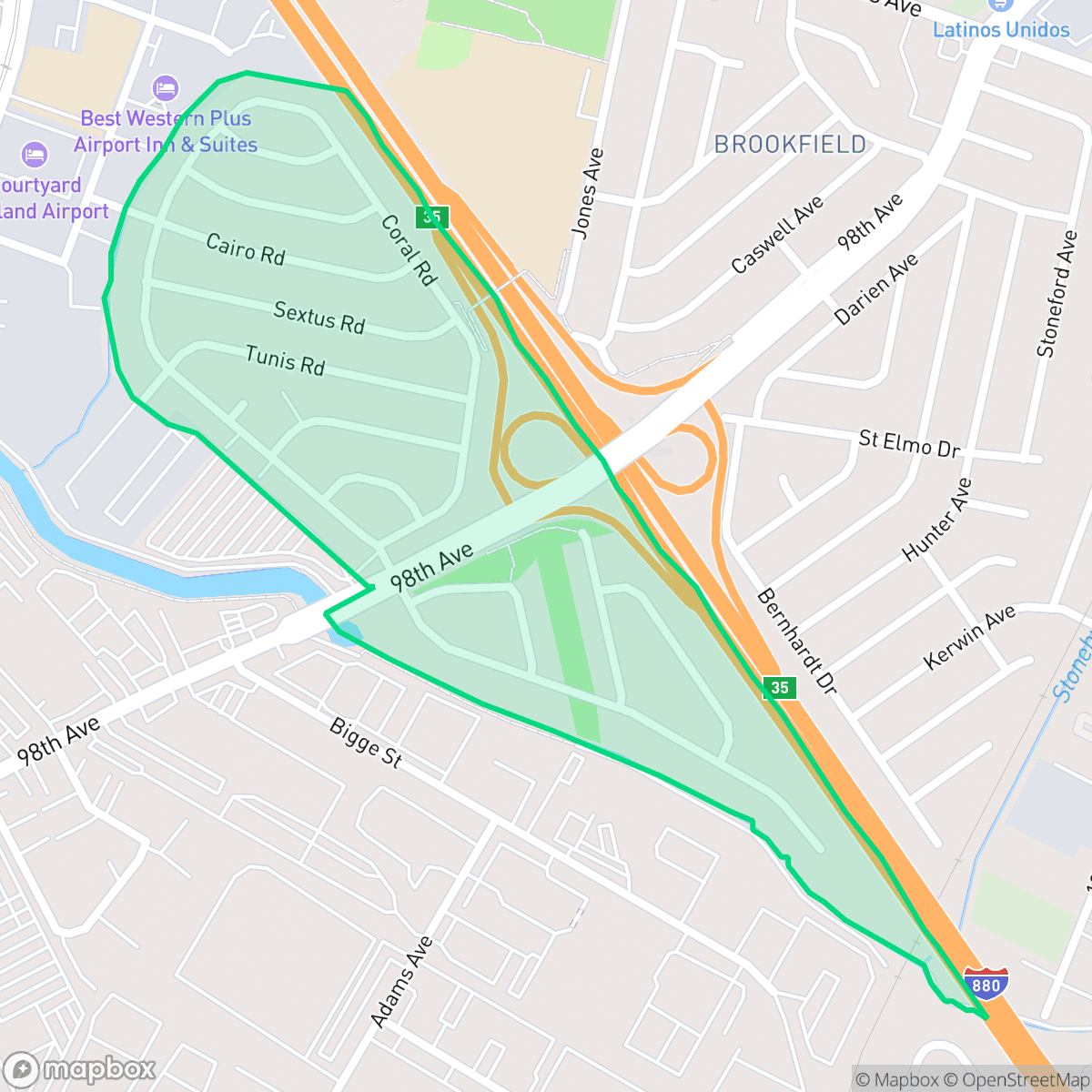
Located on the southern border of Deep East Oakland, California, near San Leandro Creek and the Oakland International Airport, the Columbia Gardens neighborhood was developed primarily during and immediately after World War War II. Established around 1943, the residential enclave was built up with modest, single-story traditional bungalows and tract homes designed to house returning military service members and wartime industrial workers. Historically, Columbia Gardens has shared close ties with adjacent communities like Sobrante Park and Brookfield Village, collectively navigating challenges of redlining, freeway isolation, and industrial environmental impacts. In 1961, the neighborhood welcomed Columbia Gardens School on Empire Road, which was later dedicated as the Dag Hammarskjöld School. Today, the neighborhood is active in community-led revitalization efforts through the East Oakland Neighborhood Initiative.
This neighborhood features a dense suburban fabric that sits in close proximity to large-scale logistics hubs and shipping facilities. The area contains a mix of residential blocks and commercial zones, creating a landscape where active daytime industrial traffic is a constant presence. While the neighborhood maintains a consistent residential character during off-hours, the physical proximity to heavy infrastructure remains a defining feature of the local environment.
Prospective residents should consider the trade-offs associated with this location, particularly regarding acoustic comfort and environmental factors. The area experiences high noise levels primarily from road traffic, and the proximity to industrial sites influences air quality and overall privacy. With moderate walkability and specific challenges regarding fire and flood safety, the neighborhood is best suited for those who prioritize proximity to major transit routes and industrial employment hubs over a traditional suburban experience.
Neighborhood Scores Across 15 Qualities
Housing units are situated in close quarters with limited separation between structures. According to iHuus data, this density of homes is slightly higher than the average for Oakland.
Residential blocks feature consistent sidewalk networks and safe crossings, though connectivity is limited by a major freeway corridor. Pedestrian accessibility is lower than the Oakland city average according to iHuus data.
Uniform tract housing and shared commercial parking areas create a highly dense visual environment. This level of visual interest is slightly below the Oakland average due to the repetitive architecture and smaller yards.
Narrow sidewalk verges and limited access to public green space make walking dogs more challenging here than in much of Oakland. While many private yards are fenced, there is a lack of wide, open grassy areas for off-leash activity.
Open land and scattered greenery are more prevalent here than in much of Oakland. Residential pockets sit alongside large industrial zones and significant highway infrastructure, according to iHuus data.
Limited social activity and a prevalence of warehouses and freight corridors make this area significantly quieter than the Oakland average. Most dining and retail options are sparse and often require a car to access, according to iHuus data.
Frequent loud disturbances from nearby airport runways and heavy rail lines characterize the area. According to iHuus data, acoustic comfort in this neighborhood is significantly lower than the Oakland average.
Air quality in this area presents a mix of acceptable and unhealthy days. According to iHuus data, the air quality is lower than the Oakland average, which may cause occasional concern for sensitive groups.
Residential areas exist alongside active commercial zones and large logistics hubs. This proximity to warehouses and heavy truck traffic is notably higher than the typical Oakland average, according to iHuus data.
Health insurance access among residents is higher than the Oakland average, according to iHuus data.
Voting patterns and census indicators show a deeply liberal political leaning, matching the broader Oakland average.
Residents experience a balanced distribution of young adults, families, and older individuals, which is very similar to the broader Oakland area according to iHuus data.
Located within a 100-year floodplain, this area faces significant flood risks that are higher than the Oakland average. Residents should be aware that flood insurance is typically required for properties in this zone according to iHuus data.
Address-Level Insights for Columbia Gardens


iHuus Neighborhood Intelligence Insights
Get address-level neighborhood insights for Columbia Gardens
- Street-level scores — see how individual blocks compare, not just neighborhood averages
- Micro-zone boundaries — identify quiet pockets, flood boundaries, and walkable clusters before you visit
- 15 dimensions in full — walkability, noise, air quality, school quality, insurance coverage, population age profile, urban/rural index, and more
- Boundary risk alerts — know if your address sits near a block boundary where scores drop, the kind of detail no listing will ever mention
- School insights — individual school ratings and insights, not just district-level data
- Compare before you commit — side-by-side data across neighborhoods, down to block precision
No credit card required
Compare with Any Neighborhood
| Dimension | Columbia Gardens | Acorn |
|---|---|---|
| 🚶 Walkabilityavg 8.99 | ||
| 🔊 Acoustic Comfortavg 3.24 | ||
| 🤫 Privacy Indexavg 3.74 | ||
| 🎨 Visual Appealavg 6.28 | ||
| 🐕 Dog Friendlinessavg 5.74 | ||
| 🗺️ Urban-Rural Indexavg 6.02 | ||
| ✨ Neighborhood Vibeavg 5.22 | ||
| 🏥 Health Insurance Coverageavg 7.4 | ||
| 🌿 Air Qualityavg 8.06 | ||
| 🏭 Industrial Proximityavg 8.37 | ||
| 🌊 Flood Safetyavg 2.61 | ||
| 🗳️ Ideological Leanavg 9.95 | ||
| 👥 Population Age Profileavg 4.92 | ||
| 🔥 Fire Safetyavg 0.17 | ||
| 🏫 School Quality |
Columbia Gardens Rankings
School Districts Serving Columbia Gardens
School Insights for Columbia Gardens
Below average outcomes; significant attendance and academic challenges.
School Insights
See what's really behind every school rating near Columbia Gardens
- Individual school ratings — each school's own score with outcome context, not just a district average
- Enrollment & class size data — student-to-teacher ratio and how it compares to the state average
- Full demographics breakdown — ethnicity and gender composition for every school in the enrollment zone
- Every school in the district — all schools within the enrollment boundary ranked by rating, not just the closest one
- Grade levels & benchmarks — elementary through high school, with below/above state-average flags
No credit card required