Coliseum Industrial, Oakland
Updated · 6,413 residents
Coliseum Industrial is a dense logistics and manufacturing hub defined by its large-scale warehouse operations and proximity to major transport corridors. The neighborhood features quiet, suburban-style residential pockets, though residents face limited walkability and consistent noise from nearby road and rail traffic.
Key Highlights
About Coliseum Industrial
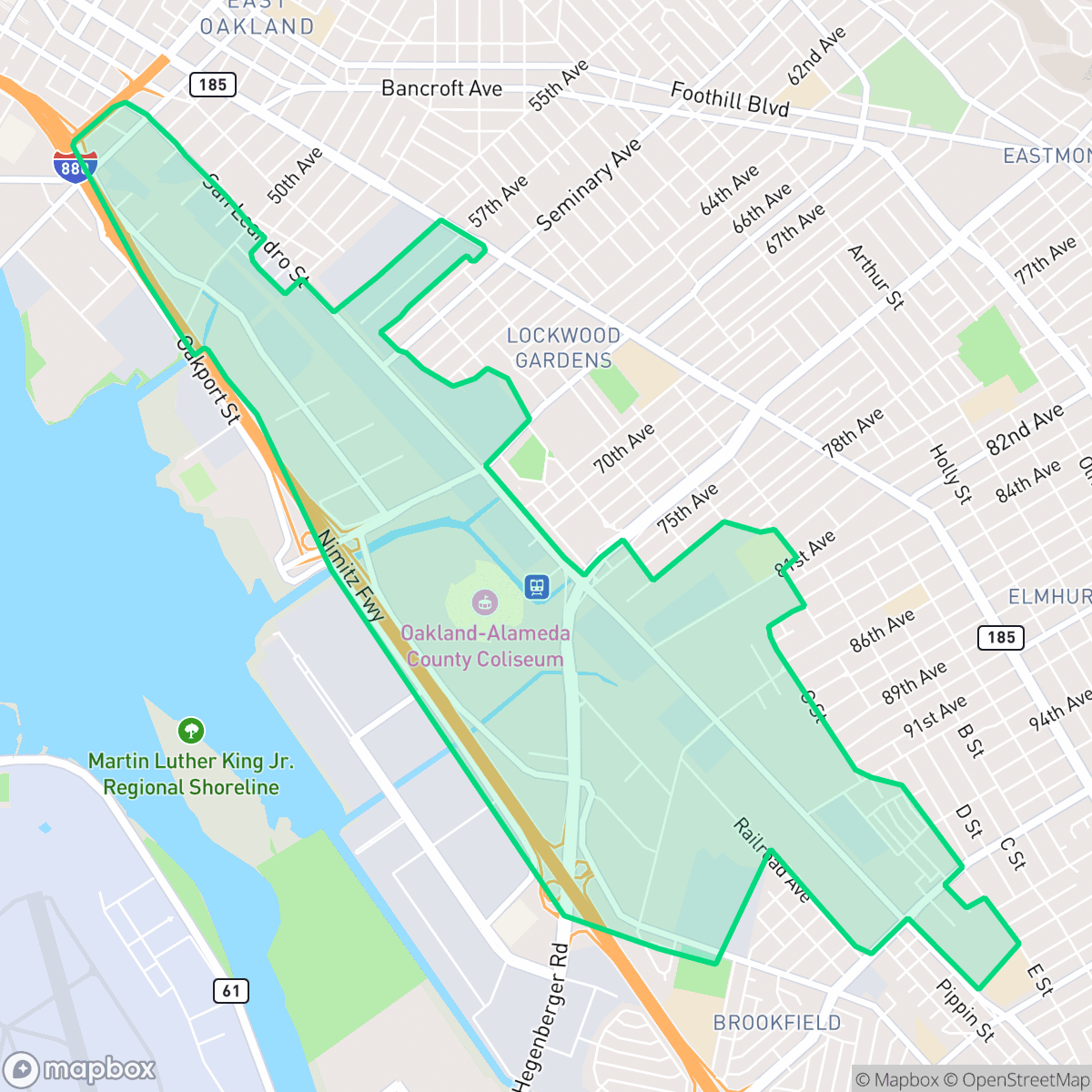
The Coliseum Industrial neighborhood in East Oakland, California, is a heavily industrialized district bordering San Leandro Bay. Historically composed of low-lying wetlands and tidal marshes fed by Damon Slough, the area underwent dramatic land reclamation and filling in the mid-20th century to accommodate heavy manufacturing, warehousing, and logistics. The neighborhood’s defining modern transformation occurred in the 1960s when the Port of Oakland donated land for the construction of the Oakland–Alameda County Coliseum Complex, which opened in 1966 along with the adjacent Oakland Arena. Today, Coliseum Industrial remains a vital logistics and industrial hub characterized by its proximity to Interstate 880 and the Martin Luther King Jr. Regional Shoreline, representing a unique intersection of heavy industry, professional sports history, and ecological bayfront restoration.
The area functions primarily as a vital logistics node, characterized by extensive warehouse complexes and freight corridors that support regional commerce. While the neighborhood maintains isolated residential blocks, the landscape is heavily influenced by its industrial footprint and constant commercial daytime activity. According to iHuus data, the environment is marked by a notable lack of pedestrian infrastructure, which makes the area better suited for those who prioritize proximity to major transit arteries over traditional neighborhood walkability. The acoustic environment is shaped by road and railroad traffic, contributing to a distinct, utilitarian atmosphere that separates it from more residential districts in Oakland.
Prospective residents should weigh the trade-offs of living in an active industrial zone, including limited access to local services and significant challenges within the local school district. The area also carries elevated concerns regarding flood and fire safety, and the infrastructure is not conducive to high levels of pet ownership or outdoor recreation. Ultimately, the neighborhood is best suited for individuals who value logistical convenience and direct access to major highways, as it offers a quiet but isolated living experience that lacks the density of amenities found in neighboring communities.
Neighborhood Scores Across 15 Qualities
Residential structures are closely packed with minimal separation between property lines. According to iHuus data, this density is slightly higher than the Oakland average, often featuring homes that share walls or sit very near one another.
Sidewalks and marked crosswalks are present along many streets, though heavy industrial traffic and large warehouses can make navigating certain areas difficult for pedestrians. This level of walkability is lower than the Oakland city average.
Dense industrial warehouses and small-lot tract housing create a functional but plain landscape. This visual environment is notably less varied than the Oakland average, lacking greenery or luxury amenities.
Public green space is scarce in this area, with most vegetation confined to fenced private yards or a single small central park. According to iHuus data, the lack of accessible parks and narrow sidewalk verges makes this neighborhood less dog friendly than the Oakland average.
Large-scale warehouses and expansive paved surfaces dominate the landscape, though more open land is present here than is typical for Oakland. This mix of industrial infrastructure and scattered open spaces creates a more spread-out environment than the dense city average.
Activity levels are notably lower than the Oakland average due to the prevalence of warehouses, freight corridors, and railway infrastructure. Most daily needs require a vehicle, as local dining and services are sparse and primarily concentrated in small, car-oriented pockets.
Constant sound from nearby railroad tracks and heavy freeway traffic defines the area. This level of acoustic disturbance is slightly higher than the Oakland average, according to iHuus data.
Air quality in this area is generally clean, though it tends to be lower than the Oakland average according to iHuus data.
Extensive logistics hubs, freight rail lines, and large-scale warehouse operations dominate the area. According to iHuus data, this concentration of trucking depots and industrial activity is significantly higher than the Oakland average.
Health insurance accessibility in this area is lower than the Oakland average, according to iHuus data.
Voting patterns and census indicators reflect a deeply liberal political landscape that is consistent with the broader Oakland area.
Resident ages are distributed across various life stages, though the demographic leans slightly older than the Oakland average according to iHuus data.
Located in a coastal high-hazard zone with significant wave action, this area faces much higher flood risks than the Oakland average. Residents should expect elevated or potentially prohibitive flood insurance costs according to iHuus data.
Address-Level Insights for Coliseum Industrial


iHuus Neighborhood Intelligence Insights
Get address-level neighborhood insights for Coliseum Industrial
- Street-level scores — see how individual blocks compare, not just neighborhood averages
- Micro-zone boundaries — identify quiet pockets, flood boundaries, and walkable clusters before you visit
- 15 dimensions in full — walkability, noise, air quality, school quality, insurance coverage, population age profile, urban/rural index, and more
- Boundary risk alerts — know if your address sits near a block boundary where scores drop, the kind of detail no listing will ever mention
- School insights — individual school ratings and insights, not just district-level data
- Compare before you commit — side-by-side data across neighborhoods, down to block precision
No credit card required
Compare with Any Neighborhood
| Dimension | Coliseum Industrial | Acorn |
|---|---|---|
| 🚶 Walkabilityavg 8.99 | ||
| 🔊 Acoustic Comfortavg 3.24 | ||
| 🤫 Privacy Indexavg 3.74 | ||
| 🎨 Visual Appealavg 6.28 | ||
| 🐕 Dog Friendlinessavg 5.74 | ||
| 🗺️ Urban-Rural Indexavg 6.02 | ||
| ✨ Neighborhood Vibeavg 5.22 | ||
| 🏥 Health Insurance Coverageavg 7.4 | ||
| 🌿 Air Qualityavg 8.06 | ||
| 🏭 Industrial Proximityavg 8.37 | ||
| 🌊 Flood Safetyavg 2.61 | ||
| 🗳️ Ideological Leanavg 9.95 | ||
| 👥 Population Age Profileavg 4.92 | ||
| 🔥 Fire Safetyavg 0.17 | ||
| 🏫 School Quality |
Coliseum Industrial Rankings
School Districts Serving Coliseum Industrial
School Insights for Coliseum Industrial
Below average outcomes; significant attendance and academic challenges.
School Insights
See what's really behind every school rating near Coliseum Industrial
- Individual school ratings — each school's own score with outcome context, not just a district average
- Enrollment & class size data — student-to-teacher ratio and how it compares to the state average
- Full demographics breakdown — ethnicity and gender composition for every school in the enrollment zone
- Every school in the district — all schools within the enrollment boundary ranked by rating, not just the closest one
- Grade levels & benchmarks — elementary through high school, with below/above state-average flags
No credit card required