Clinton, Oakland
Updated · 6,113 residents
Clinton is a highly walkable, dense urban neighborhood situated just east of Lake Merritt. Residents benefit from good air quality and proximity to diverse local dining, though the area features tightly packed housing with limited privacy.
Key Highlights
About Clinton
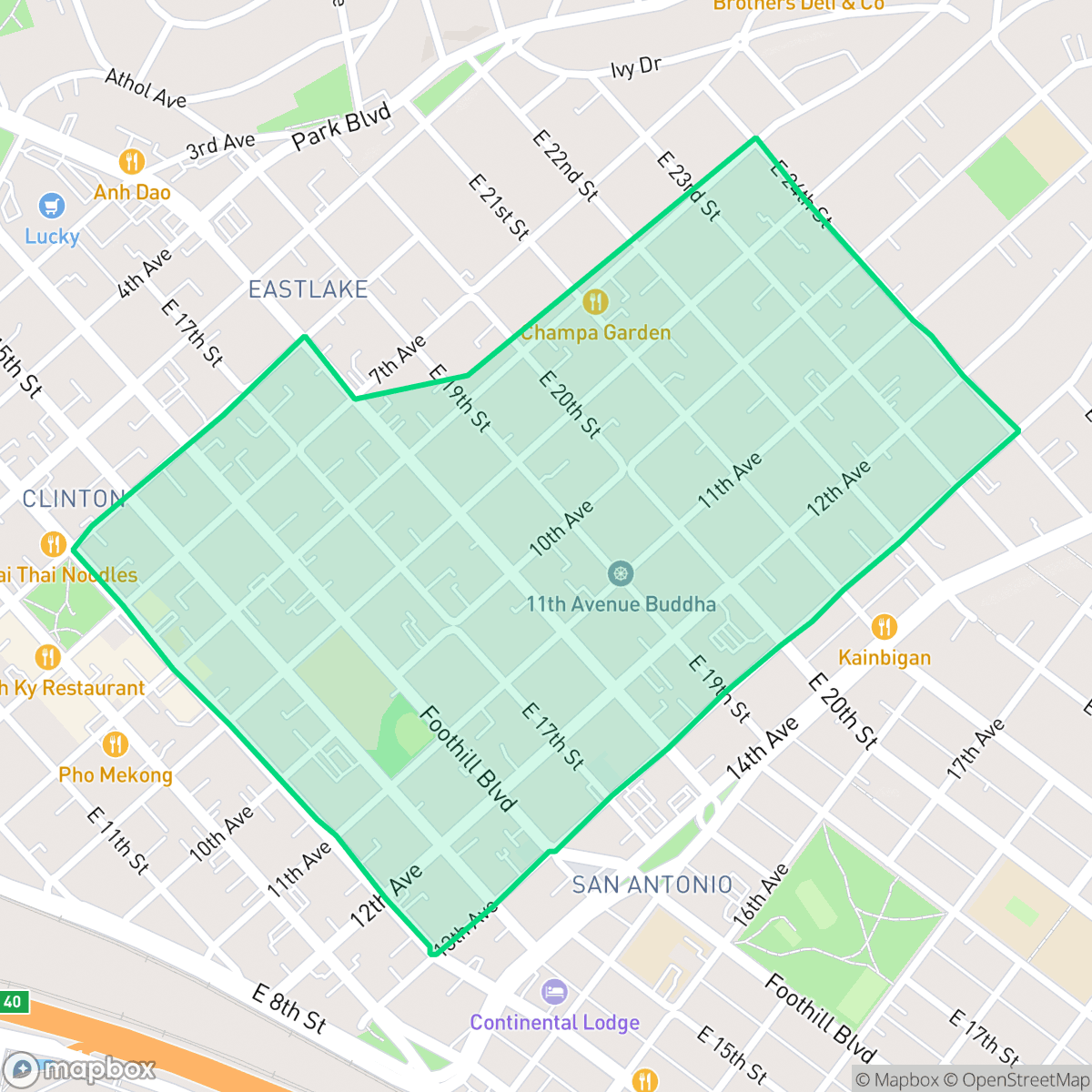
Located just east of Lake Merritt, the Clinton neighborhood originated in 1850 when the Patten brothers leased land from Vincent Peralta, officially establishing the town of Clinton in 1852 (named after Moses Chase's deceased betrothed, Mary Ellen Clinton). Clinton merged with San Antonio in 1856 to form Brooklyn, which Oakland annexed in 1872. Initially a sunny, suburban retreat for San Francisco businessmen, Clinton featured grand Victorian estates, such as the 1888 Queen Anne-style Ellen Kenna House. In 1955, Clinton became home to one of the first federal urban renewal projects in the western United States, which demolished 100 historic homes to build 50 apartment complexes. Today, the neighborhood is highly diverse, characterized by a mix of historic Victorian architecture, mid-century apartments, and a vibrant cultural identity sometimes referred to as part of Oakland's New Chinatown.
The area serves as a dense residential hub that balances historic Victorian charm with mid-century apartment living. Its grid-based layout ensures that daily errands are easily managed on foot, and the neighborhood maintains a strong sense of community through its diverse local culinary scene. According to iHuus data, the area is free from heavy industrial hazards, making it a purely residential and light commercial environment. While the streets are relatively quiet compared to major thoroughfares, the high density of the built environment means that residents live in close proximity to their neighbors. Prospective residents should weigh the benefits of high walkability and strong health insurance coverage against the realities of the local school district. The neighborhood faces significant environmental risks regarding flood and fire safety, which are important considerations for long-term property stability. While the area is well-suited for those who value an urban lifestyle near Lake Merritt, the limited privacy and the challenges facing the local school system are notable trade-offs to consider before moving.
Neighborhood Scores Across 15 Qualities
Residential structures are densely packed with minimal separation between buildings. According to iHuus data, this level of density results in less privacy than is typical for Oakland.
Continuous sidewalk networks and frequent crosswalks make navigating the area on foot very easy. According to iHuus data, the pedestrian infrastructure is even more robust than the Oakland average, though a large highway corridor does disrupt the grid in certain sections.
Standard tract housing and high density characterize the area, which presents a more utilitarian landscape than the Oakland average. Small lots and rectangular rooflines are common, with few private luxury amenities or large yards visible.
Access to pet-friendly spaces is consistent with the Oakland average. While some areas feature narrow sidewalks, proximity to Lake Merritt and local college fields provides notable opportunities for walking dogs.
Residential streets and green spaces are found in equal measure, mirroring the broader city average. The area features a dense mix of low-rise housing, multi-story apartments, and scattered institutional buildings according to iHuus data.
A mix of light industrial units and suburban streets creates a calm atmosphere, though commercial activity is less frequent than the Oakland average. Most dining options and services require a short trip by vehicle as few businesses are within walking distance.
A steady hum from nearby busy streets defines the acoustic environment. According to iHuus data, noise levels here are notably higher than the Oakland average.
Air quality remains consistently high with rare instances of elevated readings. Levels in Clinton are roughly in line with the Oakland average according to iHuus data.
Limited heavy industrial presence characterizes most of the area, though some southern sections contain warehouses and active railway corridors. According to iHuus data, the level of industrial proximity is slightly higher than the Oakland average due to the presence of major highway and rail infrastructure.
Health insurance access is relatively high for the area, though it sits slightly below the Oakland average. According to iHuus data, most residents have access to medical coverage.
Voting patterns and census indicators reflect a deeply liberal political landscape that is consistent with the broader Oakland area, according to iHuus data.
Residents live alongside a balanced variety of age groups, including young adults, families, and older individuals. This demographic spread is consistent with the broader Oakland area, according to iHuus data.
Located within a coastal high-hazard zone, this area faces significantly higher flood vulnerability than the rest of Oakland. Residents should anticipate elevated or potentially prohibitive flood insurance costs due to the risk of wave action.
Address-Level Insights for Clinton


iHuus Neighborhood Intelligence Insights
Get address-level neighborhood insights for Clinton
- Street-level scores — see how individual blocks compare, not just neighborhood averages
- Micro-zone boundaries — identify quiet pockets, flood boundaries, and walkable clusters before you visit
- 15 dimensions in full — walkability, noise, air quality, school quality, insurance coverage, population age profile, urban/rural index, and more
- Boundary risk alerts — know if your address sits near a block boundary where scores drop, the kind of detail no listing will ever mention
- School insights — individual school ratings and insights, not just district-level data
- Compare before you commit — side-by-side data across neighborhoods, down to block precision
No credit card required
Compare with Any Neighborhood
| Dimension | Clinton | Acorn |
|---|---|---|
| 🚶 Walkabilityavg 8.99 | ||
| 🔊 Acoustic Comfortavg 3.24 | ||
| 🤫 Privacy Indexavg 3.74 | ||
| 🎨 Visual Appealavg 6.28 | ||
| 🐕 Dog Friendlinessavg 5.74 | ||
| 🗺️ Urban-Rural Indexavg 6.02 | ||
| ✨ Neighborhood Vibeavg 5.22 | ||
| 🏥 Health Insurance Coverageavg 7.4 | ||
| 🌿 Air Qualityavg 8.06 | ||
| 🏭 Industrial Proximityavg 8.37 | ||
| 🌊 Flood Safetyavg 2.61 | ||
| 🗳️ Ideological Leanavg 9.95 | ||
| 👥 Population Age Profileavg 4.92 | ||
| 🔥 Fire Safetyavg 0.17 | ||
| 🏫 School Quality |
Clinton Rankings
School Districts Serving Clinton
School Insights for Clinton
Below average outcomes; significant attendance and academic challenges.
School Insights
See what's really behind every school rating near Clinton
- Individual school ratings — each school's own score with outcome context, not just a district average
- Enrollment & class size data — student-to-teacher ratio and how it compares to the state average
- Full demographics breakdown — ethnicity and gender composition for every school in the enrollment zone
- Every school in the district — all schools within the enrollment boundary ranked by rating, not just the closest one
- Grade levels & benchmarks — elementary through high school, with below/above state-average flags
No credit card required