Cleveland Heights, Oakland
Updated · 6,626 residents
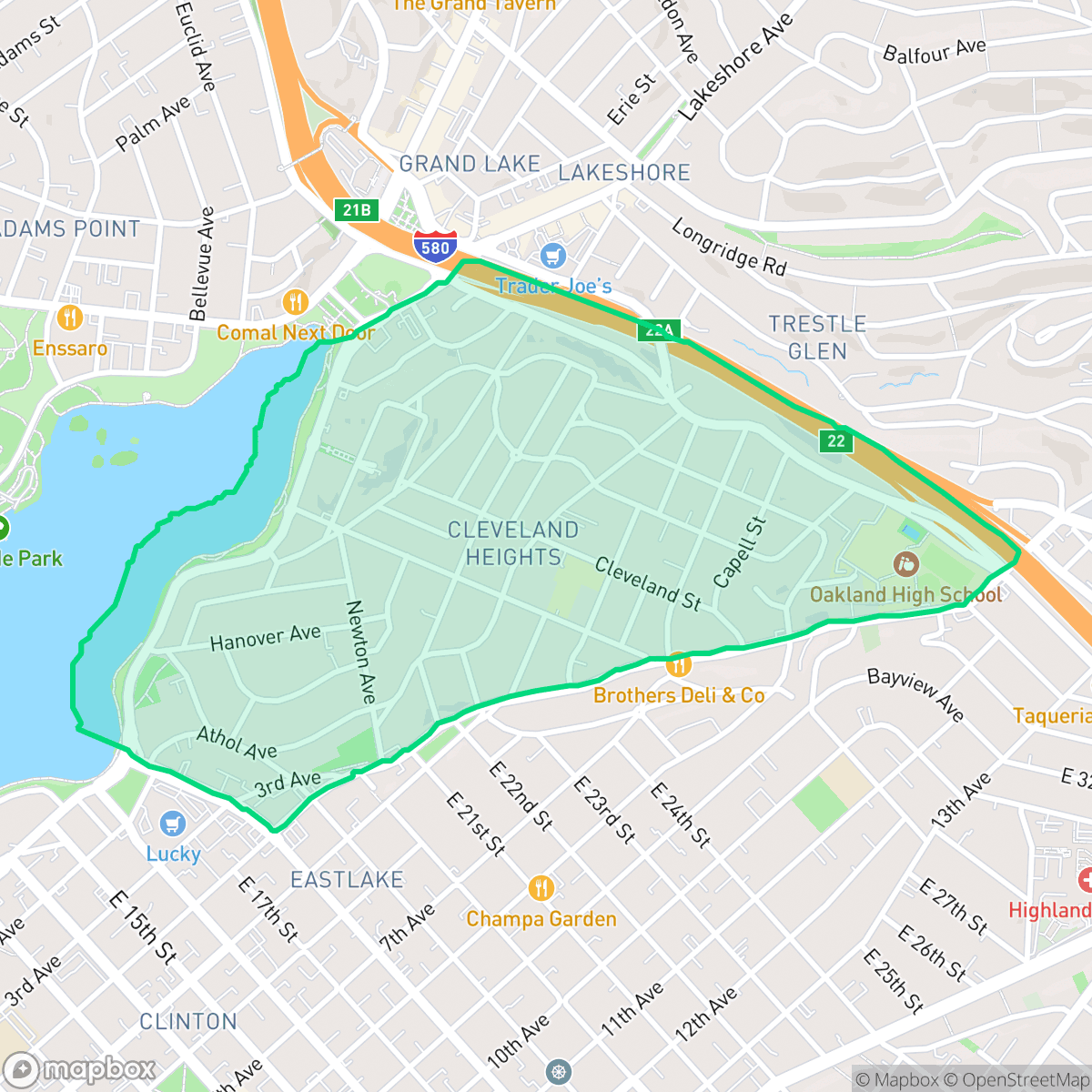
Cleveland Heights is a dense, highly walkable urban neighborhood situated on the hills east of Lake Merritt. Residents enjoy proximity to local cafes and eateries, though the area experiences significant noise from nearby highway traffic and features closely packed residential housing.
Key Highlights
About Cleveland Heights
Nestled on the sloping hills east of Lake Merritt, Oakland’s Cleveland Heights neighborhood was annexed by the city in 1909 from the former township of Brooklyn. Encompassing the historic Haddon Hill and Peralta Heights developments, the area features a rich array of early 20th-century architectural styles. The neighborhood is named after Cleveland Street, renamed in 1907 to honor President Grover Cleveland. A signature local landmark is the Cleveland Cascade, a tiered water-staircase designed by landscape architect Howard Gilkey in 1923. Historically home to prominent residents like industrialist Henry J. Kaiser, the neighborhood also gained the local moniker "China Hill" following a significant influx of Chinese families starting in the 1950s.
The neighborhood functions as a dense urban enclave characterized by its high walkability and proximity to the recreational opportunities of Lake Merritt. While the area offers a convenient lifestyle with local favorites such as Haddon Hill Cafe and Rico Rico Taco, the streetscape is defined by closely spaced homes and limited private outdoor space. According to iHuus data, the environment is primarily residential and light commercial, providing a consistent urban experience for those who prioritize accessibility over seclusion.
Prospective residents should consider the significant trade-offs regarding acoustic comfort and local infrastructure. The area experiences elevated noise levels primarily due to consistent road traffic from the adjacent highway. Additionally, families should note that the neighborhood is served by the Oakland Unified School District, which currently faces systemic challenges including budget deficits and facility maintenance backlogs. While the location is ideal for those seeking a highly walkable environment within the city, it is best suited for individuals who are comfortable with a high-density, urban setting.
Neighborhood Scores Across 15 Qualities
Residential structures often feature shared boundaries or very narrow gaps between buildings, resulting in a level of density that is consistent with the Oakland average. According to iHuus data, many homes are situated in close quarters with minimal separation between adjacent properties.
Pedestrian infrastructure is exceptionally strong here, featuring consistent sidewalks on both sides of many streets and frequent crosswalks. This network offers a higher level of accessibility for walkers than the Oakland average, although steep terrain in certain sections can impact ease of movement.
Residential structures feature typical boxy rooflines and modest yards, appearing very similar to the Oakland average. While most lots are densely packed, some larger homes with complex architectural details and private pools are visible according to iHuus data.
Direct access to Lake Merritt and abundant mature tree cover provide excellent walking opportunities. This area offers more connected green spaces and wider paths than the Oakland average, according to iHuus data.
Residential streets and green spaces exist in roughly equal measure, creating a landscape that is slightly more suburban than the Oakland average. Mature tree canopies and detached homes are interspersed with denser, low-rise urban pockets according to iHuus data.
A mix of quiet residential streets and active dining pockets creates a vibe slightly more lively than the Oakland average. While various restaurants and parks are available, many amenities are spread out and require a car to access easily.
Frequent traffic and transit noise from nearby freeways and rail lines characterizes this area. According to iHuus data, acoustic comfort in this neighborhood is lower than the Oakland average.
Air quality in this area remains consistently good with rare instances of elevated readings. This level of air purity is roughly in line with the average found throughout Oakland.
Heavy industry and hazardous facilities are entirely absent from this area. According to iHuus data, the neighborhood remains exclusively residential and light commercial, which is significantly cleaner than the Oakland average.
Health insurance access among residents is notably higher than the Oakland average, according to iHuus data.
Voting patterns and census indicators show an overwhelmingly liberal political landscape. This leans slightly more progressive than the Oakland city average, according to iHuus data.
Residents live alongside a diverse range of age groups, including young professionals, families, and seniors. This demographic spread is slightly more varied than the Oakland average, according to iHuus data.
Properties within this area are located inside a designated floodplain, making flood insurance a common requirement. According to iHuus data, the risk of flooding is higher in Cleveland Heights than the average for Oakland.
Address-Level Insights for Cleveland Heights


iHuus Neighborhood Intelligence Insights
Get address-level neighborhood insights for Cleveland Heights
- Street-level scores — see how individual blocks compare, not just neighborhood averages
- Micro-zone boundaries — identify quiet pockets, flood boundaries, and walkable clusters before you visit
- 15 dimensions in full — walkability, noise, air quality, school quality, insurance coverage, population age profile, urban/rural index, and more
- Boundary risk alerts — know if your address sits near a block boundary where scores drop, the kind of detail no listing will ever mention
- School insights — individual school ratings and insights, not just district-level data
- Compare before you commit — side-by-side data across neighborhoods, down to block precision
No credit card required
Compare with Any Neighborhood
| Dimension | Cleveland Heights | Acorn |
|---|---|---|
| 🚶 Walkabilityavg 8.99 | ||
| 🔊 Acoustic Comfortavg 3.24 | ||
| 🤫 Privacy Indexavg 3.74 | ||
| 🎨 Visual Appealavg 6.28 | ||
| 🐕 Dog Friendlinessavg 5.74 | ||
| 🗺️ Urban-Rural Indexavg 6.02 | ||
| ✨ Neighborhood Vibeavg 5.22 | ||
| 🏥 Health Insurance Coverageavg 7.4 | ||
| 🌿 Air Qualityavg 8.06 | ||
| 🏭 Industrial Proximityavg 8.37 | ||
| 🌊 Flood Safetyavg 2.61 | ||
| 🗳️ Ideological Leanavg 9.95 | ||
| 👥 Population Age Profileavg 4.92 | ||
| 🔥 Fire Safetyavg 0.17 | ||
| 🏫 School Quality |
Cleveland Heights Rankings
School Districts Serving Cleveland Heights
School Insights for Cleveland Heights
Below average outcomes; significant attendance and academic challenges.
School Insights
See what's really behind every school rating near Cleveland Heights
- Individual school ratings — each school's own score with outcome context, not just a district average
- Enrollment & class size data — student-to-teacher ratio and how it compares to the state average
- Full demographics breakdown — ethnicity and gender composition for every school in the enrollment zone
- Every school in the district — all schools within the enrollment boundary ranked by rating, not just the closest one
- Grade levels & benchmarks — elementary through high school, with below/above state-average flags
No credit card required