Clawson, Oakland
Updated · 3,062 residents
Clawson is a dense, urban neighborhood in West Oakland characterized by a mix of residential blocks and light industrial spaces. While the area offers a consistent grid layout for pedestrians, residents experience significant noise from nearby highway traffic and limited private outdoor space. According to iHuus data, the community maintains high air quality despite its proximity to major infrastructure and industrial zones.
Key Highlights
About Clawson
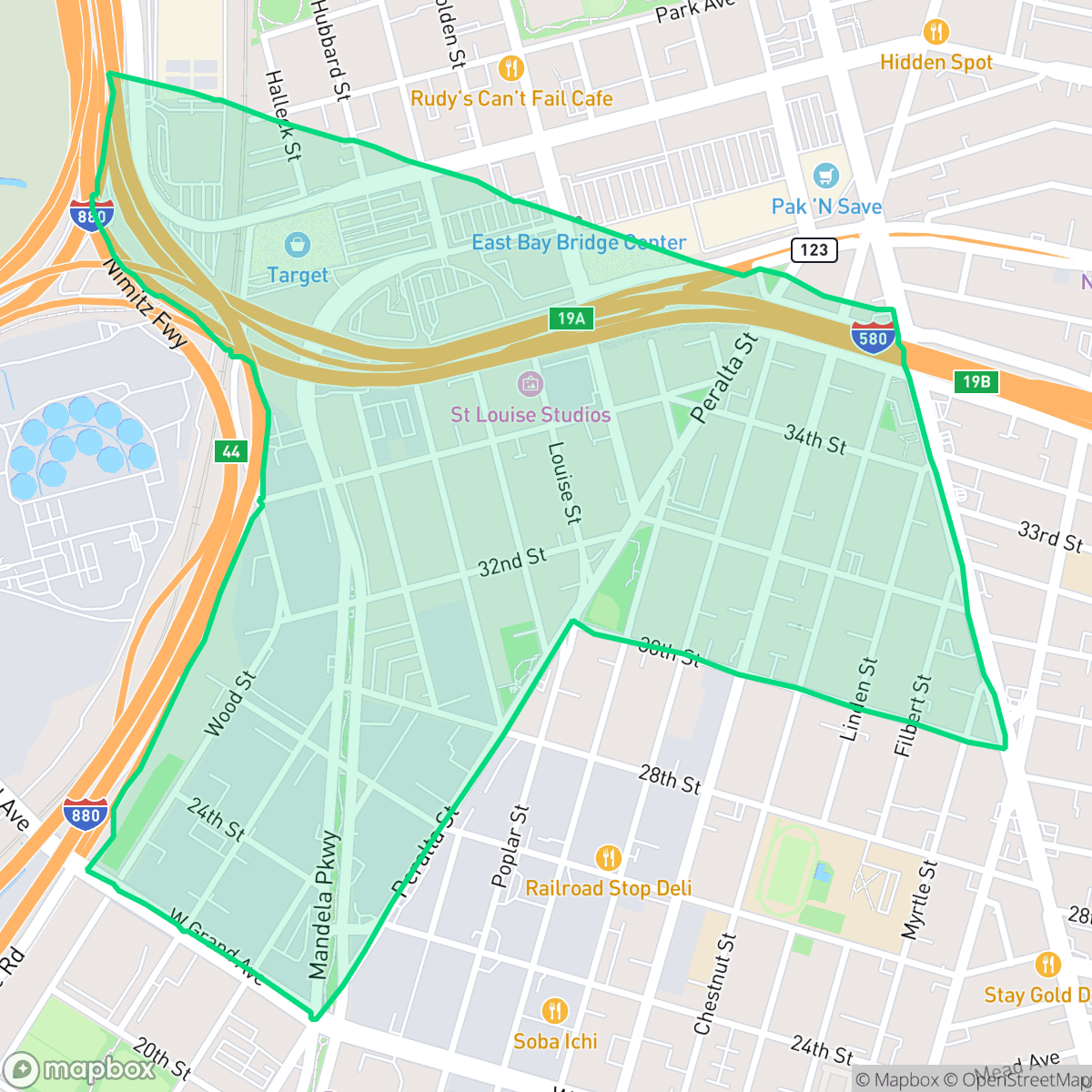
Clawson, a neighborhood in West Oakland, California, sits below the MacArthur Maze. It is named after the historic Clawson School, founded in 1883 in honor of local educator William F. Clawson. The school's 1915 Neo-Classical building, designed by architect John J. Donovan, remains the neighborhood’s defining landmark; it was closed in the 1970s and converted into residential lofts in 1999. Historically a working-class enclave populated by railroad and industrial workers, the area earned the informal moniker "Dogtown" by the late 20th century—a name attributed to the stray dogs that roamed its streets and guarded its junkyards. In recent decades, Clawson has transitioned from an industrial zone into a residential hub characterized by modern live-work spaces and restored Victorian homes.
The neighborhood functions as a compact, mixed-use environment where single-family homes and multi-unit dwellings sit alongside commercial warehouses. The streetscape follows a standard urban grid, providing sidewalks throughout the area, though these are occasionally interrupted by large freeway interchanges. While the neighborhood lacks extensive public green space, it benefits from a central location that connects residents to various parts of the city. The architectural landscape remains utilitarian, reflecting the area's history as a working-class industrial hub.
Prospective residents should note that the neighborhood presents specific trade-offs regarding acoustic comfort and environmental safety. High levels of road noise are common, and the area faces significant risks related to flooding and fire. While the neighborhood offers a distinct urban character, it is best suited for those who prioritize proximity to transit corridors and a dense, industrial-adjacent setting over quiet, suburban-style privacy. According to iHuus, the area remains a functional, albeit high-density, residential option within the broader Oakland landscape.
Neighborhood Scores Across 15 Qualities
Residential spacing is mixed, with some homes situated very close to neighbors and others maintaining a slight buffer. This density is roughly comparable to the broader Oakland area, according to iHuus data.
A consistent sidewalk grid exists on many streets, but pedestrian movement is interrupted by high traffic corridors and a major freeway interchange. While the local layout supports walking, the connectivity is lower than the Oakland city average according to iHuus data.
Standard residential rooftops and small lots characterize this area, which offers less visual variety than the Oakland average. According to iHuus data, the landscape is dominated by dense, functional housing and industrial structures without significant greenery or luxury amenities.
Public green space and wide grassy verges are scarce in this area, as most vegetation is contained within private, fenced yards. According to iHuus data, the availability of accessible parkland is below the Oakland average.
A balance of residential streets and green space exists alongside dense industrial zones and major infrastructure. This area feels slightly less urban than the Oakland average due to the presence of large warehouse blocks and single-family housing.
Industrial landscapes and highway proximity create a subdued atmosphere with a lower level of activity than the Oakland average. While some pockets feature local eateries and parks, much of the area is characterized by warehouses and a steady, low-key rhythm.
Frequent disturbances from nearby railroad tracks and freeway traffic are common in this area. According to iHuus data, acoustic comfort in Clawson is lower than the Oakland city average.
Air quality in Clawson is exceptionally high with minimal pollutants present. According to iHuus data, these conditions are significantly better than the average found throughout Oakland.
Residential life dominates this area with only occasional light commercial activity. According to iHuus data, industrial proximity is notably lower than the Oakland average, though some residents near the freeway interchange may experience noise or air hazards from nearby warehouses.
Health insurance accessibility in Clawson is slightly below the Oakland average, according to iHuus data. Most residents have access to coverage, though a notable portion of the population remains uninsured.
Voting patterns and census indicators show a predominantly liberal political leaning that is slightly more pronounced than the Oakland city average.
Residents live alongside a balanced blend of young adults, families, and older populations. This demographic distribution is roughly in line with the Oakland average, according to iHuus data.
Flood risk in this area is significantly higher than the Oakland average due to its location in a coastal high-hazard zone. Residents should anticipate potential wave action and much higher flood insurance premiums according to iHuus data.
Address-Level Insights for Clawson


iHuus Neighborhood Intelligence Insights
Get address-level neighborhood insights for Clawson
- Street-level scores — see how individual blocks compare, not just neighborhood averages
- Micro-zone boundaries — identify quiet pockets, flood boundaries, and walkable clusters before you visit
- 15 dimensions in full — walkability, noise, air quality, school quality, insurance coverage, population age profile, urban/rural index, and more
- Boundary risk alerts — know if your address sits near a block boundary where scores drop, the kind of detail no listing will ever mention
- School insights — individual school ratings and insights, not just district-level data
- Compare before you commit — side-by-side data across neighborhoods, down to block precision
No credit card required
Compare with Any Neighborhood
| Dimension | Clawson | Acorn |
|---|---|---|
| 🚶 Walkabilityavg 8.99 | ||
| 🔊 Acoustic Comfortavg 3.24 | ||
| 🤫 Privacy Indexavg 3.74 | ||
| 🎨 Visual Appealavg 6.28 | ||
| 🐕 Dog Friendlinessavg 5.74 | ||
| 🗺️ Urban-Rural Indexavg 6.02 | ||
| ✨ Neighborhood Vibeavg 5.22 | ||
| 🏥 Health Insurance Coverageavg 7.4 | ||
| 🌿 Air Qualityavg 8.06 | ||
| 🏭 Industrial Proximityavg 8.37 | ||
| 🌊 Flood Safetyavg 2.61 | ||
| 🗳️ Ideological Leanavg 9.95 | ||
| 👥 Population Age Profileavg 4.92 | ||
| 🔥 Fire Safetyavg 0.17 | ||
| 🏫 School Quality |
Clawson Rankings
School Districts Serving Clawson
School Insights for Clawson
Below average outcomes; significant attendance and academic challenges.
School Insights
See what's really behind every school rating near Clawson
- Individual school ratings — each school's own score with outcome context, not just a district average
- Enrollment & class size data — student-to-teacher ratio and how it compares to the state average
- Full demographics breakdown — ethnicity and gender composition for every school in the enrollment zone
- Every school in the district — all schools within the enrollment boundary ranked by rating, not just the closest one
- Grade levels & benchmarks — elementary through high school, with below/above state-average flags
No credit card required