Claremont, Oakland
Updated · 2,161 residents
Claremont is a visually striking, low-density enclave known for its serene atmosphere and superior air quality. While it offers a secluded, rural-like living experience, residents remain within reach of the vibrant College Avenue corridor. According to iHuus data, the area provides exceptional visual appeal and acoustic comfort, making it a quiet retreat within the Oakland landscape.
Key Highlights
About Claremont
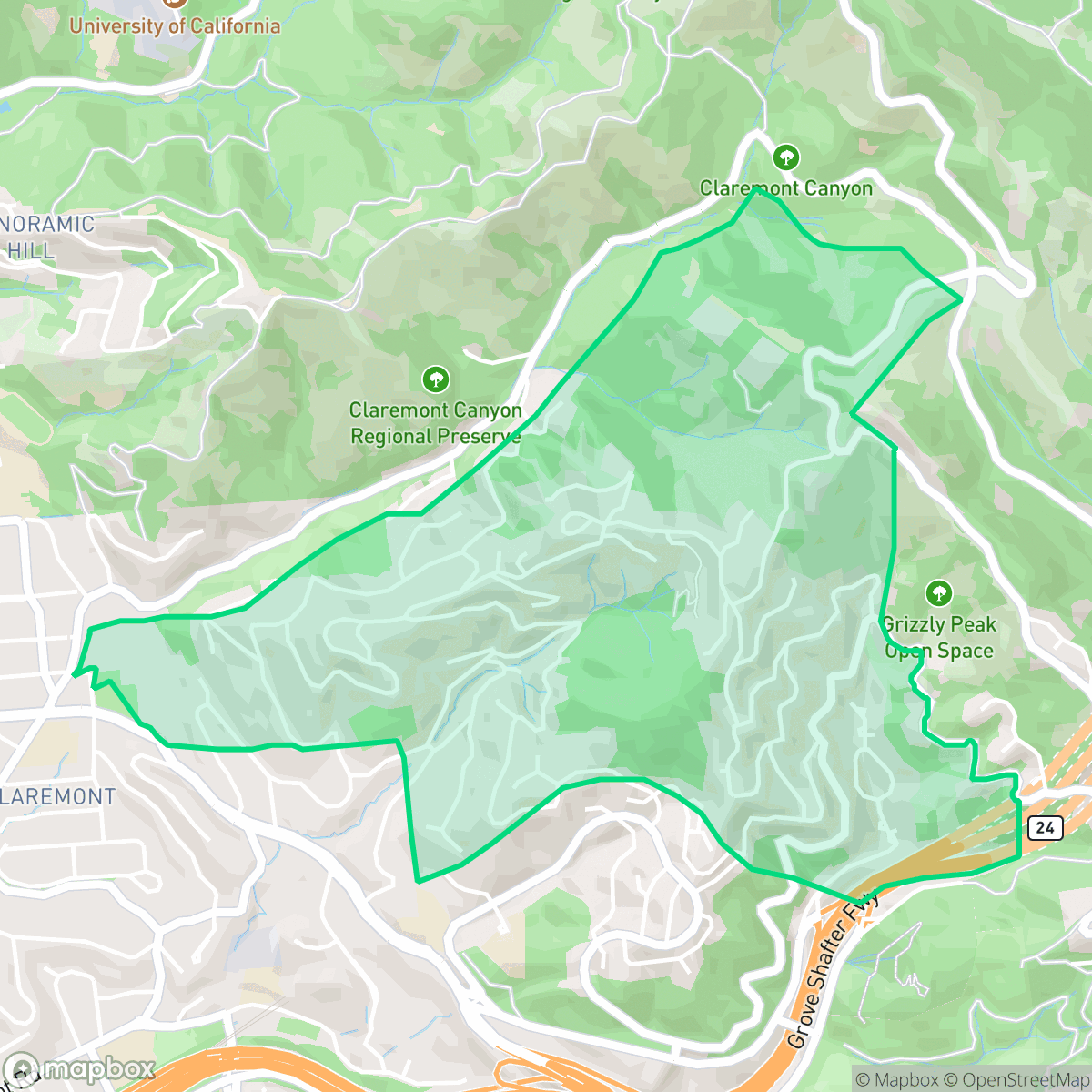
Straddling the Oakland-Berkeley border, the historic Claremont neighborhood began taking shape in 1879 when developer Grant Taggert led the renaming of Telegraph Road to Claremont Avenue. The Oakland portion of the district was officially annexed in 1909. In 1905, developer Duncan McDuffie opened Claremont Park, an upscale residential tract, while architect John Galen Howard designed the landmark Claremont Court Entry Gates. The neighborhood’s defining landmark, the majestic Claremont Hotel, broke ground in 1905 and opened in 1915. Real estate interests associated with the Key System built the resort and ran a dedicated commuter train line directly to it until 1958. Today, the neighborhood maintains its distinct character, characterized by historic homes, the scenic Claremont Canyon, and the vibrant College Avenue commercial corridor.
The area is defined by its quiet, low-density residential character and significant open space. With a visual appeal score of 10.0, the neighborhood offers a picturesque environment that feels removed from the intensity of urban life. Residents benefit from high air quality and minimal industrial proximity, contributing to a peaceful, health-conscious setting. The acoustic environment is particularly favorable, as low traffic noise levels support a tranquil atmosphere throughout the winding streets.
Prospective residents should note that the neighborhood prioritizes privacy over walkability. With a walkability score of 6.0, daily errands often require a vehicle, though the nearby commercial districts offer essential services. The area presents a trade-off regarding fire safety, which is a critical consideration in this hilly, wooded terrain. It is best suited for those who value natural beauty and a quiet, suburban-rural blend over high-density urban convenience.
Neighborhood Scores Across 15 Qualities
Residential lots feature significant separation between structures, providing much higher levels of privacy than the Oakland average. According to iHuus data, the wide spacing between homes creates a more secluded living environment.
Sidewalks are available on one side of the street and crossings are marked as safe. This level of pedestrian accessibility is lower than the Oakland average.
Expansive estates and custom architecture provide a highly manicured landscape with significantly more greenery and privacy than the Oakland average. Large residential lots and architectural variety contribute to a premium aesthetic throughout the area.
Extensive trail networks and large open spaces provide significant opportunities for pet owners. Access to greenery and parks in this area is much higher than the Oakland average, according to iHuus data.
Frequent open spaces and scattered homes amid woodland characterize this area. This landscape is significantly more open and less dense than the Oakland average, according to iHuus data.
Local activity is low and primarily centered around quiet, low-density residential streets. This area lacks a distinct commercial character and offers significantly less bustle than the Oakland average, with most amenities requiring a car.
Frequent noise from nearby transit corridors and major roadways characterizes the area. This level of acoustic disturbance is consistent with the average found throughout Oakland.
Air quality is exceptionally high and remains significantly cleaner than the Oakland average. Residents can expect minimal exposure to pollutants and very low health risks from airborne particulates.
Industrial activity and warehouses are absent from this area. According to iHuus data, the neighborhood contains no detected manufacturing facilities or hazard sites, making it more residential than most of Oakland.
Health insurance access is exceptionally high among residents, significantly surpassing the Oakland average according to iHuus data.
Voting patterns and census indicators show a highly liberal political leaning that is consistent with the broader Oakland area.
A diverse age range of young adults, families, and older residents creates a balanced demographic profile. This distribution is more varied than the average age profile found across Oakland, according to iHuus data.
Flood risk in this area is significantly lower than the Oakland average. While some residual risk exists within certain zones, most properties sit outside primary flood hazard areas according to iHuus data.
Fire hazards are notably higher in this area than the Oakland average. Residents should be aware of increased wildfire risks and may need to implement enhanced mitigation measures according to iHuus data.
Address-Level Insights for Claremont


iHuus Neighborhood Intelligence Insights
Get address-level neighborhood insights for Claremont
- Street-level scores — see how individual blocks compare, not just neighborhood averages
- Micro-zone boundaries — identify quiet pockets, flood boundaries, and walkable clusters before you visit
- 15 dimensions in full — walkability, noise, air quality, school quality, insurance coverage, population age profile, urban/rural index, and more
- Boundary risk alerts — know if your address sits near a block boundary where scores drop, the kind of detail no listing will ever mention
- School insights — individual school ratings and insights, not just district-level data
- Compare before you commit — side-by-side data across neighborhoods, down to block precision
No credit card required
Compare with Any Neighborhood
| Dimension | Claremont | Acorn |
|---|---|---|
| 🚶 Walkabilityavg 8.99 | ||
| 🔊 Acoustic Comfortavg 3.24 | ||
| 🤫 Privacy Indexavg 3.74 | ||
| 🎨 Visual Appealavg 6.28 | ||
| 🐕 Dog Friendlinessavg 5.74 | ||
| 🗺️ Urban-Rural Indexavg 6.02 | ||
| ✨ Neighborhood Vibeavg 5.22 | ||
| 🏥 Health Insurance Coverageavg 7.4 | ||
| 🌿 Air Qualityavg 8.06 | ||
| 🏭 Industrial Proximityavg 8.37 | ||
| 🌊 Flood Safetyavg 2.61 | ||
| 🗳️ Ideological Leanavg 9.95 | ||
| 👥 Population Age Profileavg 4.92 | ||
| 🔥 Fire Safetyavg 0.17 | ||
| 🏫 School Quality |
Claremont Rankings
School Districts Serving Claremont
School Insights for Claremont
Below average outcomes; significant attendance and academic challenges.
School Insights
See what's really behind every school rating near Claremont
- Individual school ratings — each school's own score with outcome context, not just a district average
- Enrollment & class size data — student-to-teacher ratio and how it compares to the state average
- Full demographics breakdown — ethnicity and gender composition for every school in the enrollment zone
- Every school in the district — all schools within the enrollment boundary ranked by rating, not just the closest one
- Grade levels & benchmarks — elementary through high school, with below/above state-average flags
No credit card required