Civic Center, Oakland
Updated · 2,679 residents
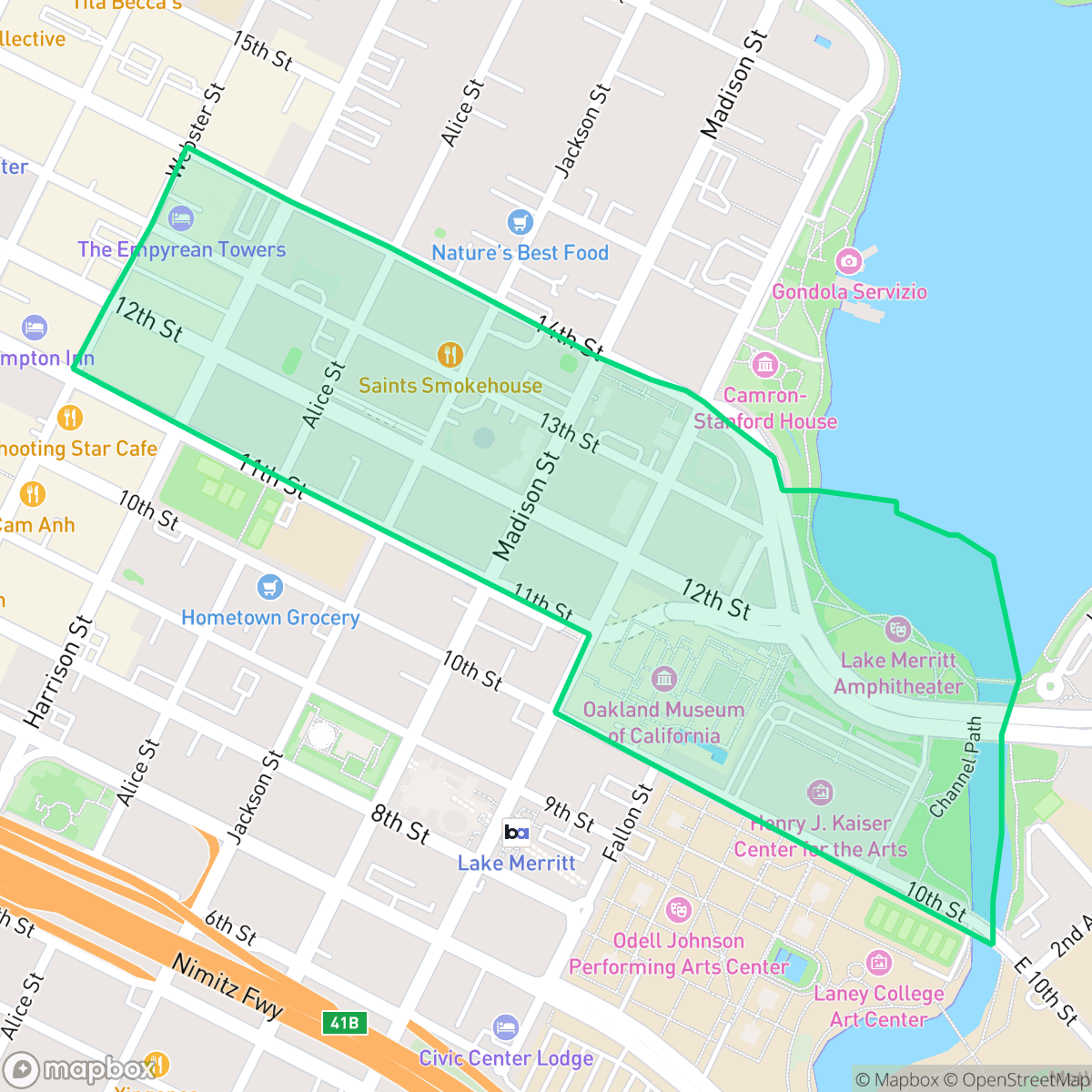
Oakland's Civic Center is a high-energy urban hub defined by its dense, pedestrian-friendly streets and immediate access to the recreational trails of Lake Merritt. Residents benefit from a vibrant local food scene and proximity to major cultural institutions, though the area is characterized by tight living quarters and consistent noise from surrounding road traffic.
Key Highlights
About Civic Center
Oakland’s Civic Center neighborhood, situated between Downtown and Lake Merritt, evolved from ambitious early 20th-century civic planning. Under Mayor John Davie (1915–1931), nearly 100 acres of swampy land at the south end of the lake were filled with dredged material to establish a grand public district. Following World War II, the city adopted a master plan to group major public and cultural institutions here. Today, the neighborhood is defined by its concentration of landmark public buildings, including the Beaux-Arts style Alameda County Courthouse, the 1914 Kaiser Convention Center (originally the Oakland Auditorium), the Oakland Museum of California, and the historic Civic Center Post Office. The district also features notable historic residences, such as the grand 1912 Hotel Oakland—now serving as senior housing—and the 1920s Peralta Apartments.
The neighborhood functions as a central node for the city, offering exceptional walkability that connects residents to diverse dining options like Alice Street Bakery Café and local favorites such as Bare Knuckle Pizza. This intensely urban environment is dominated by high-rise commercial buildings and mid-rise apartment complexes, creating a fast-paced atmosphere. The proximity to the lakefront provides a necessary green reprieve, making it a popular spot for dog owners and those who prioritize outdoor activity within a concrete-heavy setting.
Living here requires an adjustment to high-density conditions, as the area offers minimal private outdoor space and limited acoustic privacy. While the district is well-connected and lively, prospective residents should note the high volume of road traffic noise and the challenges associated with the local school district. It is best suited for professionals and individuals who value immediate access to city amenities and a fast-paced environment over suburban quiet or expansive private property.
Neighborhood Scores Across 15 Qualities
Buildings are tightly packed with very narrow separations or shared walls. This high-density urban layout offers significantly less privacy than the Oakland average according to iHuus data.
Extensive sidewalk networks and frequent pedestrian crossings make navigating the area on foot very easy. This level of pedestrian accessibility is higher than the Oakland average, according to iHuus data.
Standard urban density with a mix of apartment complexes and commercial blocks defines the area. The visual landscape features small lots and modest greenery, appearing less lush than the Oakland average according to iHuus data.
Proximity to Lake Merritt and various public fields offers significantly better access to walking trails and green space than the Oakland average. Wide paths and connected parklands make this an ideal area for pet owners.
Multi-story commercial and institutional buildings dominate the landscape with very little private greenery. This area represents a much more concentrated urban environment than the Oakland average, according to iHuus data.
Vibrant dining and diverse local destinations create a much more active atmosphere than the Oakland average. This area features a dense concentration of high-rise buildings and varied eateries, according to iHuus data.
Steady traffic sounds from nearby busy streets are present, though the area is relatively quieter than the Oakland average according to iHuus data.
Air quality in this area remains consistently good with infrequent periods of elevated readings. This level of air purity is roughly in line with the broader Oakland average, according to iHuus data.
Industrial activity is very low in this area, with only occasional light commercial use observed. This lack of heavy industry and large warehouse complexes makes the neighborhood slightly cleaner and quieter than the Oakland average, according to iHuus data.
Health insurance accessibility is significantly lower in this area than the Oakland average, according to iHuus data.
Voting patterns and census indicators show a very high concentration of liberal-leaning residents, which is consistent with the broader Oakland area according to iHuus data.
Residents live alongside a balanced mix of young professionals, families, and seniors. According to iHuus data, the population age distribution is more varied than the Oakland average.
Address-Level Insights for Civic Center


iHuus Neighborhood Intelligence Insights
Get address-level neighborhood insights for Civic Center
- Street-level scores — see how individual blocks compare, not just neighborhood averages
- Micro-zone boundaries — identify quiet pockets, flood boundaries, and walkable clusters before you visit
- 15 dimensions in full — walkability, noise, air quality, school quality, insurance coverage, population age profile, urban/rural index, and more
- Boundary risk alerts — know if your address sits near a block boundary where scores drop, the kind of detail no listing will ever mention
- School insights — individual school ratings and insights, not just district-level data
- Compare before you commit — side-by-side data across neighborhoods, down to block precision
No credit card required
Compare with Any Neighborhood
| Dimension | Civic Center | Acorn |
|---|---|---|
| 🚶 Walkabilityavg 8.99 | ||
| 🔊 Acoustic Comfortavg 3.24 | ||
| 🤫 Privacy Indexavg 3.74 | ||
| 🎨 Visual Appealavg 6.28 | ||
| 🐕 Dog Friendlinessavg 5.74 | ||
| 🗺️ Urban-Rural Indexavg 6.02 | ||
| ✨ Neighborhood Vibeavg 5.22 | ||
| 🏥 Health Insurance Coverageavg 7.4 | ||
| 🌿 Air Qualityavg 8.06 | ||
| 🏭 Industrial Proximityavg 8.37 | ||
| 🌊 Flood Safetyavg 2.61 | ||
| 🗳️ Ideological Leanavg 9.95 | ||
| 👥 Population Age Profileavg 4.92 | ||
| 🔥 Fire Safetyavg 0.17 | ||
| 🏫 School Quality |
Civic Center Rankings
School Districts Serving Civic Center
School Insights for Civic Center
Below average outcomes; significant attendance and academic challenges.
School Insights
See what's really behind every school rating near Civic Center
- Individual school ratings — each school's own score with outcome context, not just a district average
- Enrollment & class size data — student-to-teacher ratio and how it compares to the state average
- Full demographics breakdown — ethnicity and gender composition for every school in the enrollment zone
- Every school in the district — all schools within the enrollment boundary ranked by rating, not just the closest one
- Grade levels & benchmarks — elementary through high school, with below/above state-average flags
No credit card required