Chinatown, Oakland
Updated · 2,701 residents
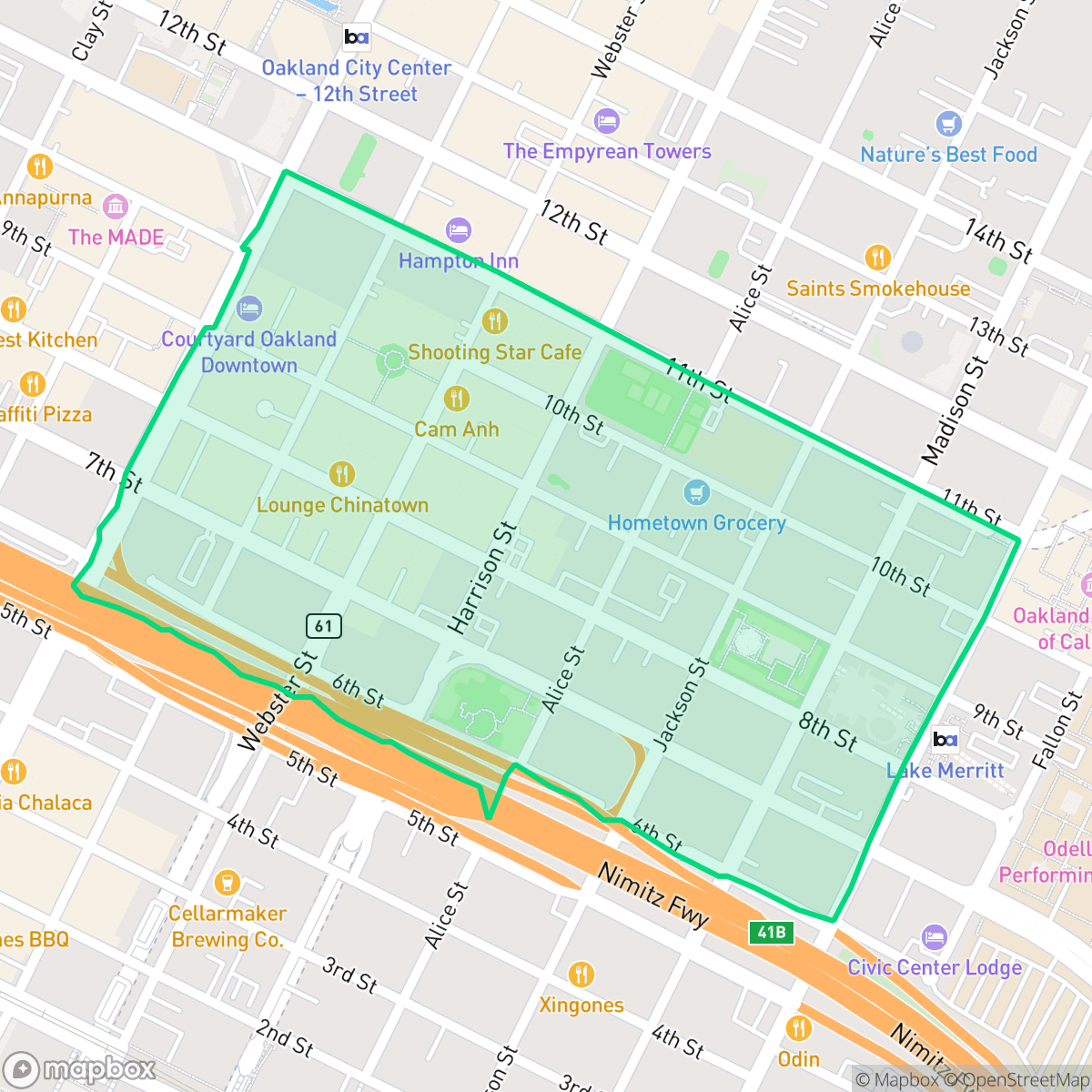
Oakland Chinatown is a high-energy, pan-Asian district defined by its exceptional walkability and dense urban layout. While the area offers a vibrant atmosphere for a diverse demographic, it is characterized by significant ambient noise and limited private outdoor space.
Key Highlights
About Chinatown
Oakland Chinatown, one of the oldest in the United States, traces its origins to the 1850s. Initially settled near the Oakland Estuary, the community was forced to relocate to its current center at 8th and Webster Streets due to discriminatory local laws and the 1882 Chinese Exclusion Act. The neighborhood expanded significantly following the 1906 San Francisco earthquake, as many refugees sought sanctuary in Oakland. Unlike many other Chinatowns, this district lacks traditional gates, blending seamlessly into the downtown fabric. It has evolved into a vibrant pan-Asian hub, home to diverse immigrant populations including Japanese, Filipino, Korean, and Southeast Asian communities. Key landmarks include the Pacific Renaissance Plaza, which houses the Oakland Asian Cultural Center and the unique Asian Branch Library, as well as Lincoln Square Park, famous for its historic junk boat playground.
The neighborhood functions as a bustling urban center where high-density residential and commercial spaces converge. It is a highly active environment, characterized by a constant flow of pedestrian traffic and a diverse demographic mix. According to iHuus data, the area maintains a notably high level of walkability, allowing residents to easily access local businesses and essential services without a vehicle. The built environment consists largely of functional mid-rise apartments and commercial structures, fostering a tight-knit community feel despite the lack of significant private green space.
Prospective residents should be prepared for a dense urban experience, as the area features minimal separation between housing units and a high degree of shared-wall living. The neighborhood experiences elevated levels of ambient noise due to nearby railroad tracks and heavy traffic corridors, which may be a consideration for those seeking quiet. Furthermore, the local school district faces ongoing challenges with budget stability and facilities maintenance. This area is best suited for individuals who prioritize proximity to transit and a lively, pedestrian-oriented lifestyle over suburban seclusion or expansive private yards.
Neighborhood Scores Across 15 Qualities
Buildings are situated in very close quarters with minimal separation between structures. According to iHuus data, this level of density and shared-wall living is significantly higher than the Oakland average.
Continuous sidewalks and dedicated pedestrian zones make navigating the area on foot exceptionally easy. This dense, grid-based network offers superior connectivity for walkers compared to the Oakland average.
The area features a mix of multi-story apartments and commercial buildings with an aesthetic that is slightly below the Oakland average. According to iHuus data, the landscape consists of functional urban structures and mid-rise developments rather than luxury estates or large private yards.
Frequent access to large lakefront parks and waterfront trails provides better-than-average opportunities for dog walking, though much of the immediate area consists of dense urban concrete with few small parks. According to iHuus data, the neighborhood offers more accessible walking areas for pets than the Oakland average.
High-density structures and extensive pavement characterize this area. This neighborhood features significantly more urban density and less greenery than the Oakland average, according to iHuus data.
Constant movement and a dense commercial presence create a much more active environment than the Oakland average. According to iHuus data, the area is defined by high-density development and frequent activity near major transit corridors.
Frequent noise from nearby railroad tracks and heavy traffic is common in this area. According to iHuus data, acoustic comfort levels are slightly below the Oakland average.
Air quality remains consistently good with rare instances of elevated readings. This level of cleanliness is roughly in line with the Oakland average, according to iHuus data.
Very little heavy industry or large warehouse activity exists here, making the area slightly more industrial-free than the Oakland average. Residents may encounter occasional low-level noise from a local brewery or light commercial loading, but the neighborhood remains primarily residential and commercial.
Health insurance access is significantly lower here than the Oakland average. According to iHuus data, a small portion of the resident population is covered by health insurance plans.
Voting patterns and census indicators show a predominantly liberal political landscape, slightly more so than the Oakland average.
Residents live alongside a relatively even mix of young professionals, families, and seniors. According to iHuus data, this age distribution is slightly more varied than the average found across Oakland.
Address-Level Insights for Chinatown


iHuus Neighborhood Intelligence Insights
Get address-level neighborhood insights for Chinatown
- Street-level scores — see how individual blocks compare, not just neighborhood averages
- Micro-zone boundaries — identify quiet pockets, flood boundaries, and walkable clusters before you visit
- 15 dimensions in full — walkability, noise, air quality, school quality, insurance coverage, population age profile, urban/rural index, and more
- Boundary risk alerts — know if your address sits near a block boundary where scores drop, the kind of detail no listing will ever mention
- School insights — individual school ratings and insights, not just district-level data
- Compare before you commit — side-by-side data across neighborhoods, down to block precision
No credit card required
Compare with Any Neighborhood
| Dimension | Chinatown | Acorn |
|---|---|---|
| 🚶 Walkabilityavg 8.99 | ||
| 🔊 Acoustic Comfortavg 3.24 | ||
| 🤫 Privacy Indexavg 3.74 | ||
| 🎨 Visual Appealavg 6.28 | ||
| 🐕 Dog Friendlinessavg 5.74 | ||
| 🗺️ Urban-Rural Indexavg 6.02 | ||
| ✨ Neighborhood Vibeavg 5.22 | ||
| 🏥 Health Insurance Coverageavg 7.4 | ||
| 🌿 Air Qualityavg 8.06 | ||
| 🏭 Industrial Proximityavg 8.37 | ||
| 🌊 Flood Safetyavg 2.61 | ||
| 🗳️ Ideological Leanavg 9.95 | ||
| 👥 Population Age Profileavg 4.92 | ||
| 🔥 Fire Safetyavg 0.17 | ||
| 🏫 School Quality |
Chinatown Rankings
School Districts Serving Chinatown
School Insights for Chinatown
Below average outcomes; significant attendance and academic challenges.
School Insights
See what's really behind every school rating near Chinatown
- Individual school ratings — each school's own score with outcome context, not just a district average
- Enrollment & class size data — student-to-teacher ratio and how it compares to the state average
- Full demographics breakdown — ethnicity and gender composition for every school in the enrollment zone
- Every school in the district — all schools within the enrollment boundary ranked by rating, not just the closest one
- Grade levels & benchmarks — elementary through high school, with below/above state-average flags
No credit card required