Chabot Park, Oakland
Updated · 3,380 residents
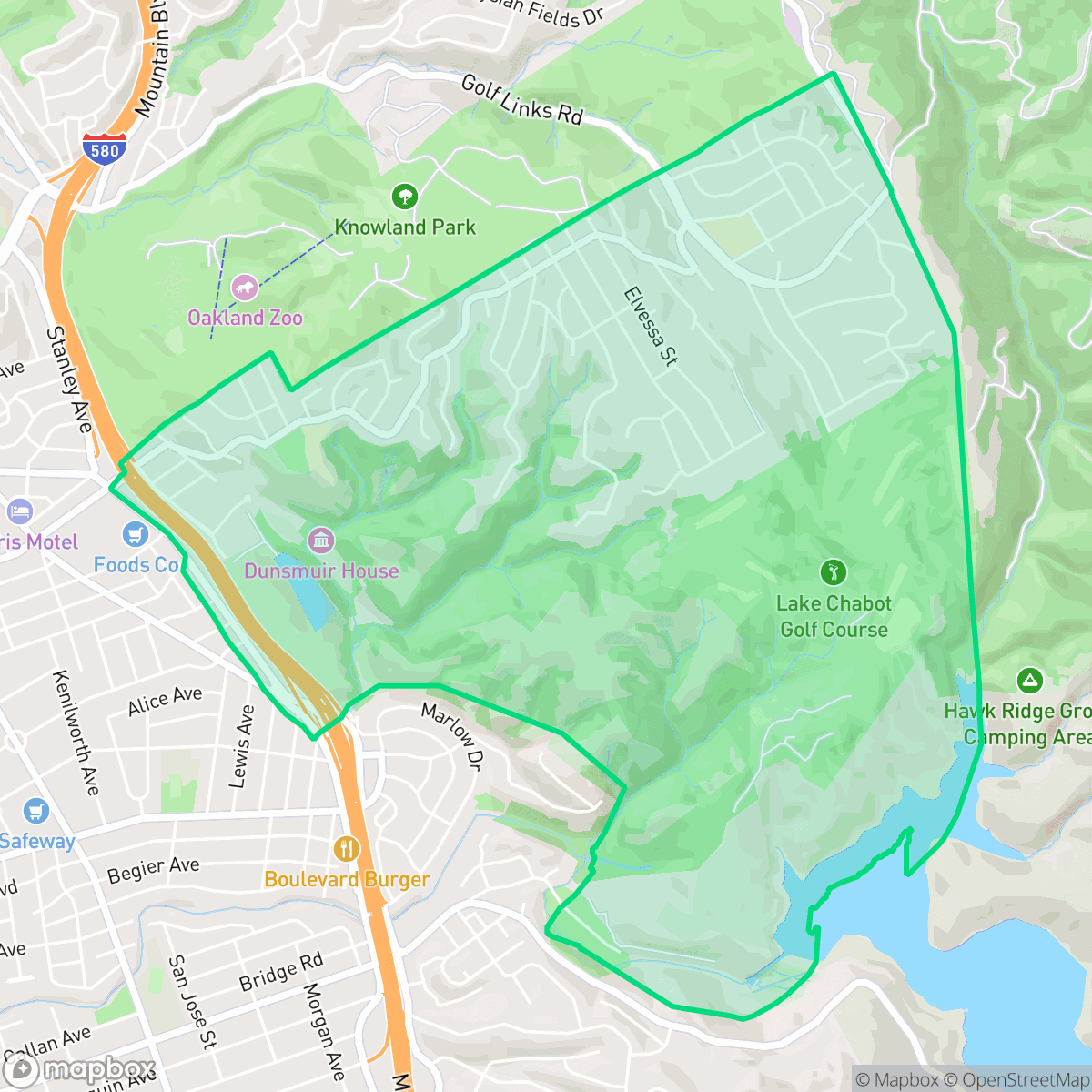
Chabot Park is a serene, low-density enclave in the Oakland hills known for its scenic beauty and proximity to vast open spaces. While the area offers a quiet, rural atmosphere ideal for pet owners, it remains a car-dependent neighborhood with limited local commercial activity.
Key Highlights
About Chabot Park
Located in the southeastern hills of Oakland, the Chabot Park neighborhood was planned in the late 1940s as part of the historic Grass Valley area. Developed by Ken Bemis, the founder of the White Log Tavern restaurant chain, the Chabot Park Estates subdivision was marketed to post-World War II homebuyers as a collection of "ranch homes in a country setting". The neighborhood's scenic, semi-rural character made it a prime location for mid-century residential expansion. Notably, in 1948, the neighborhood was selected as the site for Oakland’s official replica of "Mr. Blandings’ Dream House" at 11000 Cameron Street, built as a promotional tie-in for the Cary Grant film. The modern home drew thousands of visitors who paid admission to tour it, raising significant funds for Oakland's Children’s Hospital.
The neighborhood is defined by its rural landscape and significant green space, offering a quiet environment far removed from urban congestion. It features scattered housing blocks that prioritize privacy and visual appeal, making it a distinct departure from the denser parts of the city. According to iHuus data, the area maintains a high urban-rural index, reflecting its open character and lack of commercial development. Residents enjoy a tranquil setting that emphasizes natural surroundings over the bustle of typical city life.
Prospective residents should note that the area is heavily car-dependent, with limited walkability and few local amenities within immediate reach. While the environment is highly rated for those seeking outdoor space, homeowners should be aware of significant fire safety risks inherent to this hillside location. The neighborhood is best suited for individuals who prioritize peace and nature over easy access to urban services and nightlife.
Neighborhood Scores Across 15 Qualities
Residential spacing offers more separation than the Oakland average, though some areas feature closely situated houses with shared property lines. According to iHuus data, the neighborhood maintains a mix of detached homes with varying buffer zones between neighbors.
Residential streets feature a consistent sidewalk network and safe crossings, though the nearby freeway acts as a significant barrier to pedestrian movement. While walkable, the area falls slightly below the Oakland average for ease of foot travel.
Larger homes and frequent upscale amenities contribute to a visual environment that is more aesthetically pleasing than the Oakland average. According to iHuus data, the area features spacious driveways and well-maintained residential properties.
Extensive green spaces and connected trails within the nearby regional park provide ample areas for exercise. According to iHuus data, the abundance of wide paths and grassy verges makes this area significantly more accommodating for dog owners than the Oakland average.
Frequent open land and scattered homes among woodland characterize this area, offering a more semi-rural atmosphere than the Oakland average. According to iHuus data, the landscape features a mix of low-density residential pockets and larger natural spaces.
Residential life here is characterized by a serene, low-density landscape with significant open space. According to iHuus data, the area lacks the commercial bustle found in more active parts of Oakland, offering a more remote and tranquil atmosphere.
Frequent noise from nearby freeway and railroad corridors is a characteristic of this area. According to iHuus data, acoustic levels are slightly higher than the Oakland average.
Occasional periods of poor air quality may pose health concerns for sensitive groups. According to iHuus data, the air quality in this area is lower than the Oakland city average.
Industrial presence is nearly nonexistent here, offering a landscape that is significantly cleaner of warehouses and heavy facilities than the Oakland average. According to iHuus data, the area consists almost entirely of residential streets and green spaces, with only minor light commercial clusters located near the transit corridor.
Health insurance access is widespread among residents here, significantly higher than the Oakland average. This trend reflects a robust level of healthcare coverage within the community according to iHuus data.
Voting patterns and census indicators show a very high concentration of liberal-leaning residents, which is nearly identical to the broader Oakland area according to iHuus data.
Residents live alongside a balanced mix of young adults, families, and older populations. This demographic spread is slightly more varied than the average seen across Oakland.
Flood risk levels in Chabot Park are higher than the Oakland average, though specific hazards remain undetermined because official federal studies for this area are currently incomplete.
Fire hazards in this area are significantly higher than the Oakland average. Residents should be aware of extreme fire safety risks according to iHuus data.
Address-Level Insights for Chabot Park


iHuus Neighborhood Intelligence Insights
Get address-level neighborhood insights for Chabot Park
- Street-level scores — see how individual blocks compare, not just neighborhood averages
- Micro-zone boundaries — identify quiet pockets, flood boundaries, and walkable clusters before you visit
- 15 dimensions in full — walkability, noise, air quality, school quality, insurance coverage, population age profile, urban/rural index, and more
- Boundary risk alerts — know if your address sits near a block boundary where scores drop, the kind of detail no listing will ever mention
- School insights — individual school ratings and insights, not just district-level data
- Compare before you commit — side-by-side data across neighborhoods, down to block precision
No credit card required
Compare with Any Neighborhood
| Dimension | Chabot Park | Acorn |
|---|---|---|
| 🚶 Walkabilityavg 8.99 | ||
| 🔊 Acoustic Comfortavg 3.24 | ||
| 🤫 Privacy Indexavg 3.74 | ||
| 🎨 Visual Appealavg 6.28 | ||
| 🐕 Dog Friendlinessavg 5.74 | ||
| 🗺️ Urban-Rural Indexavg 6.02 | ||
| ✨ Neighborhood Vibeavg 5.22 | ||
| 🏥 Health Insurance Coverageavg 7.4 | ||
| 🌿 Air Qualityavg 8.06 | ||
| 🏭 Industrial Proximityavg 8.37 | ||
| 🌊 Flood Safetyavg 2.61 | ||
| 🗳️ Ideological Leanavg 9.95 | ||
| 👥 Population Age Profileavg 4.92 | ||
| 🔥 Fire Safetyavg 0.17 | ||
| 🏫 School Quality |
Chabot Park Rankings
School Districts Serving Chabot Park
School Insights for Chabot Park
Below average outcomes; significant attendance and academic challenges.
School Insights
See what's really behind every school rating near Chabot Park
- Individual school ratings — each school's own score with outcome context, not just a district average
- Enrollment & class size data — student-to-teacher ratio and how it compares to the state average
- Full demographics breakdown — ethnicity and gender composition for every school in the enrollment zone
- Every school in the district — all schools within the enrollment boundary ranked by rating, not just the closest one
- Grade levels & benchmarks — elementary through high school, with below/above state-average flags
No credit card required