Castlemont, Oakland
Updated · 3,427 residents
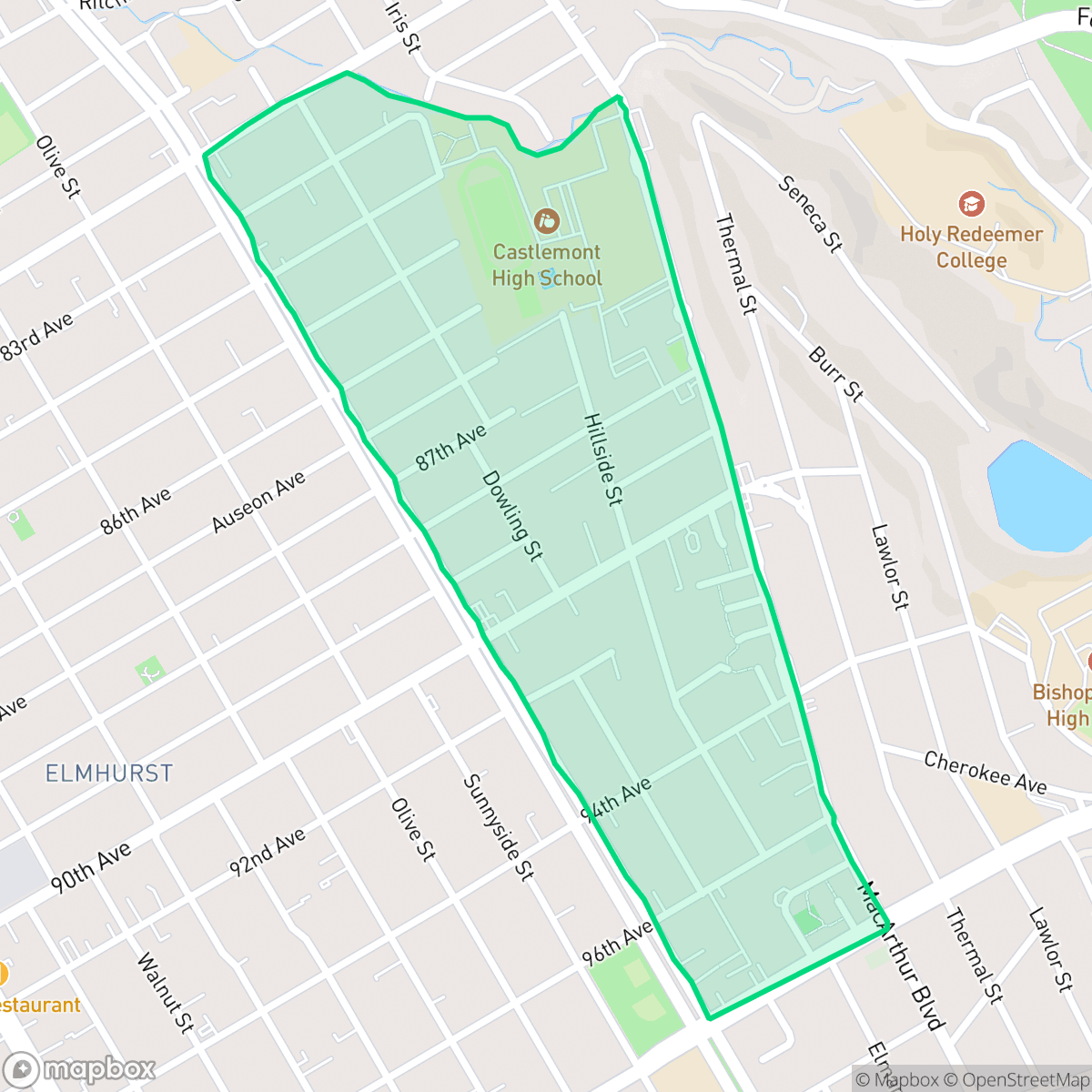
Castlemont is a dense, highly walkable residential neighborhood in East Oakland defined by its traditional urban grid and community-focused institutions. The area offers a quiet, suburban atmosphere with a layout that prioritizes pedestrian access, though residents experience limited privacy due to the close proximity of homes.
Key Highlights
About Castlemont
Located in East Oakland, California, the Castlemont neighborhood was originally part of Elmhurst. It is named after Castlemont High School, which opened in 1929 as East Oakland High School. Students voted to rename the school after its original Tudor, medieval-style brick building designed by architects Chester Miller and Carl Warneke to resemble a castle. Though the landmark structure was demolished in 1961 due to earthquake safety concerns, the name remained. In 1948, the Castlemont Gardens housing project opened along Arroyo Viejo Creek on land formerly owned by Holy Redeemer College, becoming one of the largest residential developments of its kind at the time. Today, the neighborhood is known for community institutions like Verdese Carter Park and Youth URising, a prominent youth leadership and development center.
The neighborhood functions as a quiet, residential enclave characterized by a consistent urban grid that makes it exceptionally easy to navigate on foot. Unlike many parts of the city that face industrial encroachment, this area remains purely residential and institutional, fostering a stable environment centered around local landmarks like Verdese Carter Park. The architectural landscape consists primarily of standard urban housing, featuring tightly packed homes that contribute to a high-density living experience. Prospective residents should consider that the neighborhood faces significant challenges, including limited privacy due to the close spacing of houses and concerns regarding the local school district. While the area offers a peaceful, low-traffic environment, it is important to note the heightened risks associated with flood and fire safety. It is best suited for those who prioritize a walkable, community-oriented lifestyle over expansive private outdoor space or top-tier educational facilities.
Neighborhood Scores Across 15 Qualities
Housing density is slightly higher than the Oakland average, with many homes positioned quite close to one another. According to iHuus data, some residential structures feature narrow spacing that provides limited buffering between neighbors.
Pedestrian access is exceptional due to a complete sidewalk grid and clear crosswalks on nearly every street. This level of walkability is higher than the Oakland average, according to iHuus data.
Residential streetscapes feature uniform, boxy rooflines and small yards typical of middle-class tract housing. According to iHuus data, the visual variety in this area is slightly lower than the Oakland average.
Access to green space for pets is fairly consistent with the Oakland average. While a centrally located public park and playground provide useful walking areas, many residential streets feature narrow sidewalks and limited grassy verges.
Street layouts and greenery are distributed roughly equally, mirroring the general urban-suburban balance found across Oakland. This mix of dense residential grids and institutional spaces provides a moderate level of built-up density and open space according to iHuus data.
Active urban pockets with local amenities sit alongside quieter, suburban-style streets and green spaces. According to iHuus data, the overall level of activity and variety of local spots is consistent with the average for Oakland.
Steady traffic sounds from nearby busy streets are present, though levels remain significantly more tranquil than the Oakland city average according to iHuus data.
Air quality in this area fluctuates between acceptable and unhealthy levels, which is notably lower than the Oakland average. Residents sensitive to pollution may experience occasional concern during periods of poor air quality, according to iHuus data.
Residential and institutional uses define this area, which lacks the warehouses or heavy industrial hazards found in other parts of Oakland. According to iHuus data, the neighborhood is entirely free of large-scale manufacturing or industrial facilities.
Health insurance enrollment among residents is lower than the Oakland average. According to iHuus data, a significant portion of the population remains uninsured.
Voting patterns and census indicators show a deeply liberal political leaning, which is slightly more pronounced than the average across Oakland.
Residents live alongside a balanced variety of young adults, families, and seniors. According to iHuus data, the age distribution is slightly more concentrated in certain age brackets than the Oakland average.
Flood risk in this area is significantly higher than the Oakland average; residents should prepare for potential hazards and elevated insurance costs. According to iHuus data, this neighborhood is situated within a high-hazard zone prone to coastal wave action.
Address-Level Insights for Castlemont


iHuus Neighborhood Intelligence Insights
Get address-level neighborhood insights for Castlemont
- Street-level scores — see how individual blocks compare, not just neighborhood averages
- Micro-zone boundaries — identify quiet pockets, flood boundaries, and walkable clusters before you visit
- 15 dimensions in full — walkability, noise, air quality, school quality, insurance coverage, population age profile, urban/rural index, and more
- Boundary risk alerts — know if your address sits near a block boundary where scores drop, the kind of detail no listing will ever mention
- School insights — individual school ratings and insights, not just district-level data
- Compare before you commit — side-by-side data across neighborhoods, down to block precision
No credit card required
Compare with Any Neighborhood
| Dimension | Castlemont | Acorn |
|---|---|---|
| 🚶 Walkabilityavg 8.99 | ||
| 🔊 Acoustic Comfortavg 3.24 | ||
| 🤫 Privacy Indexavg 3.74 | ||
| 🎨 Visual Appealavg 6.28 | ||
| 🐕 Dog Friendlinessavg 5.74 | ||
| 🗺️ Urban-Rural Indexavg 6.02 | ||
| ✨ Neighborhood Vibeavg 5.22 | ||
| 🏥 Health Insurance Coverageavg 7.4 | ||
| 🌿 Air Qualityavg 8.06 | ||
| 🏭 Industrial Proximityavg 8.37 | ||
| 🌊 Flood Safetyavg 2.61 | ||
| 🗳️ Ideological Leanavg 9.95 | ||
| 👥 Population Age Profileavg 4.92 | ||
| 🔥 Fire Safetyavg 0.17 | ||
| 🏫 School Quality |
Castlemont Rankings
School Districts Serving Castlemont
School Insights for Castlemont
Below average outcomes; significant attendance and academic challenges.
School Insights
See what's really behind every school rating near Castlemont
- Individual school ratings — each school's own score with outcome context, not just a district average
- Enrollment & class size data — student-to-teacher ratio and how it compares to the state average
- Full demographics breakdown — ethnicity and gender composition for every school in the enrollment zone
- Every school in the district — all schools within the enrollment boundary ranked by rating, not just the closest one
- Grade levels & benchmarks — elementary through high school, with below/above state-average flags
No credit card required