Bushrod, Oakland
Updated · 6,517 residents
Bushrod is a highly walkable North Oakland enclave defined by its dense grid of residential streets and a strong community focus on green space. Residents benefit from excellent air quality and a calm atmosphere, though the area features tightly packed housing with limited privacy and moderate traffic noise.
Key Highlights
About Bushrod
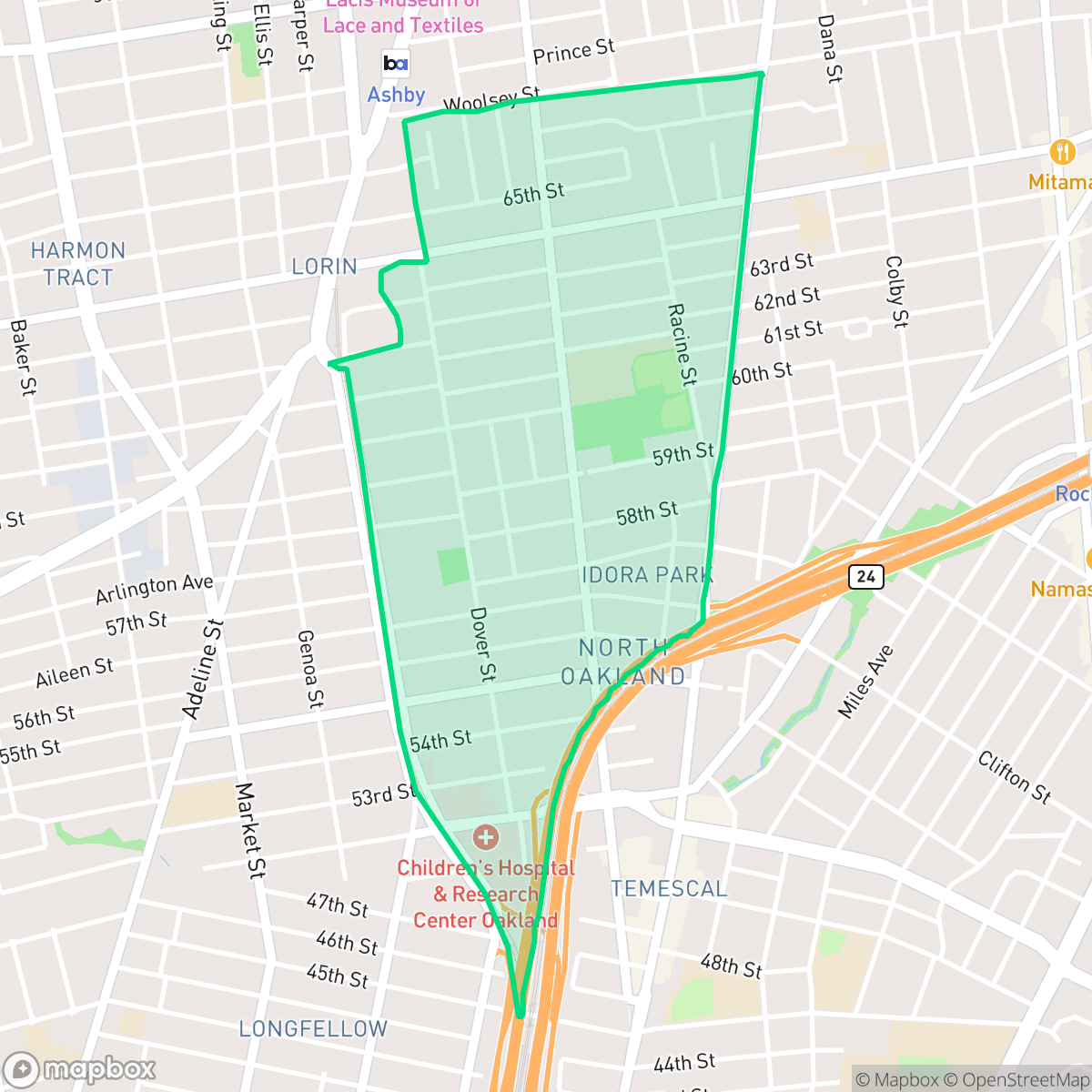
Located in North Oakland, the Bushrod neighborhood developed from late 19th-century agricultural land into a residential enclave featuring Victorian-era homes and Craftsman bungalows. The neighborhood centers around the 10-acre Bushrod Park, established in 1903 on land donated by Philadelphia physician Dr. Bushrod Washington James. Renowned as a "cradle of champions," the park’s athletic fields and tennis courts served as the training grounds for legendary sports figures in their youth, including baseball Hall of Famers Rickey Henderson and Frank Robinson, tennis champion Don Budge, and basketball stars Gary Payton and Jason Kidd. In the early 1960s, the park also served as the practice facility for the Oakland Raiders. Other local landmarks include the former Bushrod Washington Elementary School (now Sankofa Academy) and the Dover Street Edible Park community garden.
The neighborhood offers a dense, urban residential experience characterized by a consistent grid of sidewalks that makes it one of the most walkable areas in Oakland. Beyond its historic appeal, the area maintains a calm feel with local dining options like Shewhat Restaurant, Nick's Pizza, and Chen's Garden serving as community hubs. The absence of heavy industrial sites contributes to high air quality, providing a clean environment for residents who frequent the local parks and community gardens. According to iHuus data, the area is well-suited for those who prioritize pedestrian access and a quiet, neighborhood-centric lifestyle over expansive private outdoor space.
While the neighborhood is highly accessible, prospective residents should note the trade-offs associated with its high density. Homes are often situated with very little space between them, which significantly reduces individual privacy. Acoustic comfort is moderate due to consistent road traffic noise, and the area faces significant fire safety risks. Families should also be aware that local schools, including the nearby Sankofa United Elementary, currently face systemic challenges within the Oakland Unified School District.
Neighborhood Scores Across 15 Qualities
Residential structures are tightly packed with very narrow gaps between buildings, resulting in a lower level of privacy than the Oakland average. According to iHuus data, many homes in this area are separated by minimal distance or share property lines.
Pedestrian navigation is exceptionally easy due to a continuous grid of sidewalks and frequent crosswalks. This highly interconnected street network provides better accessibility for walkers than the typical Oakland neighborhood, according to iHuus data.
Residential views consist primarily of standard high-density housing with small yards and uniform rooflines. This level of visual variety is slightly below the Oakland average.
Dog walking options vary significantly across the area, with some sections offering access to large public parks and wide green verges. Other pockets feature dense housing with limited street-side greenery, making the neighborhood slightly less dog-friendly than the Oakland average according to iHuus data.
Residential streets and green spaces exist in roughly equal measure, providing a suburban feel that is slightly more developed than the Oakland average. According to iHuus data, the area features a dense mix of low-rise multi-family housing and commercial structures alongside established greenery.
Diverse dining options and local parks create a social atmosphere that is more active than the Oakland average. Residents can access various cafes, galleries, and eateries within a walkable distance of suburban streets and green spaces.
Persistent sounds from nearby freeway traffic and railroad corridors contribute to lower acoustic comfort compared to the Oakland average. According to iHuus data, residents may experience frequent disturbances from transit-related noise.
Air quality remains consistently high with minimal health concerns, representing a significant improvement over the Oakland average. According to iHuus data, the area is characterized by clean, breathable air.
Residential and light commercial uses define this area, which lacks the warehouses or heavy industrial hazards found in other parts of Oakland. According to iHuus data, the neighborhood is free from large-scale industrial facilities or hazardous sites.
Health insurance access is exceptionally high among residents, significantly exceeding the Oakland city average according to iHuus data.
Voting patterns and census indicators show a highly liberal political landscape that is slightly more pronounced than the Oakland average. According to iHuus data, residents will find the local political environment deeply aligned with progressive values.
Residents live alongside a balanced distribution of young adults, families, and older individuals. According to iHuus data, this demographic spread is consistent with the average found throughout Oakland.
Residual flood risks exist within this area due to its location in a 500-year floodplain, though safety levels remain significantly higher than the Oakland city average according to iHuus data.
Address-Level Insights for Bushrod


iHuus Neighborhood Intelligence Insights
Get address-level neighborhood insights for Bushrod
- Street-level scores — see how individual blocks compare, not just neighborhood averages
- Micro-zone boundaries — identify quiet pockets, flood boundaries, and walkable clusters before you visit
- 15 dimensions in full — walkability, noise, air quality, school quality, insurance coverage, population age profile, urban/rural index, and more
- Boundary risk alerts — know if your address sits near a block boundary where scores drop, the kind of detail no listing will ever mention
- School insights — individual school ratings and insights, not just district-level data
- Compare before you commit — side-by-side data across neighborhoods, down to block precision
No credit card required
Compare with Any Neighborhood
| Dimension | Bushrod | Acorn |
|---|---|---|
| 🚶 Walkabilityavg 8.99 | ||
| 🔊 Acoustic Comfortavg 3.24 | ||
| 🤫 Privacy Indexavg 3.74 | ||
| 🎨 Visual Appealavg 6.28 | ||
| 🐕 Dog Friendlinessavg 5.74 | ||
| 🗺️ Urban-Rural Indexavg 6.02 | ||
| ✨ Neighborhood Vibeavg 5.22 | ||
| 🏥 Health Insurance Coverageavg 7.4 | ||
| 🌿 Air Qualityavg 8.06 | ||
| 🏭 Industrial Proximityavg 8.37 | ||
| 🌊 Flood Safetyavg 2.61 | ||
| 🗳️ Ideological Leanavg 9.95 | ||
| 👥 Population Age Profileavg 4.92 | ||
| 🔥 Fire Safetyavg 0.17 | ||
| 🏫 School Quality |
Bushrod Rankings
School Districts Serving Bushrod
School Insights for Bushrod
Below average outcomes; significant attendance and academic challenges.
School Insights
See what's really behind every school rating near Bushrod
- Individual school ratings — each school's own score with outcome context, not just a district average
- Enrollment & class size data — student-to-teacher ratio and how it compares to the state average
- Full demographics breakdown — ethnicity and gender composition for every school in the enrollment zone
- Every school in the district — all schools within the enrollment boundary ranked by rating, not just the closest one
- Grade levels & benchmarks — elementary through high school, with below/above state-average flags
No credit card required