Brookfield Village, Oakland
Updated · 3,307 residents
Brookfield Village is a compact, industrial-adjacent neighborhood in Oakland characterized by its dense grid of mid-century tract homes. While the area maintains a quiet residential atmosphere, residents experience frequent noise from nearby rail lines and heavy industrial traffic.
Key Highlights
About Brookfield Village
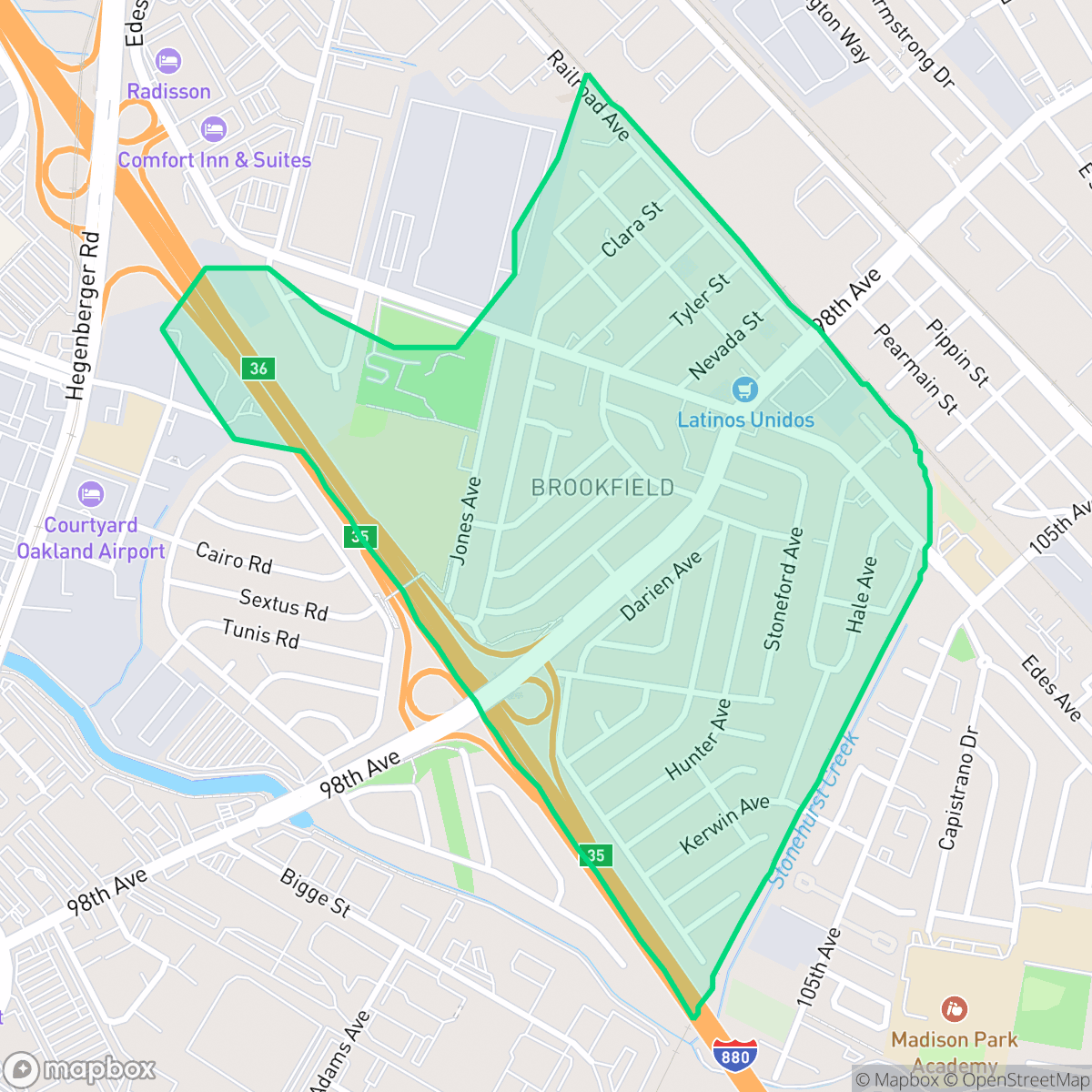
Developed during World War II by Albert Bernhardt and the Stoneon Brothers, Brookfield Village was one of Oakland’s first suburban-style tract housing developments. Built on land originally zoned for industrial use, the subdivision of over 1,200 homes was designed to house influxes of wartime manufacturing workers. Advertised as a "model village on the Pacific Coast," it featured winding, tree-lined streets and affordable single-family homes. Though initially bound by restrictive covenants limiting residency to white families, the neighborhood underwent a demographic shift; by the late 1960s, it transitioned into a vibrant community of color with many Black- and Asian-owned local businesses. Centered around 98th and Edes avenues near the Oakland International Airport, the neighborhood is also known as the childhood home of NBA player Damian Lillard.
Located near the Oakland International Airport, this neighborhood maintains a distinct industrial-suburban character defined by its tightly packed single-family homes and proximity to major logistics hubs. The local landscape is dominated by a dense street grid that provides modest walkability, though the area is physically constrained by surrounding warehouses and freight corridors. Community life centers on local institutions like Grace Baptist Church and small businesses, reflecting a long-standing residential identity that persists despite the heavy industrial surroundings.
Prospective residents should be aware of the trade-offs inherent in this location, including elevated ambient noise levels from road, rail, and air traffic. While the neighborhood benefits from better flood safety than many parts of the city, it faces challenges regarding air quality and school performance, with local educational facilities currently struggling with significant systemic issues. The area is best suited for those prioritizing proximity to industrial employment centers or seeking a traditional, if modest, residential footprint within the East Bay.
Neighborhood Scores Across 15 Qualities
Residential lots feature narrow side-yard setbacks and closely spaced houses. This level of density is roughly in line with the average seen across Oakland.
Sidewalk networks are generally present on residential streets, though large rail corridors and high traffic industrial roads can interrupt easy pedestrian movement. This level of walkability is lower than the Oakland average according to iHuus data.
Standard tract housing features uniform rooflines and modest yards. According to iHuus data, the visual landscape is less diverse than the Oakland average.
Limited public green space and narrow sidewalks make walking dogs difficult. The area lacks the wide verges and accessible parks found more frequently across Oakland.
Residential blocks and green spaces are closely integrated with large-scale warehouses and logistics corridors. This area is slightly more suburban than the Oakland average, featuring a blend of single-family homes and significant industrial footprints.
Low levels of commercial activity and a prevalence of warehouses and freight corridors create a tranquil but car-dependent environment. This area is significantly less active than the Oakland average, offering a subdued atmosphere with few walkable retail options.
Frequent noise from nearby freeway and railroad traffic is common in this area. According to iHuus data, acoustic comfort in Brookfield Village is consistent with the average levels found across Oakland.
Air quality levels fluctuate between acceptable and unhealthy periods, which is notably lower than the Oakland average according to iHuus data. Residents with respiratory sensitivities may experience occasional concern on certain days.
Active warehouses and logistics hubs border residential zones, resulting in significantly more industrial activity and truck traffic than the Oakland average. According to iHuus data, the proximity to freight rail lines and large-scale loading areas may contribute to higher levels of noise and localized pollution.
Health insurance coverage among residents is notable but falls below the Oakland average, according to iHuus data.
Voting patterns and census indicators reflect a predominantly liberal political landscape, aligning closely with the broader Oakland average.
Residents live alongside a varied mix of young adults, families, and older individuals. This demographic spread is slightly more concentrated in certain age groups than the Oakland average, according to iHuus data.
Flood risk in this area is higher than the Oakland average, though current FEMA assessments lack a detailed study to determine exact vulnerability. According to iHuus data, the area falls into a category of undetermined risk.
Address-Level Insights for Brookfield Village


iHuus Neighborhood Intelligence Insights
Get address-level neighborhood insights for Brookfield Village
- Street-level scores — see how individual blocks compare, not just neighborhood averages
- Micro-zone boundaries — identify quiet pockets, flood boundaries, and walkable clusters before you visit
- 15 dimensions in full — walkability, noise, air quality, school quality, insurance coverage, population age profile, urban/rural index, and more
- Boundary risk alerts — know if your address sits near a block boundary where scores drop, the kind of detail no listing will ever mention
- School insights — individual school ratings and insights, not just district-level data
- Compare before you commit — side-by-side data across neighborhoods, down to block precision
No credit card required
Compare with Any Neighborhood
| Dimension | Brookfield Village | Acorn |
|---|---|---|
| 🚶 Walkabilityavg 8.99 | ||
| 🔊 Acoustic Comfortavg 3.24 | ||
| 🤫 Privacy Indexavg 3.74 | ||
| 🎨 Visual Appealavg 6.28 | ||
| 🐕 Dog Friendlinessavg 5.74 | ||
| 🗺️ Urban-Rural Indexavg 6.02 | ||
| ✨ Neighborhood Vibeavg 5.22 | ||
| 🏥 Health Insurance Coverageavg 7.4 | ||
| 🌿 Air Qualityavg 8.06 | ||
| 🏭 Industrial Proximityavg 8.37 | ||
| 🌊 Flood Safetyavg 2.61 | ||
| 🗳️ Ideological Leanavg 9.95 | ||
| 👥 Population Age Profileavg 4.92 | ||
| 🔥 Fire Safetyavg 0.17 | ||
| 🏫 School Quality |
Brookfield Village Rankings
School Districts Serving Brookfield Village
School Insights for Brookfield Village
Below average outcomes; significant attendance and academic challenges.
School Insights
See what's really behind every school rating near Brookfield Village
- Individual school ratings — each school's own score with outcome context, not just a district average
- Enrollment & class size data — student-to-teacher ratio and how it compares to the state average
- Full demographics breakdown — ethnicity and gender composition for every school in the enrollment zone
- Every school in the district — all schools within the enrollment boundary ranked by rating, not just the closest one
- Grade levels & benchmarks — elementary through high school, with below/above state-average flags
No credit card required