Arroyo Viejo, Oakland
Updated · 5,441 residents
Arroyo Viejo is a dense, highly walkable East Oakland neighborhood characterized by its consistent street grid and modest, early 20th-century tract housing. While the area offers convenient access to local community hubs and essential services, residents experience a high-density urban environment with limited privacy and notable noise levels from road traffic.
Key Highlights
About Arroyo Viejo
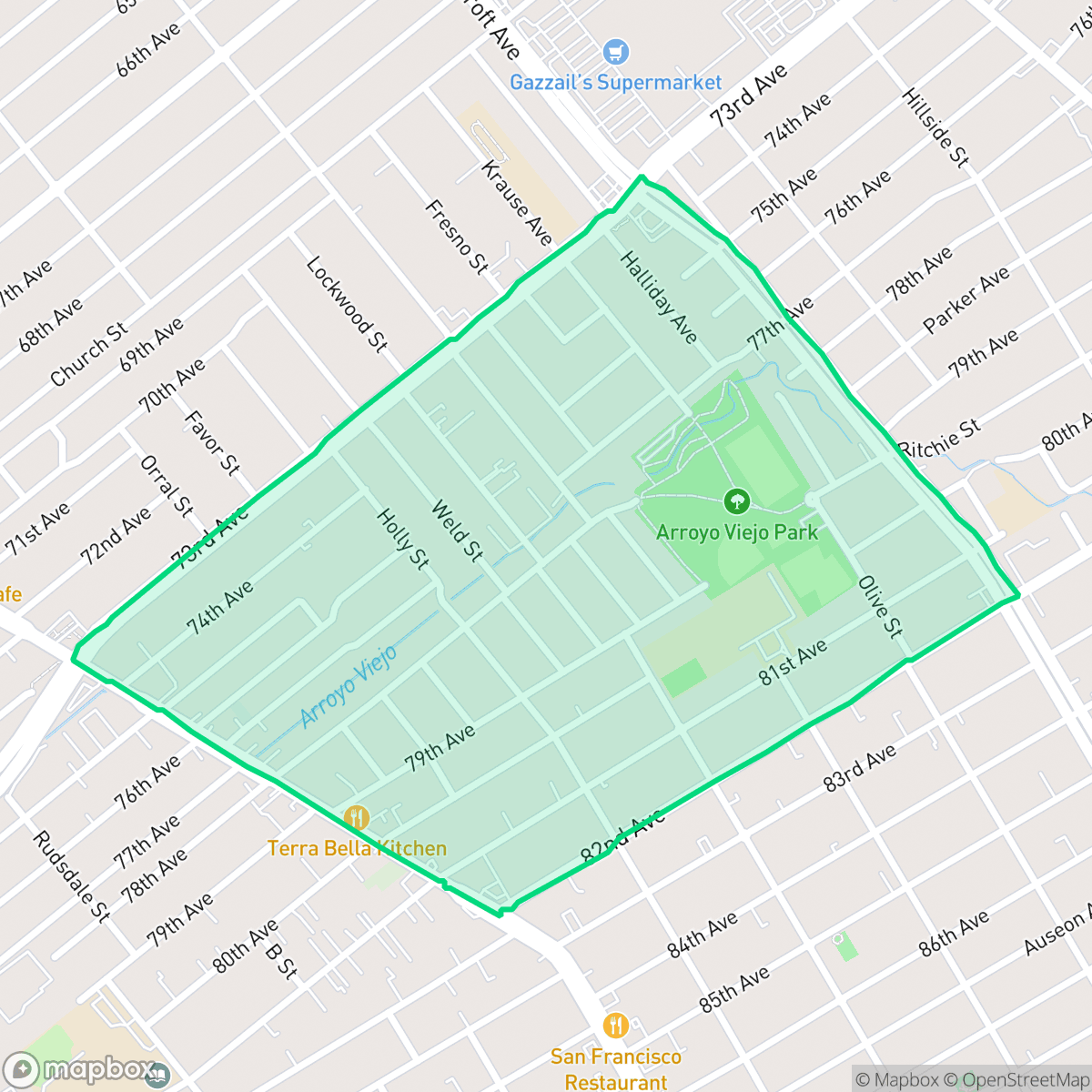
Located in East Oakland, the Arroyo Viejo neighborhood is named after the 5.1-mile Arroyo Viejo Creek (“Old Creek” in Spanish). The neighborhood’s early 20th-century development was anchored by the Electric Loop Tract, a 1910s subdivision developed by E.J. Henderson near 73rd Avenue and Foothill Boulevard that originally included a Chevrolet assembly plant. A central landmark is the sprawling Arroyo Viejo Park, which was developed by the Works Progress Administration (WPA) in the 1930s. Today, the park and its recreation center serve as vital community hubs. Operated in partnership with the Black Cultural Zone, the park hosts community gardens and cultural programs like the Levitt VIBE Oakland Music Series, reflecting the neighborhood's resilient, diverse cultural identity.
The neighborhood functions as a compact residential grid where the layout prioritizes pedestrian movement, offering consistent sidewalks and accessible intersections throughout. Its architectural character is defined by uniform, mid-century tract housing situated on small lots, which results in a high-density environment with limited space between structures. Local life revolves around community-focused institutions and small neighborhood eateries, providing a sense of stability within a busy, urban setting.
Prospective residents should note that the area presents specific trade-offs regarding environmental and structural factors. The high density contributes to lower privacy levels and elevated noise from nearby road traffic, while industrial proximity in certain sections can impact air quality and ambient conditions. Given the local school district's current challenges and the density of the built environment, the neighborhood is best suited for those who prioritize a walkable, transit-accessible location over expansive private outdoor space or quiet, secluded living.
Neighborhood Scores Across 15 Qualities
Residential structures are closely packed with minimal separation between properties. This density of housing is higher than the Oakland average, according to iHuus data.
Pedestrians benefit from a consistent grid pattern featuring wide, continuous sidewalks on both sides of nearly every street. This level of connectivity and infrastructure for crossings is superior to the Oakland average.
Standard tract housing with small yards and uniform rooflines defines the landscape. According to iHuus data, the visual variety here is slightly lower than the Oakland average.
Public park access and green verges are below the Oakland average. While a central park and playground serve some residents, much of the dense residential grid lacks accessible sidewalk space or nearby green areas for walking pets.
Low-rise residential and commercial structures are balanced with street-level greenery, offering a more suburban character than the typical Oakland urban density. According to iHuus data, this area features a higher proportion of built surfaces and less open natural space than the city average.
Local streets offer a blend of mid-rise urban blocks and quiet suburban pockets, featuring a diverse selection of dining and community hubs that provide a slightly more active atmosphere than the Oakland average.
Frequent noise from nearby railroad lines and major freeways characterizes the area. According to iHuus data, these acoustic levels are typical of the broader Oakland average.
Air quality in this area fluctuates between acceptable and unhealthy levels, appearing lower than the Oakland average. Sensitive groups may experience occasional concern on certain days according to iHuus data.
Light commercial activity and occasional warehouse sites are present, though the area remains largely residential with industrial presence slightly below the Oakland average.
Health insurance coverage among residents is relatively high, though it sits slightly below the Oakland city average according to iHuus data.
Voting patterns and census indicators show a deeply progressive political landscape that is slightly more liberal than the Oakland average.
A varied demographic of young adults, families, and seniors resides here, though the age distribution is slightly more concentrated toward certain age groups than the Oakland average. This creates a balanced residential environment according to iHuus data.
Flood vulnerability is significantly higher here than the Oakland average, according to iHuus data. This area is prone to frequent inundation during heavy rain events.
Address-Level Insights for Arroyo Viejo


iHuus Neighborhood Intelligence Insights
Get address-level neighborhood insights for Arroyo Viejo
- Street-level scores — see how individual blocks compare, not just neighborhood averages
- Micro-zone boundaries — identify quiet pockets, flood boundaries, and walkable clusters before you visit
- 15 dimensions in full — walkability, noise, air quality, school quality, insurance coverage, population age profile, urban/rural index, and more
- Boundary risk alerts — know if your address sits near a block boundary where scores drop, the kind of detail no listing will ever mention
- School insights — individual school ratings and insights, not just district-level data
- Compare before you commit — side-by-side data across neighborhoods, down to block precision
No credit card required
Compare with Any Neighborhood
| Dimension | Arroyo Viejo | Acorn |
|---|---|---|
| 🚶 Walkabilityavg 8.99 | ||
| 🔊 Acoustic Comfortavg 3.24 | ||
| 🤫 Privacy Indexavg 3.74 | ||
| 🎨 Visual Appealavg 6.28 | ||
| 🐕 Dog Friendlinessavg 5.74 | ||
| 🗺️ Urban-Rural Indexavg 6.02 | ||
| ✨ Neighborhood Vibeavg 5.22 | ||
| 🏥 Health Insurance Coverageavg 7.4 | ||
| 🌿 Air Qualityavg 8.06 | ||
| 🏭 Industrial Proximityavg 8.37 | ||
| 🌊 Flood Safetyavg 2.61 | ||
| 🗳️ Ideological Leanavg 9.95 | ||
| 👥 Population Age Profileavg 4.92 | ||
| 🔥 Fire Safetyavg 0.17 | ||
| 🏫 School Quality |
Arroyo Viejo Rankings
School Districts Serving Arroyo Viejo
School Insights for Arroyo Viejo
Below average outcomes; significant attendance and academic challenges.
School Insights
See what's really behind every school rating near Arroyo Viejo
- Individual school ratings — each school's own score with outcome context, not just a district average
- Enrollment & class size data — student-to-teacher ratio and how it compares to the state average
- Full demographics breakdown — ethnicity and gender composition for every school in the enrollment zone
- Every school in the district — all schools within the enrollment boundary ranked by rating, not just the closest one
- Grade levels & benchmarks — elementary through high school, with below/above state-average flags
No credit card required