Acorn Industrial, Oakland
Updated · 749 residents
Acorn Industrial is a compact, urban enclave in West Oakland defined by its proximity to major transit infrastructure and industrial heritage. While it offers a quiet atmosphere with emerging artisanal businesses, the area faces significant challenges regarding noise from highway traffic, limited walkability, and environmental concerns.
Key Highlights
About Acorn Industrial
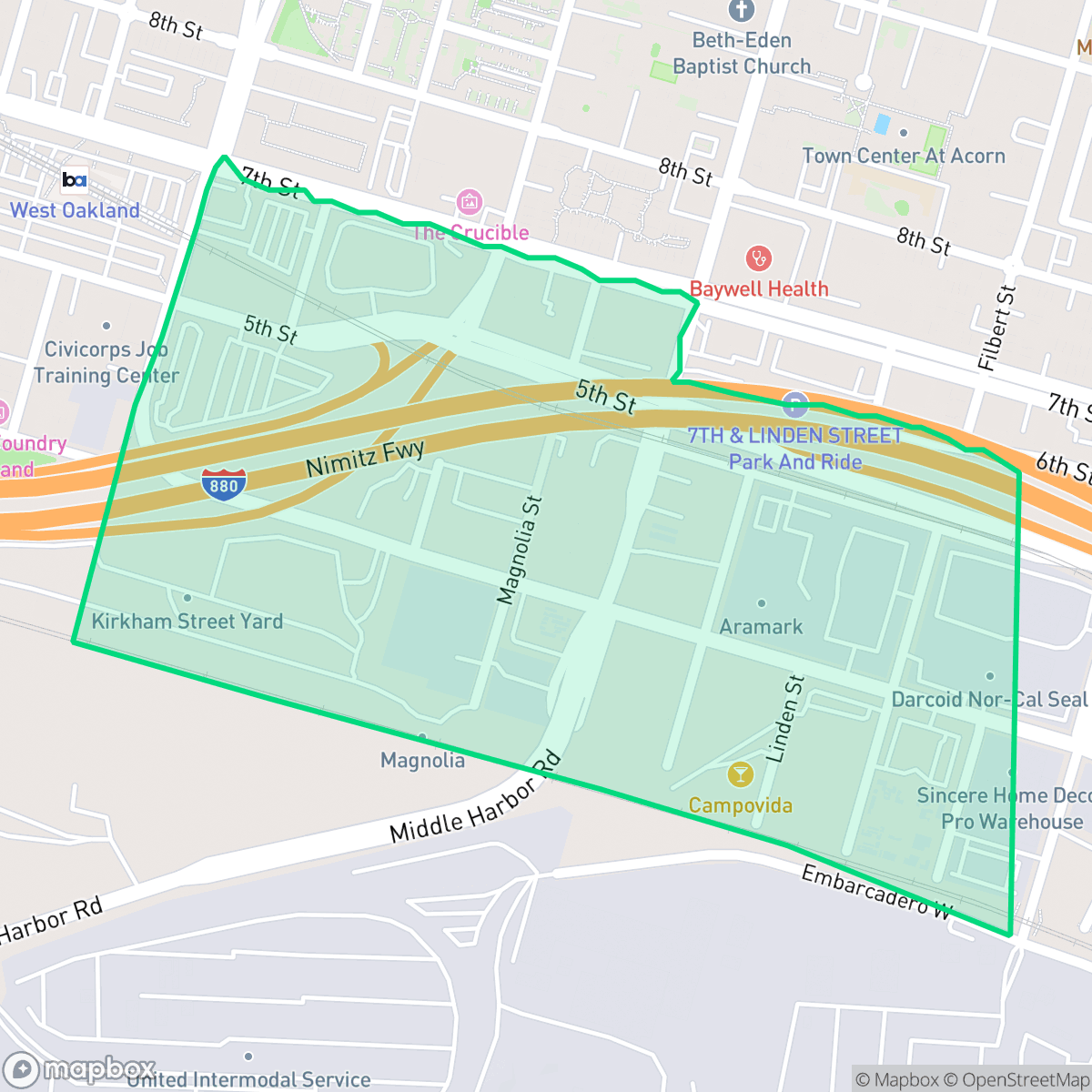
The Acorn Industrial neighborhood in West Oakland, California, originated from the city’s controversial 1961 Acorn Urban Renewal Plan. This large-scale urban renewal project demolished 45 blocks of historic West Oakland, displacing thousands of African American and Latino residents. While a portion of the cleared land became the Acorn housing projects, 32 acres south of Interstate 880 were designated for industrial redevelopment. Historically defined by heavy maritime and manufacturing industries—including the Moore Dry Dock Company and the California Pickle and Sauce Company—the area is bounded by I-880, elevated BART tracks, and Union Pacific rail lines. In recent decades, Acorn Industrial has transitioned into a creative hub. Its historic warehouses and converted lofts now house artisanal shops, galleries, and pioneering local businesses, including Old Kan Beer & Co. and the Campovida winery.
The neighborhood is characterized by a dense mix of low-rise residential blocks and heavy industrial infrastructure. It is bounded by Interstate 880 and various rail lines, resulting in a persistent noise level of 66 decibels primarily driven by road traffic. Despite these environmental factors, the area maintains a distinct identity as a creative node, featuring converted warehouses that house local breweries and cafes. According to iHuus data, the area presents a unique urban profile that balances its industrial legacy with a quiet, residential life.
Prospective residents should be aware of significant livability trade-offs, including low scores for privacy, walkability, and safety regarding fire and flood risks. The neighborhood is situated near an EPA Superfund site, which necessitates careful consideration of environmental conditions. With local schools in the Oakland Unified School District currently navigating severe budget deficits and structural instability, the area is best suited for those prioritizing proximity to specific industrial-converted workplaces or those seeking a highly specific urban niche rather than traditional suburban amenities.
Neighborhood Scores Across 15 Qualities
Residential structures are positioned closely together with minimal separation between buildings. This density results in a privacy level that is slightly lower than the Oakland average.
Quiet streets allow for walking, but a lack of sidewalks and interruptions from major highway infrastructure make the area significantly less walkable than the Oakland average, according to iHuus data.
Typical urban layouts feature modest lot sizes and multi-unit complexes. This visual character is less ornate than the average for Oakland.
Public parks and green school fields provide some accessible areas for dogs, though overall amenities are below the Oakland average. According to iHuus data, the neighborhood lacks the extensive green verges found in other parts of the city.
Large-scale warehouses and port infrastructure dominate the landscape, creating a more built-up environment than the Oakland average. Residents will find more industrial density and commercial-use land than the more suburban or residential areas found elsewhere in the city.
Activity is notably lower than the Oakland average due to a landscape dominated by warehouses, railway lines, and heavy industrial zones. While some retail and dining options exist, the area is primarily car-dependent and lacks the high-energy social atmosphere found in more dense urban neighborhoods.
Persistent noise from nearby heavy rail and industrial activity significantly exceeds the Oakland average. Residents can expect high levels of acoustic disruption due to the immediate proximity to transportation infrastructure, according to iHuus data.
Air quality remains consistently high with infrequent periods of poor ventilation. This level of cleanliness is largely comparable to the rest of Oakland.
Heavy industrial activity and a nearby EPA Superfund site create significant environmental and pollution concerns. According to iHuus data, the level of industrial proximity and associated hazards is much higher here than the Oakland average.
Health insurance enrollment among residents is lower than the Oakland city average, according to iHuus data.
Voting patterns and census indicators show a very high concentration of liberal-leaning residents, which is slightly above the Oakland average according to iHuus data.
A balanced spread of young adults, families, and older residents characterizes the area, though the population leans slightly younger than the Oakland average according to iHuus data.
Address-Level Insights for Acorn Industrial


iHuus Neighborhood Intelligence Insights
Get address-level neighborhood insights for Acorn Industrial
- Street-level scores — see how individual blocks compare, not just neighborhood averages
- Micro-zone boundaries — identify quiet pockets, flood boundaries, and walkable clusters before you visit
- 15 dimensions in full — walkability, noise, air quality, school quality, insurance coverage, population age profile, urban/rural index, and more
- Boundary risk alerts — know if your address sits near a block boundary where scores drop, the kind of detail no listing will ever mention
- School insights — individual school ratings and insights, not just district-level data
- Compare before you commit — side-by-side data across neighborhoods, down to block precision
No credit card required
Compare with Any Neighborhood
| Dimension | Acorn Industrial | Acorn |
|---|---|---|
| 🚶 Walkabilityavg 8.99 | ||
| 🔊 Acoustic Comfortavg 3.24 | ||
| 🤫 Privacy Indexavg 3.74 | ||
| 🎨 Visual Appealavg 6.28 | ||
| 🐕 Dog Friendlinessavg 5.74 | ||
| 🗺️ Urban-Rural Indexavg 6.02 | ||
| ✨ Neighborhood Vibeavg 5.22 | ||
| 🏥 Health Insurance Coverageavg 7.4 | ||
| 🌿 Air Qualityavg 8.06 | ||
| 🏭 Industrial Proximityavg 8.37 | ||
| 🌊 Flood Safetyavg 2.61 | ||
| 🗳️ Ideological Leanavg 9.95 | ||
| 👥 Population Age Profileavg 4.92 | ||
| 🔥 Fire Safetyavg 0.17 | ||
| 🏫 School Quality |
Acorn Industrial Rankings
School Districts Serving Acorn Industrial
School Insights for Acorn Industrial
Below average outcomes; significant attendance and academic challenges.
School Insights
See what's really behind every school rating near Acorn Industrial
- Individual school ratings — each school's own score with outcome context, not just a district average
- Enrollment & class size data — student-to-teacher ratio and how it compares to the state average
- Full demographics breakdown — ethnicity and gender composition for every school in the enrollment zone
- Every school in the district — all schools within the enrollment boundary ranked by rating, not just the closest one
- Grade levels & benchmarks — elementary through high school, with below/above state-average flags
No credit card required