Corona del Mar, Newport Beach
Updated · 11,204 residents
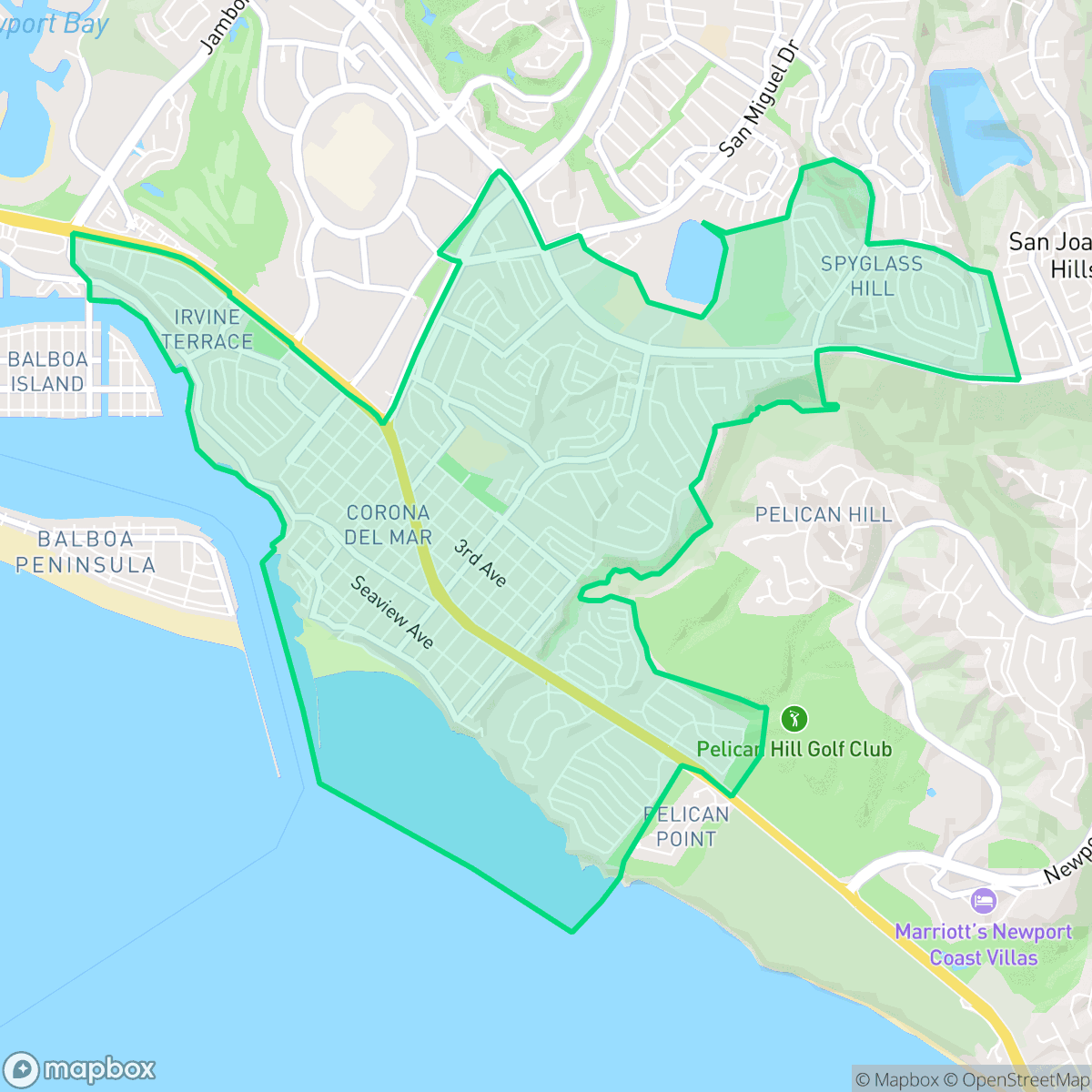
Corona del Mar is a highly walkable coastal neighborhood in Newport Beach, characterized by its dense grid of well-manicured homes and immediate access to the Pacific Ocean. While the area offers an accessible pedestrian experience, residents should anticipate consistent road traffic noise and a high-density housing layout with limited privacy.
Key Highlights
About Corona del Mar
Founded in 1904 when George E. Hart purchased 700 acres of Irvine Ranch land, Corona del Mar ("Crown of the Sea") began as a secluded seaside village accessible only by boat or muddy roads until the Pacific Coast Highway’s construction in the late 1920s. The heart of the neighborhood features the iconic "Flower Streets," a grid of alphabetical lanes from Acacia to Poppy lined with historic California coastal cottages, Mediterranean villas, and modern estates. Local landmarks include the flower-draped Goldenrod Footbridge—a historic pedestrian span built over Bayside Drive—and the botanical Sherman Library & Gardens. Steeped in coastal culture, the area hosted the 1928 Pacific Coast Surfboard Championship featuring Duke Kahanamoku and was the longtime home of Hollywood legend John Wayne.
This neighborhood serves as a central residential enclave in Newport Beach, defined by its grid-based street layout and proximity to coastal recreation. The area maintains high visual appeal through a combination of modern estates and traditional cottages, all supported by a robust sidewalk network that makes daily errands and leisure walks easy to navigate. According to iHuus data, the community benefits from a complete absence of industrial activity, ensuring that the environment remains focused on residential and recreational land use.
Prospective residents should weigh the benefits of this walkable coastal lifestyle against specific practical trade-offs. The neighborhood experiences consistent road traffic noise, which may impact acoustic comfort for those sensitive to sound. Furthermore, the high-density development results in limited privacy in some sections, with homes often situated in close proximity to one another. The area is best suited for individuals who prioritize walkability and ocean access over expansive private buffers, and who appreciate a quiet, established suburban atmosphere within a high-performing school district.
Neighborhood Scores Across 15 Qualities
Residential spacing fluctuates between high-density townhomes with shared walls and larger detached estates. This level of privacy is slightly below the Newport Beach average, according to iHuus data.
Pedestrian navigation is exceptionally easy due to a dense grid of low-speed streets, consistent sidewalks on both sides of the road, and numerous marked crosswalks. This level of accessibility for walkers is even higher than the Newport Beach average, according to iHuus data.
Manicured properties, private pools, and large estate-style homes provide a highly polished visual landscape that is more aesthetically refined than the Newport Beach average. According to iHuus data, the area features high-value architecture and proximity to well-maintained golf courses.
Coastal trails and a large golf course provide excellent walking corridors for pets. While sidewalk verges can be narrow in some residential blocks, the area offers comparable dog-friendly amenities to the rest of Newport Beach.
Residential areas feature a blend of dense coastal layouts and sprawling estates alongside significant open natural spaces. This landscape aligns with the typical suburban density found throughout Newport Beach, according to iHuus data.
Residential life here maintains a steady, calm rhythm with a balanced mix of green space and street life. According to iHuus data, the neighborhood offers slightly more social variety and local amenities than the Newport Beach average, though many areas remain primarily low-density and car-oriented.
Frequent noise from nearby transit corridors and major roadways is a notable feature of this area. According to iHuus data, acoustic levels are slightly higher than the Newport Beach average.
Air quality levels typically fluctuate between acceptable and unhealthy, presenting occasional concerns for sensitive groups. This condition is consistent with the average seen across Newport Beach, according to iHuus data.
Land use consists entirely of residential, recreational, and light commercial areas with no detectable warehouses or hazardous facilities. This area lacks the industrial activity found in some other parts of the city, according to iHuus data.
Health insurance access is exceptionally high among residents, appearing significantly above the Newport Beach average according to iHuus data.
Voting patterns and census indicators show a strong conservative leaning, which is more pronounced here than the average for Newport Beach, according to iHuus data.
Residents will find a varied demographic ranging from young professionals to families and seniors. This population distribution is more balanced than the average seen throughout Newport Beach, according to iHuus data.
Residual flood risks exist within some areas of the neighborhood, though safety levels remain slightly above the Newport Beach average according to iHuus data.
Extreme fire hazards are present in this area, representing a significantly higher risk level than the Newport Beach average. Residents should prioritize maximum fire protection measures and emergency preparedness according to iHuus data.
Address-Level Insights for Corona del Mar


iHuus Neighborhood Intelligence Insights
Get address-level neighborhood insights for Corona del Mar
- Street-level scores — see how individual blocks compare, not just neighborhood averages
- Micro-zone boundaries — identify quiet pockets, flood boundaries, and walkable clusters before you visit
- 15 dimensions in full — walkability, noise, air quality, school quality, insurance coverage, population age profile, urban/rural index, and more
- Boundary risk alerts — know if your address sits near a block boundary where scores drop, the kind of detail no listing will ever mention
- School insights — individual school ratings and insights, not just district-level data
- Compare before you commit — side-by-side data across neighborhoods, down to block precision
No credit card required
Compare with Any Neighborhood
| Dimension | Corona del Mar | Cameo Highlands |
|---|---|---|
| 🚶 Walkabilityavg 9.07 | ||
| 🔊 Acoustic Comfortavg 3.27 | ||
| 🤫 Privacy Indexavg 4.75 | ||
| 🎨 Visual Appealavg 7.76 | ||
| 🐕 Dog Friendlinessavg 7.52 | ||
| 🗺️ Urban-Rural Indexavg 6.78 | ||
| ✨ Neighborhood Vibeavg 3.93 | ||
| 🏥 Health Insurance Coverageavg 8.72 | ||
| 🌿 Air Qualityavg 6 | ||
| 🏭 Industrial Proximityavg 9.54 | ||
| 🌊 Flood Safetyavg 6.29 | ||
| 🗳️ Ideological Leanavg 2.06 | ||
| 👥 Population Age Profileavg 5.54 | ||
| 🔥 Fire Safetyavg 0.42 | ||
| 🏫 School Quality |
Corona del Mar Rankings
School Districts Serving Corona del Mar
School Insights for Corona del Mar
Below average outcomes; significant attendance and academic challenges.
School Insights
See what's really behind every school rating near Corona del Mar
- Individual school ratings — each school's own score with outcome context, not just a district average
- Enrollment & class size data — student-to-teacher ratio and how it compares to the state average
- Full demographics breakdown — ethnicity and gender composition for every school in the enrollment zone
- Every school in the district — all schools within the enrollment boundary ranked by rating, not just the closest one
- Grade levels & benchmarks — elementary through high school, with below/above state-average flags
No credit card required