Olivewood, National City
Updated · 8,979 residents
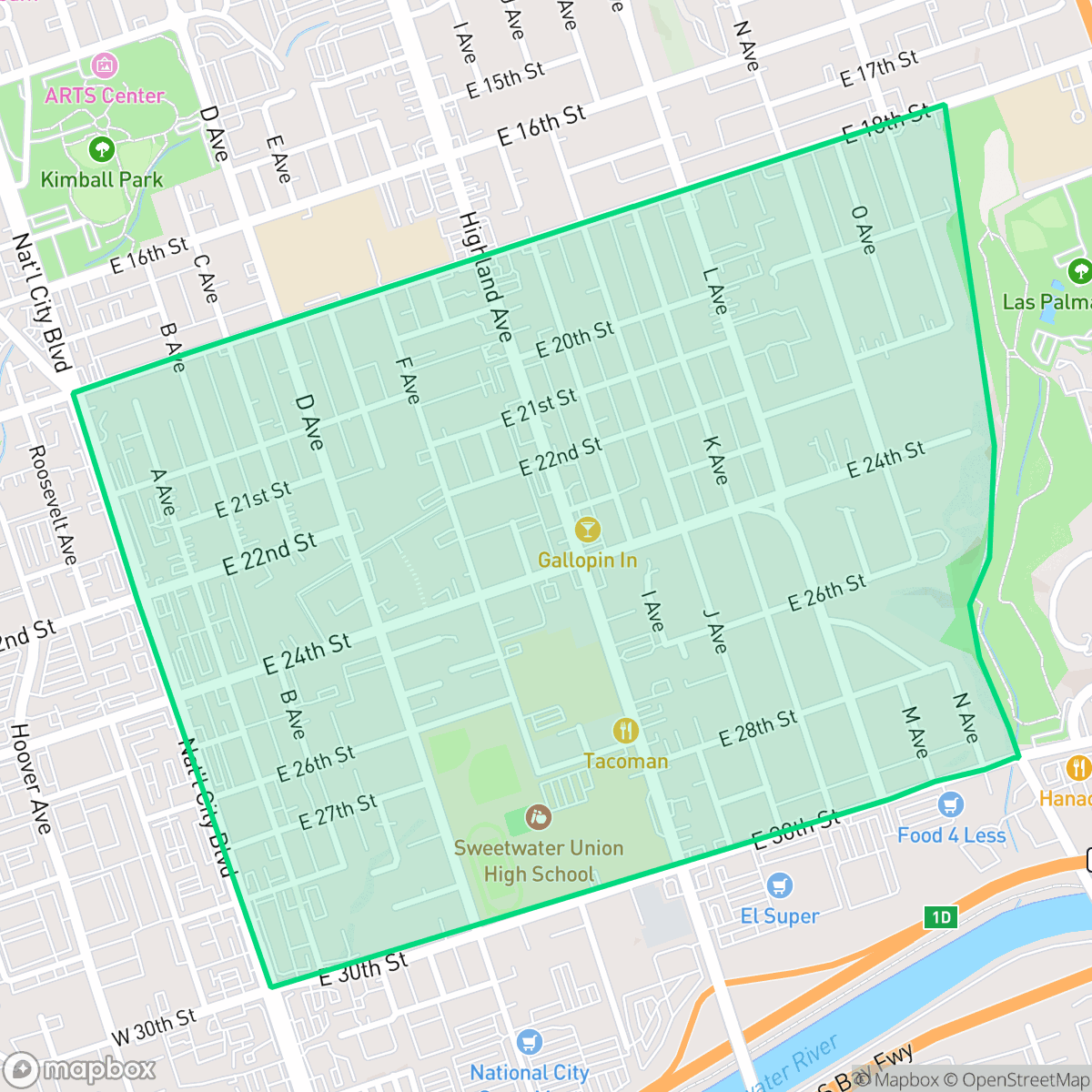
Olivewood is a highly walkable neighborhood in National City characterized by a dense, grid-based layout and a strong sense of community. Residents benefit from consistent sidewalk access and a mix of historic charm and local culinary staples, though the area features closely packed housing with limited private outdoor space.
Key Highlights
About Olivewood
The Olivewood neighborhood in National City, California, developed around the late 19th-century homestead of city pioneer Warren Kimball and his wife, Flora, an educator and suffragist. Flora’s original estate, renowned for its lush gardens, inspired the neighborhood's name. A central landmark is the Olivewood Gardens & Learning Center, which features a pristine 1896 Queen Anne-style Victorian home built by National City Postmaster Oliver H. Noyes. In 1985, the estate was purchased by John and Christy Walton, who donated the property in 2006 to foster environmental education and nutrition programs. Another historic neighborhood anchor is the Olivewood Clubhouse at 24th Street and F Avenue, built in 1911 by Warren Kimball as a memorial to Flora. Today, the neighborhood maintains its historic character, blending mid-20th-century homes with active community-led agricultural spaces.
The neighborhood functions as a dense urban grid where residents enjoy exceptional walkability and convenient access to local dining, such as Carnitas Quiroga and Menuderia Don Vicente. According to iHuus data, the area maintains a moderate acoustic environment with an average noise level of 55 decibels, primarily driven by road traffic. The landscape is defined by a blend of mid-century homes and multi-unit complexes, creating a compact residential environment that prioritizes connectivity over expansive private yards.
Prospective residents should note that the high density results in limited privacy, as structures are frequently positioned less than 10 meters apart. While the area lacks private luxury amenities and extensive green belts, it offers a stable, urban-centric lifestyle for those who value proximity to local services and high-quality pedestrian infrastructure. Education options are split between the National Elementary School District and the Sweetwater Union High School District, which provide a range of academic environments for families in the region.
Neighborhood Scores Across 15 Qualities
Residential structures are often closely spaced with minimal distance between neighbors. This level of density is roughly in line with the National City average.
Pedestrian access is excellent throughout Olivewood due to a consistent grid of sidewalks on both sides of most streets and dedicated crossings. According to iHuus data, this level of walkability is notably higher than the National City average.
Standard tract housing and apartment blocks dominate the landscape, characterized by small yards and uniform structures. This area features slightly less visual variety compared to the average for National City.
Access to a large southern park and nearby green belts provides more walking options than the National City average. Some areas feature narrower sidewalk verges and limited public grass, so pet owners should prioritize routes near the western parklands.
Residential streets and green spaces exist in roughly equal measure to the area's paved surfaces and commercial footprints. This layout is consistent with the broader National City average, providing a mix of low-rise urban density and suburban grid patterns according to iHuus data.
A mix of suburban streets and light industrial zones creates a character that is more active than the National City average. Residents have access to a diverse range of local dining and amenities spread across several lively blocks.
Steady traffic sounds from nearby busy streets are common in this area. According to iHuus data, this level of acoustic activity is roughly consistent with the average found throughout National City.
Air quality levels in Olivewood fluctuate between acceptable and unhealthy, matching the typical levels found across National City. Sensitive groups may experience occasional concern during periods of poor air quality, according to iHuus data.
Primarily residential with occasional light commercial use, this area features slightly more industrial presence than the National City average. Residents may encounter some noise and truck traffic due to nearby warehouses and a major highway bisecting the neighborhood, according to iHuus data.
Health insurance coverage among residents is notably lower than the National City average, according to iHuus data. This indicates a higher proportion of uninsured individuals living within the neighborhood.
Voting patterns and census indicators in Olivewood reflect a predominantly liberal leaning that is slightly more pronounced than the National City average, according to iHuus data.
Residents live alongside a balanced mix of young adults, families, and seniors. This demographic spread is largely consistent with the wider National City area, according to iHuus data.
Located within a designated floodplain, this area faces significant flood risks that may necessitate flood insurance. This level of vulnerability is comparable to the broader National City area, according to iHuus data.
Address-Level Insights for Olivewood


iHuus Neighborhood Intelligence Insights
Get address-level neighborhood insights for Olivewood
- Street-level scores — see how individual blocks compare, not just neighborhood averages
- Micro-zone boundaries — identify quiet pockets, flood boundaries, and walkable clusters before you visit
- 15 dimensions in full — walkability, noise, air quality, school quality, insurance coverage, population age profile, urban/rural index, and more
- Boundary risk alerts — know if your address sits near a block boundary where scores drop, the kind of detail no listing will ever mention
- School insights — individual school ratings and insights, not just district-level data
- Compare before you commit — side-by-side data across neighborhoods, down to block precision
No credit card required
Compare with Any Neighborhood
| Dimension | Olivewood | Central |
|---|---|---|
| 🚶 Walkabilityavg 7.96 | ||
| 🔊 Acoustic Comfortavg 4.12 | ||
| 🤫 Privacy Indexavg 3.91 | ||
| 🎨 Visual Appealavg 5.6 | ||
| 🐕 Dog Friendlinessavg 5.13 | ||
| 🗺️ Urban-Rural Indexavg 5.85 | ||
| ✨ Neighborhood Vibeavg 5.31 | ||
| 🏥 Health Insurance Coverageavg 4.68 | ||
| 🌿 Air Qualityavg 6 | ||
| 🏭 Industrial Proximityavg 7.5 | ||
| 🌊 Flood Safetyavg 1.88 | ||
| 🗳️ Ideological Leanavg 8.93 | ||
| 👥 Population Age Profileavg 4.63 | ||
| 🔥 Fire Safety | ||
| 🏫 School Quality |
Olivewood Rankings
School Districts Serving Olivewood
School Insights for Olivewood
Below average outcomes; significant attendance and academic challenges.
School Insights
See what's really behind every school rating near Olivewood
- Individual school ratings — each school's own score with outcome context, not just a district average
- Enrollment & class size data — student-to-teacher ratio and how it compares to the state average
- Full demographics breakdown — ethnicity and gender composition for every school in the enrollment zone
- Every school in the district — all schools within the enrollment boundary ranked by rating, not just the closest one
- Grade levels & benchmarks — elementary through high school, with below/above state-average flags
No credit card required